



 Chat with AI
Exam 7: Consumers, producers, and the Efficiency of Markets

Exam 1: Ten Principles of Economics237 Questions
Exam 2: Thinking Like an Economist267 Questions
Exam 3: Interdependence and the Gains From Trade217 Questions
Exam 4: The Market Forces of Supply and Demand303 Questions
Exam 5: Elasticity and Its Applications282 Questions
Exam 6: Supply, demand, and Government Policies252 Questions
Exam 7: Consumers, producers, and the Efficiency of Markets248 Questions
Exam 8: Application: the Costs of Taxation245 Questions
Exam 9: Application: International Trade245 Questions
Exam 10: Externalities288 Questions
Exam 11: Public Goods and Common Resources258 Questions
Exam 12: The Design of the Tax System328 Questions
Exam 13: The Costs of Production303 Questions
Exam 14: Firms in Competitive Markets271 Questions
Exam 15: Monopoly306 Questions
Exam 16: Oligopoly291 Questions
Exam 17: Monopolistic Competition257 Questions
Exam 18: The Markets for the Factors of Production284 Questions
Exam 19: Earnings and Discrimination286 Questions
Exam 20: Income Inequality and Poverty247 Questions
Exam 21: The Theory of Consumer Choice238 Questions
Exam 22: Frontiers of Microeconomics199 Questions
Exam 23: Measuring a Nations Income215 Questions
Exam 24: Measuring the Cost of Living208 Questions
Exam 25: Production and Growth240 Questions
Exam 26: Saving, investment, and the Financial System282 Questions
Exam 27: The Basic Tools of Finance249 Questions
Exam 28: Unemployment242 Questions
Exam 29: The Monetary System277 Questions
Exam 30: Money Growth and Inflation224 Questions
Exam 31: Open-Economy Macroeconomics: Basic Concepts256 Questions
Exam 32: A Macroeconomic Theory of the Open Economy217 Questions
Exam 33: Aggregate Demand and Aggregate Supply302 Questions
Exam 34: The Influence of Monetary and Fiscal Policy on Aggregate Demand249 Questions
Exam 35: The Short Run Trade Off Between Inflation and Unemployment246 Questions
Exam 36: Five Debates Over Macroeconomic Policy140 Questions
Select questions type


Figure 7-11. On the graph below, Q represents the quantity of the good and P represents the good's price.
 -Refer to Figure 7-11.At the equilibrium,consumer surplus amounts to
 (Multiple Choice)
4.8/5  (84)
(84) Which of the following is not true when the price of a good or service falls?
(Multiple Choice)
4.9/5 (83)
(83) Each seller of a product is willing to sell as long as the price he or she can receive is greater than the opportunity cost of producing the product.
(True/False)
4.9/5 (75)
(75) 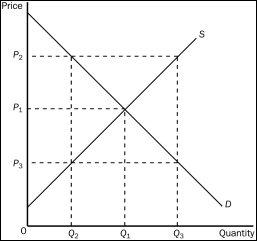 -Refer to Figure 7-12.At the quantity Q₂,
Table 7-3
For each of three potential buyers of oranges, the table displays the willingness to pay for the first three oranges of the day. Assume Alex, Barb, and Carlos are the only three buyers of oranges, and only three oranges can be supplied per day.
 -Refer to Table 7-3.Which of the following statements is correct?
 (Multiple Choice)
4.8/5 (87)
(87) Figure 7-7
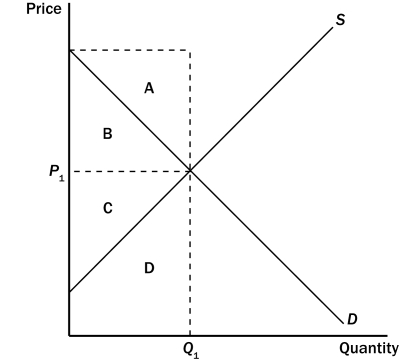 -Refer to Figure 7-7.Which area represents total surplus in the market when the price is P₁?
 (Multiple Choice)
5.0/5 (80)
(80) Figure 7-1
 -Refer to Figure 7-1.When the price is P₁,consumer surplus is
 (Multiple Choice)
4.8/5 (86)
(86) One of the basic principles of economics is that markets are usually a good way to organize economic activity.This principle is explained by the study of
(Multiple Choice)
4.9/5 (79)
(79) The following table represents the costs of five possible sellers.
Table 7-4
 -Refer to Table 7-4.Suppose each of the five sellers can supply at most one unit of the good;then the market quantity supplied is exactly 3 if the price is
 (Multiple Choice)
4.7/5 (83)
(83) Ronnie operates a lawn-care service.On each day,the cost of mowing the first lawn is $10;the cost of mowing the second lawn is $12;and the cost of mowing the third lawn is $15.His producer surplus on the first three lawns of the day is $53.If Ronnie charges all customers the same price for lawn mowing,that price is
(Multiple Choice)
4.9/5 (84)
(84) Figure 7-10
 -Refer to Figure 7-10.At the equilibrium,total consumer surplus is represented by the area
 (Multiple Choice)
4.9/5 (73)
(73) The distinction between efficiency and equity can be described as follows:
(Multiple Choice)
4.9/5 (69)
(69) Suppose that the equilibrium price in the market for widgets is $5.If a law increased the minimum legal price for widgets to $6,producer surplus
(Multiple Choice)
4.8/5 (66)
(66) This table refers to five possible buyers' willingness to pay for a case of Vanilla Coke.
Table 7-2
 -Refer to Table 7-2.If the market price is $3.80,
 (Multiple Choice)
4.7/5 (78)
(78) If the price a consumer pays for a product is equal to a consumer's willingness to pay,then the consumer surplus relevant to that purchase is
(Multiple Choice)
4.7/5 (79)
(79) 
Filters
- Essay(0)
- Multiple Choice(0)
- Short Answer(0)
- True False(0)
- Matching(0)