



 Chat with AI
Exam 7: Consumers, producers, and the Efficiency of Markets

Exam 1: Ten Principles of Economics237 Questions
Exam 2: Thinking Like an Economist267 Questions
Exam 3: Interdependence and the Gains From Trade217 Questions
Exam 4: The Market Forces of Supply and Demand303 Questions
Exam 5: Elasticity and Its Applications282 Questions
Exam 6: Supply, demand, and Government Policies252 Questions
Exam 7: Consumers, producers, and the Efficiency of Markets248 Questions
Exam 8: Application: the Costs of Taxation245 Questions
Exam 9: Application: International Trade245 Questions
Exam 10: Externalities288 Questions
Exam 11: Public Goods and Common Resources258 Questions
Exam 12: The Design of the Tax System328 Questions
Exam 13: The Costs of Production303 Questions
Exam 14: Firms in Competitive Markets271 Questions
Exam 15: Monopoly306 Questions
Exam 16: Oligopoly291 Questions
Exam 17: Monopolistic Competition257 Questions
Exam 18: The Markets for the Factors of Production284 Questions
Exam 19: Earnings and Discrimination286 Questions
Exam 20: Income Inequality and Poverty247 Questions
Exam 21: The Theory of Consumer Choice238 Questions
Exam 22: Frontiers of Microeconomics199 Questions
Exam 23: Measuring a Nations Income215 Questions
Exam 24: Measuring the Cost of Living208 Questions
Exam 25: Production and Growth240 Questions
Exam 26: Saving, investment, and the Financial System282 Questions
Exam 27: The Basic Tools of Finance249 Questions
Exam 28: Unemployment242 Questions
Exam 29: The Monetary System277 Questions
Exam 30: Money Growth and Inflation224 Questions
Exam 31: Open-Economy Macroeconomics: Basic Concepts256 Questions
Exam 32: A Macroeconomic Theory of the Open Economy217 Questions
Exam 33: Aggregate Demand and Aggregate Supply302 Questions
Exam 34: The Influence of Monetary and Fiscal Policy on Aggregate Demand249 Questions
Exam 35: The Short Run Trade Off Between Inflation and Unemployment246 Questions
Exam 36: Five Debates Over Macroeconomic Policy140 Questions
Select questions type


Figure 7-8
 -Refer to Figure 7-8.Sellers whose costs are less than price are represented by which line segment?
 (Multiple Choice)
4.8/5  (82)
(82) Connie can clean windows in large office buildings at a cost of $1 per window.The market price for window-cleaning services is $3 per window.If Connie cleans 100 windows,her producer surplus is $100.
(True/False)
4.8/5 (80)
(80) Table 7-3
For each of three potential buyers of oranges, the table displays the willingness to pay for the first three oranges of the day. Assume Alex, Barb, and Carlos are the only three buyers of oranges, and only three oranges can be supplied per day.
 -Refer to Table 7-3.If the market price of an orange increases from $0.60 to $1.05,total consumer surplus
 (Multiple Choice)
4.8/5 (89)
(89) If a consumer is willing and able to pay $20 for a particular good and if he pays $16 for the good,then for that consumer,consumer surplus amounts to
(Multiple Choice)
4.8/5 (81)
(81) This table refers to five possible buyers' willingness to pay for a case of Vanilla Coke.
Table 7-2
 -Refer to Table 7-2.Which of the following is not true?
 (Multiple Choice)
4.8/5 (74)
(74)  -Refer to Figure 7-6.Area A represents
Figure 7-9
 -Refer to Figure 7-9.At the equilibrium price,producer surplus is
 (Multiple Choice)
4.8/5 (83)
(83) Figure 7-1
 -Refer to Figure 7-1.When the price rises from P₁ to P₂,consumer surplus
 (Multiple Choice)
5.0/5 (83)
(83) When a buyer's willingness to pay for a good is equal to the price of the good,
(Multiple Choice)
4.9/5 (90)
(90) This table refers to five possible buyers' willingness to pay for a case of Vanilla Coke.
Table 7-2
-Refer to Table 7-2.If the market price is $5.50,the consumer surplus in the market will be
-Refer to Table 7-2.If the market price is $5.50,the consumer surplus in the market will be (Multiple Choice)
4.7/5 (73)
(73) Figure 7-7
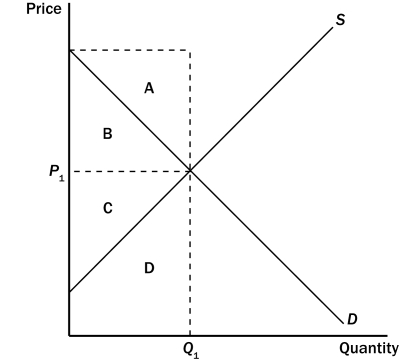 -Refer to Figure 7-7.Which area represents producer surplus when the price is P₁?
 (Multiple Choice)
4.8/5 (85)
(85) Suppose consumer income increases.If grass seed is a normal good,the equilibrium price of grass seed will
(Multiple Choice)
4.7/5 (75)
(75) Figure 7-10
 -Refer to Figure 7-10.At the market-clearing equilibrium,total surplus is represented by the area
 (Multiple Choice)
4.9/5 (89)
(89) Marjorie is willing to pay $68 for a pair of shoes for a formal dance.She finds a pair at her favorite outlet shoe store for $48.Marjorie's consumer surplus is
(Multiple Choice)
5.0/5 (74)
(74) Figure 7-11. On the graph below, Q represents the quantity of the good and P represents the good's price.
 -Refer to Figure 7-11.If four units of the good are produced and sold,then
 (Multiple Choice)
4.8/5 (68)
(68) 
Filters
- Essay(0)
- Multiple Choice(0)
- Short Answer(0)
- True False(0)
- Matching(0)