



 Chat with AI
Exam 13: Game Theory and Strategic Play

Exam 1: The Principles and Practice of Economics103 Questions
Exam 2: Economic Methods and Economic Questions94 Questions
Exam 3: Optimization: Doing the Best You Can94 Questions
Exam 4: Demand, supply, and Equilibrium185 Questions
Exam 5: Consumers and Incentives187 Questions
Exam 6: Sellers and Incentives261 Questions
Exam 7: Perfect Competition and the Invisible Hand251 Questions
Exam 8: Trade264 Questions
Exam 9: Externalities and Public Goods223 Questions
Exam 10: The Government in the Economy: Taxation and Regulation244 Questions
Exam 11: Markets for Factors of Production237 Questions
Exam 12: Monopoly295 Questions
Exam 13: Game Theory and Strategic Play199 Questions
Exam 14: Oligopoly and Monopolistic Competition264 Questions
Exam 15: Trade-Offs Involving Time and Risk147 Questions
Exam 16: The Economics of Information119 Questions
Exam 17: Auctions and Bargaining123 Questions
Exam 18: Social Economics111 Questions
Select questions type


Scenario: Your friend Joe and you decide to race your new cars. However, both of you are caught speeding by a police patrol. The matrix below shows the respective payoffs for each choice of actions. The first number listed in each cell is the payoff to the row player, and the second number listed is the payoff to the column player.
 -Refer to the scenario above.Which of the following is true?
 (Multiple Choice)
4.8/5  (82)
(82) Scenario: The payoff matrix given below shows the payoffs to two rival firms in millions of U.S. dollars for each strategy they choose. The first number listed in each cell is the payoff to the row player, and the second number listed is the payoff to the column player.
 -Refer to the scenario above.The sum of the firms' payoffs is maximum when ________.
 (Multiple Choice)
4.9/5 (87)
(87) The following figure depicts four simultaneous-move games. The first element of each payoff cell is the payoff to Player A. The other element is the payoff to Player B.
 -Refer to the figure above.Which of these simultaneous-move games best represents the following scenario: the battle of the sexes.The husband prefers to go see a boxing match (X),while the wife prefers to go to the ballet (Y).However,they both prefer being together than being alone.
 (Multiple Choice)
4.9/5 (95)
(95) Scenario: Contiguous states often use tax policy to attract residents, firms, and economic activity. These "tax competitions" between states can be modeled with game theory. Suppose New Jersey currently has a state sales tax of 7 percent and Pennsylvania has a state sales tax of 6 percent. The game shown below models the effect of a reduction in each state's sales tax rate to 3 percent on each state's sales tax revenue. Assume the motivation of each state is to maximize tax revenue. The first number in a cell is the payoff to New Jersey; the second number is the payoff to Pennsylvania.
 (Source: John Greenwald, "A No-Win War Between the States," Time, April 8, 1996, 44-45.
-Refer to the scenario above.Does New Jersey have a dominant strategy?
(Source: John Greenwald, "A No-Win War Between the States," Time, April 8, 1996, 44-45.
-Refer to the scenario above.Does New Jersey have a dominant strategy? (Multiple Choice)
4.9/5 (83)
(83) Scenario: Two rival firms are considering sponsoring an event. Each firm believes that sponsoring the event will increase its sales by a certain percentage. The payoff matrix showing the increase in sales for the firms is given below. The first number listed in each cell is the payoff to the row player, and the second number listed is the payoff to the column player.
 -Refer to the scenario above.What is likely to be the impact on Firm A's sales if Firm A decides not to sponsor the event?
 (Multiple Choice)
4.9/5 (98)
(98) Suppose two outdoor apparel firms,L.L.Bean and Eddie Bauer,are contemplating introducing the same new product to their existing product lines.For this problem,assume that Eddie Bauer "moves" (makes this decision)first,and then L.L.Bean makes its decision.Each firm can choose to either introduce the new product or continue with the existing product.Eddie Bauer moves first,and there is "full information," meaning that each firm knows the potential payoffs (profits associated with each action).In the extensive form of this sequential game,shown in the figure below,profits (shown in parentheses in the art)are annual profits in thousands of dollars.
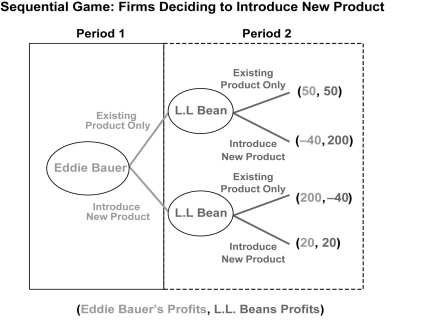 Given the information above,which of the following statements is true? Explain how you arrived at your answer.
 (Multiple Choice)
4.8/5 (76)
(76) Scenario: The following table represents the game matrix for the penalty kicks in a soccer game. There are two players in the game: the kicker and the goalie. The kicker has two choices: to kick the ball to the right or to the left. The goalie also has two choice to jump to the right, or to the left. Each goal counts to +1 point for the kicker and -1 points for the goalie. The symbols in the table stand for the numerical payoff to each player. The first symbol listed in each cell is the payoff to the kicker, and the second number listed is the payoff to the goalie.
 -Refer to the scenario above.The symbol z is equal to ________,and the symbol t is equal to ________.
 (Multiple Choice)
4.9/5 (59)
(59) Scenario: Consider the tragedy of the commons problem. Suppose two firms (Row Inc. and Colm Inc.) are involved in a production process that exploits a natural resource. Each firm has two options: 1 and 2. The matrix below shows the game matrix for these two firms. The first number listed in each cell is the payoff to Row Inc., and the second number listed is the payoff to Colm Inc.
 -Refer to the scenario above.If these two firms plan to operate in the long run,they will collectively be better off if ________.
 (Multiple Choice)
4.8/5 (83)
(83) Scenario: Miguel and Stephanie are competitors who sell tacos out of their food trucks by the same beach. For each taco they sell, they get a profit of $1.00. Each morning they must decide at which of the three legally permitted locations, A, B, or C, they should park their trucks. The picture below shows the three locations.
 In each of the three locations, there are 100 customers per day, and each customer buys a taco from the nearest vendor. If the two trucks are in the same location, then each vendor gets half of the customers. So, for example, if Miguel's truck is in location A, and Stephanie's is also in location A, then half of customers from locations A, B, and C will buy from Miguel's and the other half will buy from Stephanie's, so that each gets a profit of $150. If Miguel's truck is in location A and Stephanie's is in location B, then everyone in location A will buy from Miguel and everyone from locations B and C will buy from Stephanie, so that Miguel's profit is $100 while Stephanie's is $200. If Miguel's truck is in location A and Stephanie's is in location C, then everyone in A plus a half from B will buy from Miguel, and everyone in C plus half from B will buy from Stephanie so that each vendor gets a profit of $150, and so on. The table below is the payoff matrix for this game. The first number in each cell is Miguel's profit, and the second number is Stephanie's profit.
 -Refer to the scenario above.What,if any,is a Nash equilibrium for this game?
In each of the three locations, there are 100 customers per day, and each customer buys a taco from the nearest vendor. If the two trucks are in the same location, then each vendor gets half of the customers. So, for example, if Miguel's truck is in location A, and Stephanie's is also in location A, then half of customers from locations A, B, and C will buy from Miguel's and the other half will buy from Stephanie's, so that each gets a profit of $150. If Miguel's truck is in location A and Stephanie's is in location B, then everyone in location A will buy from Miguel and everyone from locations B and C will buy from Stephanie, so that Miguel's profit is $100 while Stephanie's is $200. If Miguel's truck is in location A and Stephanie's is in location C, then everyone in A plus a half from B will buy from Miguel, and everyone in C plus half from B will buy from Stephanie so that each vendor gets a profit of $150, and so on. The table below is the payoff matrix for this game. The first number in each cell is Miguel's profit, and the second number is Stephanie's profit.
-Refer to the scenario above.What,if any,is a Nash equilibrium for this game? (Multiple Choice)
4.7/5 (95)
(95) The following figure depicts four simultaneous-move games. The first element of each payoff cell is the payoff to Player A. The other element is the payoff to Player B.
 -Refer to the figure above.In which one of these simultaneous-play games is the unique Nash equilibrium Players A and B both choosing X?
 (Multiple Choice)
4.8/5 (80)
(80) Scenario: Jim and Janis must complete a task together at their job. Jim can put no effort, low effort, or high effort into the job, while Janis, being more conscientious than Jim, has choice of low effort or high effort. Their compensation, summarized in the payoff matrix below (in thousands of dollars), depends on the quality of their work, which in turn depends on the efforts they put into the task. The first number in each cell is Jim's payoff, and the second number is Janis' payoff.
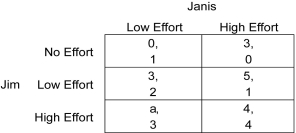 -Refer to the scenario above.If a < 3,then ________ form a Nash equilibrium.
 (Multiple Choice)
4.7/5 (58)
(58) Which of the following is true of a simultaneous-move game?
(Multiple Choice)
4.8/5 (83)
(83) Two friends,Pat and Julie,are going to a concert.They play a simple game in which they hold out one or two fingers to decide who will pay for the other's ticket.Pat wins if the fingers held out add up to an even number; Julie wins if the fingers held out add up to an odd number.The price of the ticket is $9.
a)Construct a payoff matrix for the game.
b)Is there a unique Nash equilibrium in this game?
c)Which strategy should a player use to maximize her chances of winning the game?
(Essay)
4.9/5 (83)
(83) Scenario: The payoff matrix given below shows the payoffs to two firms in millions of U.S. dollars for choosing two alternative strategies. The first number listed in each cell is the payoff to the row player, and the second number listed is the payoff to the column player.
 -Refer to the scenario above.What is the payoff to Firm A in equilibrium?
 (Multiple Choice)
5.0/5 (68)
(68) John and Jacob are participating in a contest as a team.In the first round of the game,John has to decide whether or not he trusts Jacob.If John trusts Jacob,Jacob can choose to either defect or cooperate.If Jacob defects,Jacob will win $200 while John will gain nothing and if Jacob cooperates,both of them will win $100.However,in case John does not trust Jacob,both will win only $10.What is the payoff to the players in equilibrium? Can the equilibrium of this game be any different and under what circumstances?
(Essay)
4.9/5 (81)
(81) Tom and Billy are playing a game.They both toss a coin simultaneously.If the results of the tosses are the same,both heads or both tails,Tom wins.If the results of the tosses are different,one heads and one tails,Billy wins.This is an example of ________.
(Multiple Choice)
4.8/5 (77)
(77) 
Filters
- Essay(0)
- Multiple Choice(0)
- Short Answer(0)
- True False(0)
- Matching(0)