



 Chat with AI
Exam 13: Game Theory and Strategic Play

Exam 1: The Principles and Practice of Economics103 Questions
Exam 2: Economic Methods and Economic Questions94 Questions
Exam 3: Optimization: Doing the Best You Can94 Questions
Exam 4: Demand, supply, and Equilibrium185 Questions
Exam 5: Consumers and Incentives187 Questions
Exam 6: Sellers and Incentives261 Questions
Exam 7: Perfect Competition and the Invisible Hand251 Questions
Exam 8: Trade264 Questions
Exam 9: Externalities and Public Goods223 Questions
Exam 10: The Government in the Economy: Taxation and Regulation244 Questions
Exam 11: Markets for Factors of Production237 Questions
Exam 12: Monopoly295 Questions
Exam 13: Game Theory and Strategic Play199 Questions
Exam 14: Oligopoly and Monopolistic Competition264 Questions
Exam 15: Trade-Offs Involving Time and Risk147 Questions
Exam 16: The Economics of Information119 Questions
Exam 17: Auctions and Bargaining123 Questions
Exam 18: Social Economics111 Questions
Select questions type


Scenario: Jim and Janis must complete a task together at their job. Jim can put no effort, low effort, or high effort into the job, while Janis, being more conscientious than Jim, has choice of low effort or high effort. Their compensation, summarized in the payoff matrix below (in thousands of dollars), depends on the quality of their work, which in turn depends on the efforts they put into the task. The first number in each cell is Jim's payoff, and the second number is Janis' payoff.
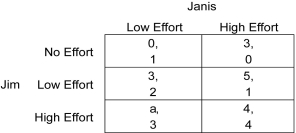 -Refer to the scenario above.If a > 3,then ________.
 (Multiple Choice)
5.0/5  (71)
(71) Scenario: Consider a trust game between an employer and a worker. The employer will either trust or not trust the worker. If the employer trusts the worker, she will hire him and then the worker would either work faithfully for the employer, or shirk in his work. The diagram below shows their respective payoffs in different situations.
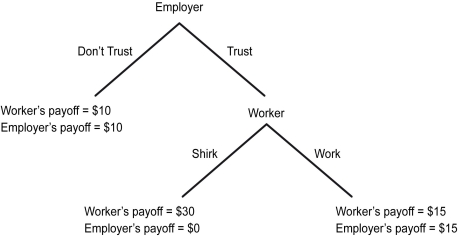 -Refer to the scenario above.If the interaction between the employer and the worker is to be repeated for many periods in future,the equilibrium of this game is ________.
 (Multiple Choice)
4.9/5 (87)
(87) The following figure depicts four sequential games. Player A is the first to move and Player B is the second to move.
 -Refer to the figure above.In which game does Player A lose money while Player B wins money in equilibrium?
 (Multiple Choice)
4.9/5 (69)
(69) Scenario: The payoff matrix given below shows the payoffs to two firms in millions of U.S. dollars for choosing two alternative strategies. The first number listed in each cell is the payoff to the row player, and the second number listed is the payoff to the column player.
 -Refer to the scenario above.Which of the following will happen in equilibrium?
 (Multiple Choice)
4.8/5 (75)
(75) The following payoff matrix represents a simultaneous-move game between two players: John and Trevor. Each player has to choices: Black or White. The first number in each cell is the payoff to John, and the second number is the payoff to Trevor.
 -Refer to the table above.If John chooses ________,Trevor is better off choosing ________.And if Trevor chooses ________,John is better off choosing ________.
 (Multiple Choice)
4.9/5 (82)
(82) Gary and Christine are two players in game in which Gary's decisions are based on the choice made by Christine.This is an example of a(n)________.
(Multiple Choice)
4.8/5 (83)
(83) Two rival cosmetics brands are considering launching a new product.If Firm 1 launches a product for older women while Firm 2 targets college students,Firm 1 will earn $40,000,while Firm 2 will earn $50,000.If both the firms launch a product for older women,Firm 1 will earn $20,000,while Firm 2 will earn $15,000.If Firm 1 launches a product for college students while Firm 2 targets older women,Firm 1 will earn $60,000,while Firm 2 will earn $40,000.If both firms target college students,both firms will earn $30,000.However,Firm 2 will choose its target consumers after Firm 1 has chosen its target consumers.
a)Draw a game tree to represent this situation.
b)What is the equilibrium outcome of this game?
c)Will there be a change in the equilibrium outcome if the firms make decisions simultaneously?
(Essay)
4.9/5 (75)
(75) Scenario: Jack and Jill have gone cycling and have come to a place where the road is obstructed by a fallen tree. They can move the tree if both of them try. If neither of them tries, they have to turn back and reach home very late. However, if one of them tries while the other does not help, the one who tries will have a muscle sprain and will not be able to move the tree. The matrix below shows the utility each player derives in each situation. The first number listed in each cell is the payoff to the row player, and the second number listed is the payoff to the column player.
 -Refer to the scenario above.Jack will derive ________ units of utility if Jill tries to move the tree while he does not try at all.
 (Multiple Choice)
4.9/5 (87)
(87) Scenario: Jack and Jill have gone cycling and have come to a place where the road is obstructed by a fallen tree. They can move the tree if both of them try. If neither of them tries, they have to turn back and reach home very late. However, if one of them tries while the other does not help, the one who tries will have a muscle sprain and will not be able to move the tree. The matrix below shows the utility each player derives in each situation. The first number listed in each cell is the payoff to the row player, and the second number listed is the payoff to the column player.
-Refer to the scenario above.Jack will derive ________ units of utility if he tries to move the tree while Jill does not try at all.
-Refer to the scenario above.Jack will derive ________ units of utility if he tries to move the tree while Jill does not try at all. (Multiple Choice)
4.8/5 (72)
(72) Scenario: Two friends have agreed on a unique strategy to decide who will complete his homework first and help the other. They have agreed to simultaneously display one of three different symbols using their hands-a rock, paper, or scissors. They have decided to follow simple rules to determine the winner of the game: rock breaks scissors, scissors cut paper, and paper covers rock. If both of them hold out the same symbol, the game is a tie.
-Refer to the scenario above.Which of the following is a winning strategy for this game?
(Multiple Choice)
4.8/5 (85)
(85) Scenario: Two rival firms are considering sponsoring an event. Each firm believes that sponsoring the event will increase its sales by a certain percentage. The payoff matrix showing the increase in sales for the firms is given below. The first number listed in each cell is the payoff to the row player, and the second number listed is the payoff to the column player.
 -Refer to the scenario above.What is likely to be the impact on Firm B's sales if Firm B decides not to sponsor the event?
 (Multiple Choice)
4.9/5 (70)
(70) Scenario: Alex puts $100 on the table. Bob chooses either to take $51 for himself and $49 for Clare or pass. If Bob passes, then Alex adds another $2 and Clare chooses either to take $52 for herself and $50 for Bob or pass. If Clare passes, then Alex adds another $2 and Bob chooses either to take $53 for himself and $51 for Clare or pass, and so on. In other words, a player chooses either to take $2 more for himself/herself or pass, and, every time a player passes, Alex adds another $2. The game ends if $200 is on the table or either Bob or Clare chooses not to pass before that. If the amount on the table reached $200, then Bob and Clare get $99.99 each (Alex takes two pennies back). The figure below shows the extensive form of this game. Bob's payoff is written first and Clare's second.
 -Refer to the scenario above.Suppose that,if the game reached the end with $200 on the table,Bob and Clare get $100 each instead of $99.99.Then which of the following could happen in an equilibrium?
 (Multiple Choice)
4.8/5 (82)
(82) Scenario: Consider the tragedy of the commons problem. Suppose two firms (Row Inc. and Colm Inc.) are involved in a production process that exploits a natural resource. Each firm has two options: 1 and 2. The matrix below shows the game matrix for these two firms. The first number listed in each cell is the payoff to Row Inc., and the second number listed is the payoff to Colm Inc.
 -Refer to the scenario above.This game ________.
 (Multiple Choice)
4.8/5 (69)
(69) Which of the following situations is an example of a zero-sum game?
(Multiple Choice)
4.9/5 (66)
(66) Scenario: Two rival firms charge equal prices for their products, which are perfect substitutes. Firm 1 is considering offering a 10 percent discount on the market price to increase sales. The game tree below shows the respective payoffs to each firm, depending on the decisions each makes.
 -Refer to the scenario above.In equilibrium,________.
 (Multiple Choice)
4.9/5 (77)
(77) Scenario: Consider the following non-cooperative, simultaneous-move game where each player knows her own and her opponent's payoffs. This game is called the dating dilemma. Hayley and Jack are a couple deciding what to do on a Saturday afternoon in the summer. Hayley wants to go to the Museum of Modern Art (MoMA), while Jack wants to go to a New York Mets game. Neither Jack nor Hayley will derive any benefit from going to their preferred activity without their partner. The payoff matrix for this game is presented below.
 -Refer to the scenario above.Are there any Nash equilibria?
 (Multiple Choice)
4.8/5 (84)
(84) Scenario: The ultimatum game is a two-player game played as follows. One player, the proposer, is told to divide a sum of money between the two players. The proposer proposes how to divide the sum. The other player, the responder, then chooses to either accept or reject the proposal. If the responder accepts the proposal, the money is split according to the proposal. If the responder rejects the proposal, neither receives any money. When this game is played by real people from a common social group, it is frequently observed that the proposer offers close to 50-50 split and the responder rejects offers below 30 percent of the sum.
-Refer to the scenario above.According to the theory presented in the textbook,which of the following would happen in the Nash equilibrium?
(Multiple Choice)
4.9/5 (78)
(78) Scenario: Alex puts $100 on the table. Bob chooses either to take $51 for himself and $49 for Clare or pass. If Bob passes, then Alex adds another $2 and Clare chooses either to take $52 for herself and $50 for Bob or pass. If Clare passes, then Alex adds another $2 and Bob chooses either to take $53 for himself and $51 for Clare or pass, and so on. In other words, a player chooses either to take $2 more for himself/herself or pass, and, every time a player passes, Alex adds another $2. The game ends if $200 is on the table or either Bob or Clare chooses not to pass before that. If the amount on the table reached $200, then Bob and Clare get $99.99 each (Alex takes two pennies back). The figure below shows the extensive form of this game. Bob's payoff is written first and Clare's second.
-Refer to the scenario above.Suppose that,if the game reached the end with $200 on the table,Bob and Clare get $100 each instead of $99.99.Then which of the following could happen in an equilibrium?
-Refer to the scenario above.Suppose that,if the game reached the end with $200 on the table,Bob and Clare get $100 each instead of $99.99.Then which of the following could happen in an equilibrium? (Multiple Choice)
4.8/5 (69)
(69) Scenario: Two firms in a market must choose between two alternative strategies: X and Y. The figure below shows the game tree that these firms can use to make their decisions.
 -Refer to the scenario above.Which of the following is true?
 (Multiple Choice)
4.8/5 (83)
(83) 
Filters
- Essay(0)
- Multiple Choice(0)
- Short Answer(0)
- True False(0)
- Matching(0)