



 Chat with AI
Exam 13: Game Theory and Strategic Play

Exam 1: The Principles and Practice of Economics103 Questions
Exam 2: Economic Methods and Economic Questions94 Questions
Exam 3: Optimization: Doing the Best You Can94 Questions
Exam 4: Demand, supply, and Equilibrium185 Questions
Exam 5: Consumers and Incentives187 Questions
Exam 6: Sellers and Incentives261 Questions
Exam 7: Perfect Competition and the Invisible Hand251 Questions
Exam 8: Trade264 Questions
Exam 9: Externalities and Public Goods223 Questions
Exam 10: The Government in the Economy: Taxation and Regulation244 Questions
Exam 11: Markets for Factors of Production237 Questions
Exam 12: Monopoly295 Questions
Exam 13: Game Theory and Strategic Play199 Questions
Exam 14: Oligopoly and Monopolistic Competition264 Questions
Exam 15: Trade-Offs Involving Time and Risk147 Questions
Exam 16: The Economics of Information119 Questions
Exam 17: Auctions and Bargaining123 Questions
Exam 18: Social Economics111 Questions
Select questions type


Scenario: Suppose two soda brands, Mountain Dew and Mello Yello, are trying to decide whether to launch advertising campaigns for their respective products. These decisions will be taken simultaneously, the brands will not be cooperating, and we will assume each brand's strategist knows her own and her opponent's payoffs in all cases. The payoff matrix for this game is shown below.
 -Refer to the scenario above.Does Mountain Dew have a dominant strategy?
 (Multiple Choice)
4.9/5  (86)
(86) Sam Walton chose a very different strategy for locating his Wal-Mart discount stores than did his rivals in the 1960s.Specifically,Walton chose to locate his stores in cities that were much smaller than locations chosen by his rivals.Walton believed that once he located a store in these smaller communities,there would be no incentive for a rival discount retailer to build another store in the community.This is an example of ________.
(Multiple Choice)
4.9/5 (91)
(91) The difference between an extensive-form game and a simultaneous-move game is that ________.
(Multiple Choice)
4.7/5 (82)
(82) Scenario: Miguel and Stephanie are competitors who sell tacos out of their food trucks by the same beach. For each taco they sell, they get a profit of $1.00. Each morning they must decide at which of the three legally permitted locations, A, B, or C, they should park their trucks. The picture below shows the three locations.
 In each of the three locations, there are 100 customers per day, and each customer buys a taco from the nearest vendor. If the two trucks are in the same location, then each vendor gets half of the customers. So, for example, if Miguel's truck is in location A, and Stephanie's is also in location A, then half of customers from locations A, B, and C will buy from Miguel's and the other half will buy from Stephanie's, so that each gets a profit of $150. If Miguel's truck is in location A and Stephanie's is in location B, then everyone in location A will buy from Miguel and everyone from locations B and C will buy from Stephanie, so that Miguel's profit is $100 while Stephanie's is $200. If Miguel's truck is in location A and Stephanie's is in location C, then everyone in A plus a half from B will buy from Miguel, and everyone in C plus half from B will buy from Stephanie so that each vendor gets a profit of $150, and so on. The table below is the payoff matrix for this game. The first number in each cell is Miguel's profit, and the second number is Stephanie's profit.
 -Refer to the scenario above.If Miguel's truck is located at C,what is Stephanie's best response?
In each of the three locations, there are 100 customers per day, and each customer buys a taco from the nearest vendor. If the two trucks are in the same location, then each vendor gets half of the customers. So, for example, if Miguel's truck is in location A, and Stephanie's is also in location A, then half of customers from locations A, B, and C will buy from Miguel's and the other half will buy from Stephanie's, so that each gets a profit of $150. If Miguel's truck is in location A and Stephanie's is in location B, then everyone in location A will buy from Miguel and everyone from locations B and C will buy from Stephanie, so that Miguel's profit is $100 while Stephanie's is $200. If Miguel's truck is in location A and Stephanie's is in location C, then everyone in A plus a half from B will buy from Miguel, and everyone in C plus half from B will buy from Stephanie so that each vendor gets a profit of $150, and so on. The table below is the payoff matrix for this game. The first number in each cell is Miguel's profit, and the second number is Stephanie's profit.
-Refer to the scenario above.If Miguel's truck is located at C,what is Stephanie's best response? (Multiple Choice)
4.9/5 (74)
(74) Scenario: Vladimir and Alphonso are collectors of Toy Story figurines. Each has six dollar bills to spend on three figurines-Sheriff Woody, Buzz Lightyear, and Jessie-that are put up for auction where Vlad and Alph are the only bidders. They simultaneously and independently write down their bids, in whole numbers adding up to $6, for the three figurines and give them to the auctioneer. Whoever wrote the higher number for a figurine wins it. For example, if Vlad bids ($3, $1, $2), meaning $3 for Sheriff Woody, $1 for Buzz Lightyear, and $2 for Jessie, and Alph bids ($2, $3, $1), then Vlad wins Sheriff Woody and Jessie, while Alph wins Buzz Lightyear. If there is a tie, then a fair coin is flipped to determine the winner so that each bidder has 50 percent chance of winning a figurine. Vlad and Alph consider this case as "winning" a figurine. Vlad and Alph care only about how many more, or less, figurines they win compared to the other.
-Refer to the scenario above.This game is an example of ________.
(Multiple Choice)
4.9/5 (84)
(84) Scenario: Suppose two soda brands, Mountain Dew and Mello Yello, are trying to decide whether to launch advertising campaigns for their respective products. These decisions will be taken simultaneously, the brands will not be cooperating, and we will assume each brand's strategist knows her own and her opponent's payoffs in all cases. The payoff matrix for this game is shown below.
-Refer to the scenario above.Does Mello Yello have a dominant strategy?
-Refer to the scenario above.Does Mello Yello have a dominant strategy? (Multiple Choice)
4.8/5 (82)
(82) Scenario: The matrix below shows the payoffs to two firms when they choose between two different strategies. The first number listed in each cell is the payoff to the row player, and the second number listed is the payoff to the column player.
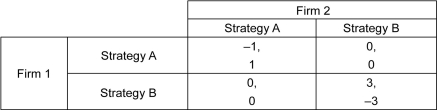 -Refer to the scenario above.Which of the following is true of this game?
 (Multiple Choice)
4.7/5 (70)
(70) Scenario: Two firms in a market sell identical goods and charge a price of $5 per unit. However, the cost of a crucial input used in producing these goods has increased. As a result, both firms are considering increasing the price of the good to $6. If the firms do not raise their prices at the same time, the firm that raises the price stands to lose market share. The payoff matrix shows the respective payoffs on the basis of the prices charged by each firm. Here, payoffs denote the number of units sold by each firm. The first number listed in each cell is the payoff to the row player, and the second number listed is the payoff to the column player.
 -Refer to the scenario above.Which of the following is true in this case?
 (Multiple Choice)
4.9/5 (84)
(84) Scenario: Two firms in a market must choose between two alternative strategies: X and Y. The figure below shows the game tree that these firms can use to make their decisions.
 -Refer to the scenario above.In equilibrium,________.
 (Multiple Choice)
4.7/5 (81)
(81) Scenario: Consider the tragedy of the commons problem. Suppose two firms (Row Inc. and Colm Inc.) are involved in a production process that exploits a natural resource. Each firm has two options: 1 and 2. The matrix below shows the game matrix for these two firms. The first number listed in each cell is the payoff to Row Inc., and the second number listed is the payoff to Colm Inc.
 -Refer to the scenario above.This game is ________.
 (Multiple Choice)
4.9/5 (84)
(84) A ________ is used to represent a simultaneous-move game,and a ________ is used to represent an extensive-form game.
(Multiple Choice)
4.9/5 (96)
(96) Scenario: Company A and Company B are considering spending a certain sum of money to advertise their new range of products. If Company A chooses to advertise while Company B does not, Company A's annual sales will increase by $5 million, while Company B's sales will remain unchanged. If Company B chooses to advertise while Company A does not, Company B's annual sales will increase by $5 million, while Company A will not experience any change in its sales. If both the companies decide to advertise, their sales will increase sales by $2 million each, and if neither of them spends on advertisement, their sales will remain unchanged.
-Refer to the scenario above.Which of the following is true?
(Multiple Choice)
4.9/5 (69)
(69) Scenario: Beth and Charles are playing a trust game. At the beginning of the game, Beth has to choose whether to trust Charles. If she trusts him, he can choose to either defect or cooperate. The diagram below shows their respective payoffs in different situations.
 -Refer to the scenario above.Charles will receive a payoff of ________ if Beth trusts him and he defects.
 (Multiple Choice)
4.8/5 (70)
(70) Scenario: Company A and Company B are considering spending a certain sum of money to advertise their new range of products. If Company A chooses to advertise while Company B does not, Company A's annual sales will increase by $5 million, while Company B's sales will remain unchanged. If Company B chooses to advertise while Company A does not, Company B's annual sales will increase by $5 million, while Company A will not experience any change in its sales. If both the companies decide to advertise, their sales will increase sales by $2 million each, and if neither of them spends on advertisement, their sales will remain unchanged.
-Refer to the scenario above.Suppose the cost of advertising in this industry is very high and each company will incur a cost of $3 million annually if they choose to advertise.Which of the following is true in this case?
(Multiple Choice)
4.8/5 (85)
(85) Scenario: Two rival firms have to choose between two strategies to maximize their benefits. The two alternative strategies available are Strategy X and Strategy Y. The matrix below shows the respective payoffs for each strategy chosen by the firms. The first number listed in each cell is the payoff to the row player, and the second number listed is the payoff to the column player.
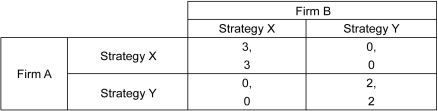 -Refer to the scenario above.Which of the following is true in this case?
 (Multiple Choice)
4.7/5 (88)
(88) Maria Brown is a young tennis player who has shot to fame after defeating Sarah Knowles in three consecutive matches.In the fourth match,Sarah decides to serve to the left each time.Is this an optimal winning strategy for Sarah?
(Essay)
5.0/5 (79)
(79) 
Filters
- Essay(0)
- Multiple Choice(0)
- Short Answer(0)
- True False(0)
- Matching(0)