



 Chat with AI
Exam 13: Game Theory and Strategic Play

Exam 1: The Principles and Practice of Economics103 Questions
Exam 2: Economic Methods and Economic Questions94 Questions
Exam 3: Optimization: Doing the Best You Can94 Questions
Exam 4: Demand, supply, and Equilibrium185 Questions
Exam 5: Consumers and Incentives187 Questions
Exam 6: Sellers and Incentives261 Questions
Exam 7: Perfect Competition and the Invisible Hand251 Questions
Exam 8: Trade264 Questions
Exam 9: Externalities and Public Goods223 Questions
Exam 10: The Government in the Economy: Taxation and Regulation244 Questions
Exam 11: Markets for Factors of Production237 Questions
Exam 12: Monopoly295 Questions
Exam 13: Game Theory and Strategic Play199 Questions
Exam 14: Oligopoly and Monopolistic Competition264 Questions
Exam 15: Trade-Offs Involving Time and Risk147 Questions
Exam 16: The Economics of Information119 Questions
Exam 17: Auctions and Bargaining123 Questions
Exam 18: Social Economics111 Questions
Select questions type


Bill and Tom are playing a game.At each round of the game,they have to choose either Strategy X or Strategy Y.However,Tom can make a decision only after Bill has made his decision.If they both choose X,each gains $100,and if both of them choose Y,each gains $50.However,if Bill chooses X and Tom chooses Y,Bill gains $60 while Tom gains $140.Similarly,when Bill chooses Y and Tom chooses X,Tom gains $60 while Bill gains $140.
a)Draw a game tree to represent this game.
b)What type of game is being played? What is the procedure used to solve such a game?
c)What is Tom's optimal strategy if Bill chooses Strategy X?
d)What is Bill's payoff in equilibrium?
(Essay)
4.8/5  (69)
(69) Scenario: Consider the following non-cooperative, simultaneous-move game where each player knows her own and her opponent's payoffs. This game is called the dating dilemma. Hayley and Jack are a couple deciding what to do on a Saturday afternoon in the summer. Hayley wants to go to the Museum of Modern Art (MoMA), while Jack wants to go to a New York Mets game. Neither Jack nor Hayley will derive any benefit from going to their preferred activity without their partner. The payoff matrix for this game is presented below.
 -Refer to the scenario above.Does Hayley have a pure strategy?
 (Multiple Choice)
4.9/5 (79)
(79) Scenario: Consider the tragedy of the commons problem. Suppose two firms (Row Inc. and Colm Inc.) are involved in a production process that exploits a natural resource. Each firm has two options: 1 and 2. The matrix below shows the game matrix for these two firms. The first number listed in each cell is the payoff to Row Inc., and the second number listed is the payoff to Colm Inc.
 -Refer to the scenario above.What is the equilibrium outcome in this case?
 (Multiple Choice)
4.8/5 (69)
(69) Scenario: The ultimatum game is a two-player game played as follows. One player, the proposer, is told to divide a sum of money between the two players. The proposer proposes how to divide the sum. The other player, the responder, then chooses to either accept or reject the proposal. If the responder accepts the proposal, the money is split according to the proposal. If the responder rejects the proposal, neither receives any money. When this game is played by real people from a common social group, it is frequently observed that the proposer offers close to 50-50 split and the responder rejects offers below 30 percent of the sum.
-Refer to the scenario above.According to the theory presented in the textbook,if the proposer offered 1 percent,should the responder accept?
(Multiple Choice)
4.9/5 (79)
(79) Which of the following is true of the prisoners' dilemma game?
(Multiple Choice)
4.9/5 (86)
(86) Scenario: The payoff matrix given below shows the payoffs to two rival firms in millions of U.S. dollars for each strategy they choose. The first number listed in each cell is the payoff to the row player, and the second number listed is the payoff to the column player.
 -Refer to the scenario above.In the dominant strategy equilibrium,the payoff to Firm B is ________.
 (Multiple Choice)
4.9/5 (64)
(64) Does game theory always predict real-world situations involving strategic interactions? Why or why not?
(Essay)
5.0/5 (86)
(86) Scenario: Jack and Jill have gone cycling and have come to a place where the road is obstructed by a fallen tree. They can move the tree if both of them try. If neither of them tries, they have to turn back and reach home very late. However, if one of them tries while the other does not help, the one who tries will have a muscle sprain and will not be able to move the tree. The matrix below shows the utility each player derives in each situation. The first number listed in each cell is the payoff to the row player, and the second number listed is the payoff to the column player.
 -Refer to the scenario above.This game ________.
 (Multiple Choice)
4.7/5 (88)
(88) Scenario: Two friends have agreed on a unique strategy to decide who will complete his homework first and help the other. They have agreed to simultaneously display one of three different symbols using their hands-a rock, paper, or scissors. They have decided to follow simple rules to determine the winner of the game: rock breaks scissors, scissors cut paper, and paper covers rock. If both of them hold out the same symbol, the game is a tie.
-Refer to the scenario above.This is an example of ________.
(Multiple Choice)
4.8/5 (75)
(75) Scenario: The following table represents the game matrix for the penalty kicks in a soccer game. There are two players in the game: the kicker and the goalie. The kicker has two choices: to kick the ball to the right or to the left. The goalie also has two choice to jump to the right, or to the left. Each goal counts to +1 point for the kicker and -1 points for the goalie. The symbols in the table stand for the numerical payoff to each player. The first symbol listed in each cell is the payoff to the kicker, and the second number listed is the payoff to the goalie.
 -Refer to the scenario above.This game ________.
 (Multiple Choice)
4.9/5 (83)
(83) Scenario: The following table represents the game matrix for the penalty kicks in a soccer game. There are two players in the game: the kicker and the goalie. The kicker has two choices: to kick the ball to the right or to the left. The goalie also has two choice to jump to the right, or to the left. Each goal counts to +1 point for the kicker and -1 points for the goalie. The symbols in the table stand for the numerical payoff to each player. The first symbol listed in each cell is the payoff to the kicker, and the second number listed is the payoff to the goalie.
-Refer to the scenario above.This game is ________.
-Refer to the scenario above.This game is ________. (Multiple Choice)
4.9/5 (67)
(67) The following figure depicts four simultaneous-move games. The first element of each payoff cell is the payoff to Player A. The other element is the payoff to Player B.
 -Refer to the figure above.Which of these simultaneous-move games best represents the following scenario: a penalty kick in soccer.Player A is the striker and Player B is the goalie.For the striker,Action X means kicking the ball toward the left side of the net,while Y means kicking toward the right side of the net.For the goalie,X means that the goalie dives toward the left of the net and Y means that the goalie dives toward the right.
 (Multiple Choice)
5.0/5 (77)
(77) Scenario: The payoff matrix given below shows the payoffs to two rival firms in millions of U.S. dollars for each strategy they choose. The first number listed in each cell is the payoff to the row player, and the second number listed is the payoff to the column player.
-Refer to the scenario above.Which of the following is true?
-Refer to the scenario above.Which of the following is true? (Multiple Choice)
4.8/5 (84)
(84) Scenario: Two factories dump their waste in a river. This has led to the contamination of the water, which is also used by the factories in their production processes. The matrix below shows the profits of the two firms based on their respective decisions to dump their waste in the river. Note that each firm's choice affects the other firm's profit. The first number listed in each cell is the payoff to the row player, and the second number listed is the payoff to the column player.
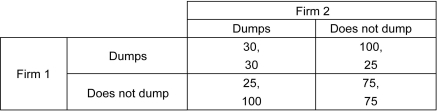 -Refer to the scenario above.What is the equilibrium outcome in this case?
 (Multiple Choice)
4.8/5 (83)
(83) How does a dominant strategy equilibrium occur in a simultaneous-move game?
(Essay)
4.9/5 (82)
(82) Why do some people tip generously at restaurants to which they never plan to return?
(Essay)
4.8/5 (88)
(88) Which of the following is likely to use the concepts of game theory?
(Multiple Choice)
4.8/5 (75)
(75) 
Filters
- Essay(0)
- Multiple Choice(0)
- Short Answer(0)
- True False(0)
- Matching(0)