



 Chat with AI
Exam 13: Game Theory and Strategic Play

Exam 1: The Principles and Practice of Economics103 Questions
Exam 2: Economic Methods and Economic Questions94 Questions
Exam 3: Optimization: Doing the Best You Can94 Questions
Exam 4: Demand, supply, and Equilibrium185 Questions
Exam 5: Consumers and Incentives187 Questions
Exam 6: Sellers and Incentives261 Questions
Exam 7: Perfect Competition and the Invisible Hand251 Questions
Exam 8: Trade264 Questions
Exam 9: Externalities and Public Goods223 Questions
Exam 10: The Government in the Economy: Taxation and Regulation244 Questions
Exam 11: Markets for Factors of Production237 Questions
Exam 12: Monopoly295 Questions
Exam 13: Game Theory and Strategic Play199 Questions
Exam 14: Oligopoly and Monopolistic Competition264 Questions
Exam 15: Trade-Offs Involving Time and Risk147 Questions
Exam 16: The Economics of Information119 Questions
Exam 17: Auctions and Bargaining123 Questions
Exam 18: Social Economics111 Questions
Select questions type


Scenario: The ultimatum game is a two-player game played as follows. One player, the proposer, is told to divide a sum of money between the two players. The proposer proposes how to divide the sum. The other player, the responder, then chooses to either accept or reject the proposal. If the responder accepts the proposal, the money is split according to the proposal. If the responder rejects the proposal, neither receives any money. When this game is played by real people from a common social group, it is frequently observed that the proposer offers close to 50-50 split and the responder rejects offers below 30 percent of the sum.
-Refer to the scenario above.According to the theory presented in the textbook,if the proposer offered 0 percent,should the responder accept?
(Multiple Choice)
4.7/5  (66)
(66) Scenario: Beth and Charles are playing a trust game. At the beginning of the game, Beth has to choose whether to trust Charles. If she trusts him, he can choose to either defect or cooperate. The diagram below shows their respective payoffs in different situations.
 -Refer to the scenario above.In equilibrium,Beth's payoff is ________.
 (Multiple Choice)
4.7/5 (79)
(79) The following figure depicts four simultaneous-move games. The first element of each payoff cell is the payoff to Player A, and the second element is the payoff to Player B.
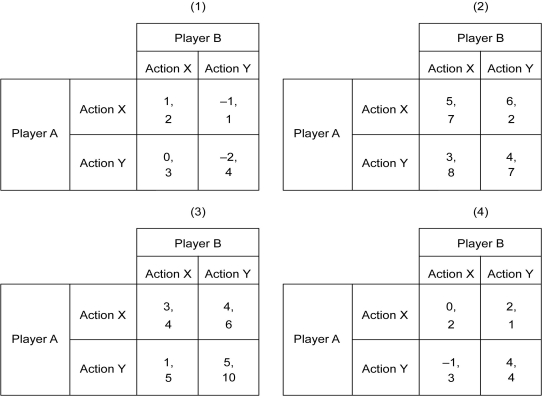 -Refer to the figure above.In which of these simultaneous-move games does only player A have a dominant strategy?
 (Multiple Choice)
4.8/5 (85)
(85) Consider another version of the advertising game between Mountain Dew and Mello Yello.Again,each brand is deciding whether to launch an advertising campaign.These decisions will be taken simultaneously,the brands will not be cooperating,and we will assume each brand's strategist knows her own and her opponent's payoffs in all cases.The payoff matrix is listed below.
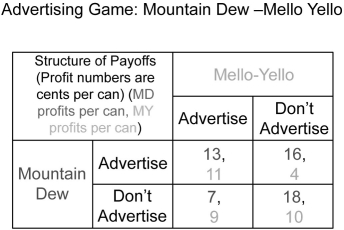 Is there a Nash equilibrium in this advertising game?
 (Multiple Choice)
4.9/5 (79)
(79) Scenario: Beth and Charles are playing a trust game. At the beginning of the game, Beth has to choose whether to trust Charles. If she trusts him, he can choose to either defect or cooperate. The diagram below shows their respective payoffs in different situations.
-Refer to the scenario above.If this game is repeated several times,and reputational considerations are taken into account,Beth will earn ________ and Charles will earn ________ every time.
-Refer to the scenario above.If this game is repeated several times,and reputational considerations are taken into account,Beth will earn ________ and Charles will earn ________ every time. (Multiple Choice)
4.8/5 (78)
(78) The following figure depicts four simultaneous-move games. The first element of each payoff cell is the payoff to Player A. The other element is the payoff to Player B.
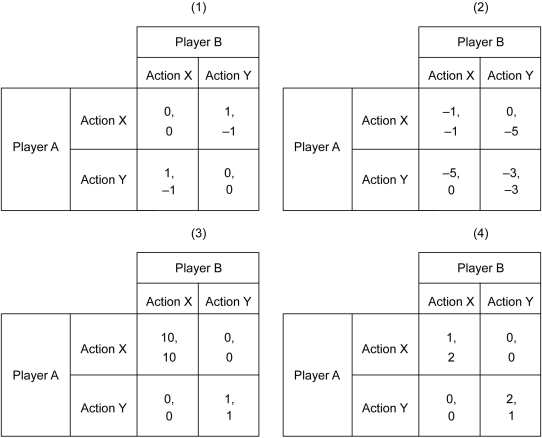 -Refer to the figure above.Which of these simultaneous-move games best represents the following scenario: the prisoner's dilemma,where X means confess and Y means hold out.
 (Multiple Choice)
4.9/5 (74)
(74) Scenario: Two rival firms are considering sponsoring an event. Each firm believes that sponsoring the event will increase its sales by a certain percentage. The payoff matrix showing the increase in sales for the firms is given below. The first number listed in each cell is the payoff to the row player, and the second number listed is the payoff to the column player.
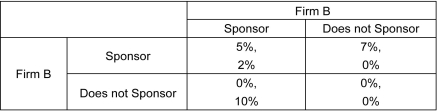 -Refer to the scenario above.What is likely to be the impact on Firm B's sales if Firm B decides to sponsor the event?
 (Multiple Choice)
4.8/5 (83)
(83) Scenario: Beth and Charles are playing a trust game. At the beginning of the game, Beth has to choose whether to trust Charles. If she trusts him, he can choose to either defect or cooperate. The diagram below shows their respective payoffs in different situations.
-Refer to the scenario above.This is an example of ________.
-Refer to the scenario above.This is an example of ________. (Multiple Choice)
4.8/5 (83)
(83) The following payoff matrix represents a simultaneous-move game between two players: John and Trevor. Each player has to choices: Black or White. The first number in each cell is the payoff to John, and the second number is the payoff to Trevor.
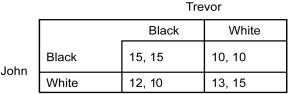 -Refer to the table above.Which statement is true?
 (Multiple Choice)
4.9/5 (96)
(96) Scenario: The following table represents the game matrix for the penalty kicks in a soccer game. There are two players in the game: the kicker and the goalie. The kicker has two choices: to kick the ball to the right or to the left. The goalie also has two choice to jump to the right, or to the left. Each goal counts to +1 point for the kicker and -1 points for the goalie. The symbols in the table stand for the numerical payoff to each player. The first symbol listed in each cell is the payoff to the kicker, and the second number listed is the payoff to the goalie.
 -Refer to the scenario above.In this game,choosing a ________ has a clear advantage for the kicker,and choosing a ________ has clear advantage for the goalie.
 (Multiple Choice)
4.8/5 (87)
(87) A strategy is called a pure strategy if it involves choosing ________.
(Multiple Choice)
4.9/5 (76)
(76) Scenario: Rita and Mike have been caught cheating on an examination. They are taken to separate rooms for interrogation. Their payoff matrix is given below. The first outcome listed in each cell is the payoff to the row player, and the second outcome listed is the payoff to the column player.
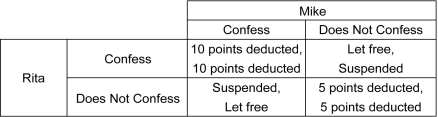 -Refer to the scenario above.Which of the following is likely to happen if Rita confesses and Mike does not confess?
 (Multiple Choice)
4.7/5 (93)
(93) Which of the following games is not a simultaneous-move game?
(Multiple Choice)
4.8/5 (83)
(83) Scenario: Alex puts $100 on the table. Bob chooses either to take $51 for himself and $49 for Clare or pass. If Bob passes, then Alex adds another $2 and Clare chooses either to take $52 for herself and $50 for Bob or pass. If Clare passes, then Alex adds another $2 and Bob chooses either to take $53 for himself and $51 for Clare or pass, and so on. In other words, a player chooses either to take $2 more for himself/herself or pass, and, every time a player passes, Alex adds another $2. The game ends if $200 is on the table or either Bob or Clare chooses not to pass before that. If the amount on the table reached $200, then Bob and Clare get $99.99 each (Alex takes two pennies back). The figure below shows the extensive form of this game. Bob's payoff is written first and Clare's second.
 -Refer to the scenario above.In the equilibrium,________.
 (Multiple Choice)
4.8/5 (80)
(80) The following figure depicts four sequential games. Player A is the first to move and Player B is the second to move.
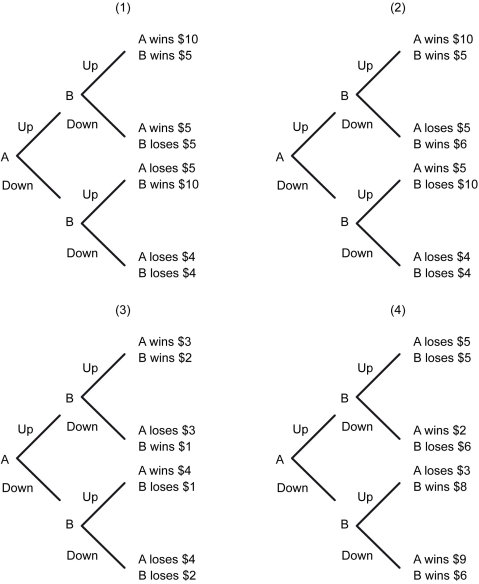 -Refer to the figure above.In which game do both players win money in equilibrium?
 (Multiple Choice)
5.0/5 (72)
(72) Scenario: Jack and Jill have gone cycling and have come to a place where the road is obstructed by a fallen tree. They can move the tree if both of them try. If neither of them tries, they have to turn back and reach home very late. However, if one of them tries while the other does not help, the one who tries will have a muscle sprain and will not be able to move the tree. The matrix below shows the utility each player derives in each situation. The first number listed in each cell is the payoff to the row player, and the second number listed is the payoff to the column player.
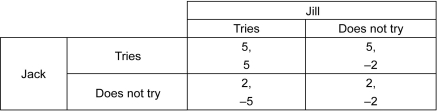 -Refer to the scenario above.Which of the following is true in this case?
 (Multiple Choice)
4.8/5 (88)
(88) Scenario: Jack and Jill have gone cycling and have come to a place where the road is obstructed by a fallen tree. They can move the tree if both of them try. If neither of them tries, they have to turn back and reach home very late. However, if one of them tries while the other does not help, the one who tries will have a muscle sprain and will not be able to move the tree. The matrix below shows the utility each player derives in each situation. The first number listed in each cell is the payoff to the row player, and the second number listed is the payoff to the column player.
-Refer to the scenario above.Jill will derive ________ units of utility if she tries to move the tree while Jack does not try at all.
-Refer to the scenario above.Jill will derive ________ units of utility if she tries to move the tree while Jack does not try at all. (Multiple Choice)
4.8/5 (90)
(90) 
Filters
- Essay(0)
- Multiple Choice(0)
- Short Answer(0)
- True False(0)
- Matching(0)