



 Chat with AI
Exam 13: Game Theory and Strategic Play

Exam 1: The Principles and Practice of Economics103 Questions
Exam 2: Economic Methods and Economic Questions94 Questions
Exam 3: Optimization: Doing the Best You Can94 Questions
Exam 4: Demand, supply, and Equilibrium185 Questions
Exam 5: Consumers and Incentives187 Questions
Exam 6: Sellers and Incentives261 Questions
Exam 7: Perfect Competition and the Invisible Hand251 Questions
Exam 8: Trade264 Questions
Exam 9: Externalities and Public Goods223 Questions
Exam 10: The Government in the Economy: Taxation and Regulation244 Questions
Exam 11: Markets for Factors of Production237 Questions
Exam 12: Monopoly295 Questions
Exam 13: Game Theory and Strategic Play199 Questions
Exam 14: Oligopoly and Monopolistic Competition264 Questions
Exam 15: Trade-Offs Involving Time and Risk147 Questions
Exam 16: The Economics of Information119 Questions
Exam 17: Auctions and Bargaining123 Questions
Exam 18: Social Economics111 Questions
Select questions type


Scenario: Beth and Charles are playing a trust game. At the beginning of the game, Beth has to choose whether to trust Charles. If she trusts him, he can choose to either defect or cooperate. The diagram below shows their respective payoffs in different situations.
 -Refer to the scenario above.If this game is repeated several times,and reputational considerations are taken into account,Beth will ________ Charles and Charles will ________ every time.
 (Multiple Choice)
4.9/5  (67)
(67) Scenario: Two rival firms have to choose between two strategies to maximize their benefits. The two alternative strategies available are Strategy X and Strategy Y. The matrix below shows the respective payoffs for each strategy chosen by the firms. The first number listed in each cell is the payoff to the row player, and the second number listed is the payoff to the column player.
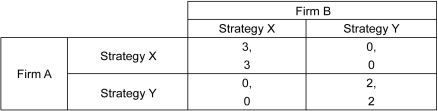 -Refer to the scenario above.This game ________.
 (Multiple Choice)
4.8/5 (82)
(82) Scenario: To win candy bars, Tom and Sam are playing a game in which they are blindfolded and are asked to raise either their right hand or their left hand when a bell rings. The matrix below shows their payoffs in different situations. Payoff here denotes the number of candy bars they get. The first number listed in each cell is the payoff to the row player, and the second number listed is the payoff to the column player.
 -Refer to the scenario above.Which of the following strategy combinations denotes a Nash equilibrium?
 (Multiple Choice)
4.9/5 (78)
(78) Scenario: Consider a trust game between an employer and a worker. The employer will either trust or not trust the worker. If the employer trusts the worker, she will hire him and then the worker would either work faithfully for the employer, or shirk in his work. The diagram below shows their respective payoffs in different situations.
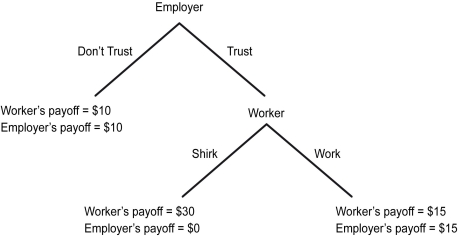 -Refer to the scenario above.The equilibrium of this game is ________.
 (Multiple Choice)
4.8/5 (69)
(69) The following figure depicts four simultaneous-move games. The first element of each payoff cell is the payoff to Player A. The other element is the payoff to Player B.
 -Refer to the figure above.In which one of these simultaneous-play games is the unique Nash equilibrium Player A choosing X and Player B choosing Y?
 (Multiple Choice)
4.7/5 (74)
(74) Scenario: Miguel and Stephanie are competitors who sell tacos out of their food trucks by the same beach. For each taco they sell, they get a profit of $1.00. Each morning they must decide at which of the three legally permitted locations, A, B, or C, they should park their trucks. The picture below shows the three locations.
 In each of the three locations, there are 100 customers per day, and each customer buys a taco from the nearest vendor. If the two trucks are in the same location, then each vendor gets half of the customers. So, for example, if Miguel's truck is in location A, and Stephanie's is also in location A, then half of customers from locations A, B, and C will buy from Miguel's and the other half will buy from Stephanie's, so that each gets a profit of $150. If Miguel's truck is in location A and Stephanie's is in location B, then everyone in location A will buy from Miguel and everyone from locations B and C will buy from Stephanie, so that Miguel's profit is $100 while Stephanie's is $200. If Miguel's truck is in location A and Stephanie's is in location C, then everyone in A plus a half from B will buy from Miguel, and everyone in C plus half from B will buy from Stephanie so that each vendor gets a profit of $150, and so on. The table below is the payoff matrix for this game. The first number in each cell is Miguel's profit, and the second number is Stephanie's profit.
 -Refer to the scenario above.If Miguel's truck is located at B,what is Stephanie's best response?
In each of the three locations, there are 100 customers per day, and each customer buys a taco from the nearest vendor. If the two trucks are in the same location, then each vendor gets half of the customers. So, for example, if Miguel's truck is in location A, and Stephanie's is also in location A, then half of customers from locations A, B, and C will buy from Miguel's and the other half will buy from Stephanie's, so that each gets a profit of $150. If Miguel's truck is in location A and Stephanie's is in location B, then everyone in location A will buy from Miguel and everyone from locations B and C will buy from Stephanie, so that Miguel's profit is $100 while Stephanie's is $200. If Miguel's truck is in location A and Stephanie's is in location C, then everyone in A plus a half from B will buy from Miguel, and everyone in C plus half from B will buy from Stephanie so that each vendor gets a profit of $150, and so on. The table below is the payoff matrix for this game. The first number in each cell is Miguel's profit, and the second number is Stephanie's profit.
-Refer to the scenario above.If Miguel's truck is located at B,what is Stephanie's best response? (Multiple Choice)
4.9/5 (84)
(84) Mr.Smith wants to go on a vacation with his wife.Mrs.Smith wants to go to a beach.He,however,wants to go trekking in the hills.The payoff matrix given below shows the units of satisfaction derived in each situation.The first number listed in each cell is the payoff to Mr.Smith,and the second number listed is the payoff to Mrs.Smith.
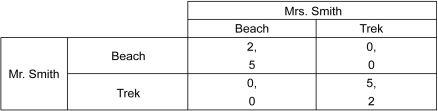 This game has ________.
 (Multiple Choice)
4.8/5 (76)
(76) Recall the trust game reported in the Evidence-Based Economics element in section 13.5.Consider the game where the trust game is played twice in succession.
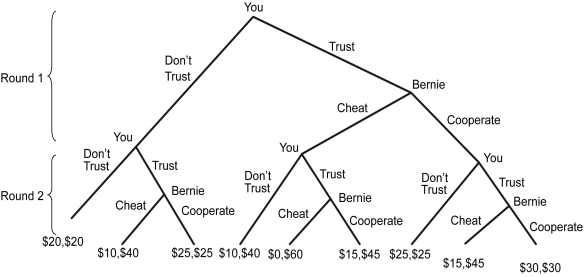 Payoffs are the sum of payoff in each round.For example,suppose you choose Trust and Bernie chooses Cheat in the first round,then you choose Don't Trust in the second round (Bernie could choose either,because it does not get to his turn anyway).Then you earn $0 and Bernie earns $30 in the first round,and you earn $10 and Bernie earns $10 in the second round,so that your total payoff is $10 and Bernie's is $40.
a)Apply backward induction to this game.How do you and Bernie behave in the two-round version?
b)What would be the backward induction solution if the trust game is repeated three times? Four times? Twenty thousand times? Does this agree with what you read in the Evidence-Based Economics element in section 13.5?
Payoffs are the sum of payoff in each round.For example,suppose you choose Trust and Bernie chooses Cheat in the first round,then you choose Don't Trust in the second round (Bernie could choose either,because it does not get to his turn anyway).Then you earn $0 and Bernie earns $30 in the first round,and you earn $10 and Bernie earns $10 in the second round,so that your total payoff is $10 and Bernie's is $40.
a)Apply backward induction to this game.How do you and Bernie behave in the two-round version?
b)What would be the backward induction solution if the trust game is repeated three times? Four times? Twenty thousand times? Does this agree with what you read in the Evidence-Based Economics element in section 13.5? (Essay)
4.9/5 (74)
(74) In a game,a Nash equilibrium is reached only if the players ________.
(Multiple Choice)
4.9/5 (69)
(69) Refer to Evidence-Based Economics element in section 13.4 of the text.
a)Describe a variation of beauty contest game used in the experiment.
b)Explain why every player submitting 0 is the Nash equilibrium.
c)Describe the results of the experiment.
(Essay)
4.9/5 (68)
(68) Scenario: Diana and Artemis can either jointly hunt stags (adult deer) or individually hunt rabbits. Hunting stags requires cooperation, but if the two cooperate, then they get a large amount of meat. If either hunts stags alone, the chance of success is zero. Hunting rabbits is easy for an individual and even easier for if the two cooperate, but rabbits would provide smaller amounts of meat than would stags. The payoff matrix below reflects this situation. Payoffs are days' worth of meat.
 -In the tragedy of the commons game illustrated in the text using manufacturing firms located along the Gowanus Canal,the outcome of both firms polluting is ________.
 (Multiple Choice)
4.9/5 (75)
(75) Scenario: Diana and Artemis can either jointly hunt stags (adult deer) or individually hunt rabbits. Hunting stags requires cooperation, but if the two cooperate, then they get a large amount of meat. If either hunts stags alone, the chance of success is zero. Hunting rabbits is easy for an individual and even easier for if the two cooperate, but rabbits would provide smaller amounts of meat than would stags. The payoff matrix below reflects this situation. Payoffs are days' worth of meat.
-Refer to the scenario above.What should be the value of b?
-Refer to the scenario above.What should be the value of b? (Multiple Choice)
4.8/5 (80)
(80) Scenario: Contiguous states often use tax policy to attract residents, firms, and economic activity. These "tax competitions" between states can be modeled with game theory. Suppose New Jersey currently has a state sales tax of 7 percent and Pennsylvania has a state sales tax of 6 percent. The game shown below models the effect of a reduction in each state's sales tax rate to 3 percent on each state's sales tax revenue. Assume the motivation of each state is to maximize tax revenue. The first number in a cell is the payoff to New Jersey; the second number is the payoff to Pennsylvania.
 (Source: John Greenwald, "A No-Win War Between the States," Time, April 8, 1996, 44-45.
-Refer to the scenario above.Is there a dominant strategy equilibrium?
(Source: John Greenwald, "A No-Win War Between the States," Time, April 8, 1996, 44-45.
-Refer to the scenario above.Is there a dominant strategy equilibrium? (Multiple Choice)
4.8/5 (85)
(85) Scenario: Rita and Mike have been caught cheating on an examination. They are taken to separate rooms for interrogation. Their payoff matrix is given below. The first outcome listed in each cell is the payoff to the row player, and the second outcome listed is the payoff to the column player.
 -Refer to the scenario above.Which of the following is likely to happen if Rita does not confess?
 (Multiple Choice)
4.9/5 (84)
(84) Scenario: Two firms in a market sell identical goods and charge a price of $5 per unit. However, the cost of a crucial input used in producing these goods has increased. As a result, both firms are considering increasing the price of the good to $6. If the firms do not raise their prices at the same time, the firm that raises the price stands to lose market share. The payoff matrix shows the respective payoffs on the basis of the prices charged by each firm. Here, payoffs denote the number of units sold by each firm. The first number listed in each cell is the payoff to the row player, and the second number listed is the payoff to the column player.
 -Refer to the scenario above.This is an example of a(n)________.
 (Multiple Choice)
4.7/5 (80)
(80) Suppose you and your roommate are trying to decide how to divide up the remaining slice of pizza left over from the night before.You assert that because you went down to the dorm lobby and picked up the pizza,you get to "cut and choose." This is an example of ________.
(Multiple Choice)
4.9/5 (75)
(75) Scenario: Contiguous states often use tax policy to attract residents, firms, and economic activity. These "tax competitions" between states can be modeled with game theory. Suppose New Jersey currently has a state sales tax of 7 percent and Pennsylvania has a state sales tax of 6 percent. The game shown below models the effect of a reduction in each state's sales tax rate to 3 percent on each state's sales tax revenue. Assume the motivation of each state is to maximize tax revenue. The first number in a cell is the payoff to New Jersey; the second number is the payoff to Pennsylvania.
(Source: John Greenwald, "A No-Win War Between the States," Time, April 8, 1996, 44-45.
-Refer to the scenario above.Does Pennsylvania have a dominant strategy?
(Source: John Greenwald, "A No-Win War Between the States," Time, April 8, 1996, 44-45.
-Refer to the scenario above.Does Pennsylvania have a dominant strategy? (Multiple Choice)
4.9/5 (83)
(83) Scenario: Miguel and Stephanie are competitors who sell tacos out of their food trucks by the same beach. For each taco they sell, they get a profit of $1.00. Each morning they must decide at which of the three legally permitted locations, A, B, or C, they should park their trucks. The picture below shows the three locations.
 In each of the three locations, there are 100 customers per day, and each customer buys a taco from the nearest vendor. If the two trucks are in the same location, then each vendor gets half of the customers. So, for example, if Miguel's truck is in location A, and Stephanie's is also in location A, then half of customers from locations A, B, and C will buy from Miguel's and the other half will buy from Stephanie's, so that each gets a profit of $150. If Miguel's truck is in location A and Stephanie's is in location B, then everyone in location A will buy from Miguel and everyone from locations B and C will buy from Stephanie, so that Miguel's profit is $100 while Stephanie's is $200. If Miguel's truck is in location A and Stephanie's is in location C, then everyone in A plus a half from B will buy from Miguel, and everyone in C plus half from B will buy from Stephanie so that each vendor gets a profit of $150, and so on. The table below is the payoff matrix for this game. The first number in each cell is Miguel's profit, and the second number is Stephanie's profit.
 -Refer to the scenario above.Is Miguel choosing A and Stephanie choosing C a Nash equilibrium? Why?
In each of the three locations, there are 100 customers per day, and each customer buys a taco from the nearest vendor. If the two trucks are in the same location, then each vendor gets half of the customers. So, for example, if Miguel's truck is in location A, and Stephanie's is also in location A, then half of customers from locations A, B, and C will buy from Miguel's and the other half will buy from Stephanie's, so that each gets a profit of $150. If Miguel's truck is in location A and Stephanie's is in location B, then everyone in location A will buy from Miguel and everyone from locations B and C will buy from Stephanie, so that Miguel's profit is $100 while Stephanie's is $200. If Miguel's truck is in location A and Stephanie's is in location C, then everyone in A plus a half from B will buy from Miguel, and everyone in C plus half from B will buy from Stephanie so that each vendor gets a profit of $150, and so on. The table below is the payoff matrix for this game. The first number in each cell is Miguel's profit, and the second number is Stephanie's profit.
-Refer to the scenario above.Is Miguel choosing A and Stephanie choosing C a Nash equilibrium? Why? (Multiple Choice)
4.8/5 (73)
(73) Scenario: Jack and Jill have gone cycling and have come to a place where the road is obstructed by a fallen tree. They can move the tree if both of them try. If neither of them tries, they have to turn back and reach home very late. However, if one of them tries while the other does not help, the one who tries will have a muscle sprain and will not be able to move the tree. The matrix below shows the utility each player derives in each situation. The first number listed in each cell is the payoff to the row player, and the second number listed is the payoff to the column player.
 -Refer to the scenario above.Jack will derive ________ units of utility if Jill tries to move the tree while he does not try at all.
 (Multiple Choice)
4.8/5 (72)
(72) 
Filters
- Essay(0)
- Multiple Choice(0)
- Short Answer(0)
- True False(0)
- Matching(0)