



 Chat with AI
Exam 13: Game Theory and Strategic Play

Exam 1: The Principles and Practice of Economics103 Questions
Exam 2: Economic Methods and Economic Questions94 Questions
Exam 3: Optimization: Doing the Best You Can94 Questions
Exam 4: Demand, supply, and Equilibrium185 Questions
Exam 5: Consumers and Incentives187 Questions
Exam 6: Sellers and Incentives261 Questions
Exam 7: Perfect Competition and the Invisible Hand251 Questions
Exam 8: Trade264 Questions
Exam 9: Externalities and Public Goods223 Questions
Exam 10: The Government in the Economy: Taxation and Regulation244 Questions
Exam 11: Markets for Factors of Production237 Questions
Exam 12: Monopoly295 Questions
Exam 13: Game Theory and Strategic Play199 Questions
Exam 14: Oligopoly and Monopolistic Competition264 Questions
Exam 15: Trade-Offs Involving Time and Risk147 Questions
Exam 16: The Economics of Information119 Questions
Exam 17: Auctions and Bargaining123 Questions
Exam 18: Social Economics111 Questions
Select questions type


Scenario: To win candy bars, Tom and Sam are playing a game in which they are blindfolded and are asked to raise either their right hand or their left hand when a bell rings. The matrix below shows their payoffs in different situations. Payoff here denotes the number of candy bars they get. The first number listed in each cell is the payoff to the row player, and the second number listed is the payoff to the column player.
 -Refer to the scenario above.Tom will receive ________ if he raises his right hand and Sam raises his left hand.
 (Multiple Choice)
4.8/5  (81)
(81) Scenario: Alex puts $100 on the table. Bob chooses either to take $51 for himself and $49 for Clare or pass. If Bob passes, then Alex adds another $2 and Clare chooses either to take $52 for herself and $50 for Bob or pass. If Clare passes, then Alex adds another $2 and Bob chooses either to take $53 for himself and $51 for Clare or pass, and so on. In other words, a player chooses either to take $2 more for himself/herself or pass, and, every time a player passes, Alex adds another $2. The game ends if $200 is on the table or either Bob or Clare chooses not to pass before that. If the amount on the table reached $200, then Bob and Clare get $99.99 each (Alex takes two pennies back). The figure below shows the extensive form of this game. Bob's payoff is written first and Clare's second.
 -Refer to the scenario above.If the game reached Bob's turn with $196 on the table,he should ________.
 (Multiple Choice)
4.9/5 (81)
(81) Scenario: To win candy bars, Tom and Sam are playing a game in which they are blindfolded and are asked to raise either their right hand or their left hand when a bell rings. The matrix below shows their payoffs in different situations. Payoff here denotes the number of candy bars they get. The first number listed in each cell is the payoff to the row player, and the second number listed is the payoff to the column player.
-Refer to the scenario above.Which of the following is true?
-Refer to the scenario above.Which of the following is true? (Multiple Choice)
4.9/5 (74)
(74) Scenario: The ultimatum game is a two-player game played as follows. One player, the proposer, is told to divide a sum of money between the two players. The proposer proposes how to divide the sum. The other player, the responder, then chooses to either accept or reject the proposal. If the responder accepts the proposal, the money is split according to the proposal. If the responder rejects the proposal, neither receives any money. When this game is played by real people from a common social group, it is frequently observed that the proposer offers close to 50-50 split and the responder rejects offers below 30 percent of the sum.
-Refer to the scenario above.According to the theory you learned in the textbook,if the proposer offered 50 percent,should the responder accept?
(Multiple Choice)
4.9/5 (83)
(83) Scenario: Company A and Company B are considering spending a certain sum of money to advertise their new range of products. If Company A chooses to advertise while Company B does not, Company A's annual sales will increase by $5 million, while Company B's sales will remain unchanged. If Company B chooses to advertise while Company A does not, Company B's annual sales will increase by $5 million, while Company A will not experience any change in its sales. If both the companies decide to advertise, their sales will increase sales by $2 million each, and if neither of them spends on advertisement, their sales will remain unchanged.
-Refer to the scenario above.If the cost of advertising is negligible,what will be the outcome of this game?
(Multiple Choice)
4.9/5 (70)
(70) Scenario: The payoff matrix given below shows the payoffs to two rival firms in millions of U.S. dollars for each strategy they choose. The first number listed in each cell is the payoff to the row player, and the second number listed is the payoff to the column player.
 -Refer to the scenario above.In this game,the dominant strategy equilibrium occurs if ________.
 (Multiple Choice)
4.7/5 (70)
(70) Scenario: The following payoff matrix represents a simultaneous-move game between two players: Kay and Jack. Each player has two choices: Black or White. The first number in each cell is the payoff to Kay, and the second number is the payoff to Jack.
 -Refer to the scenario above.If Kay and Jay both choose White,________.
 (Multiple Choice)
4.9/5 (82)
(82) Scenario: Jack and Jill have gone cycling and have come to a place where the road is obstructed by a fallen tree. They can move the tree if both of them try. If neither of them tries, they have to turn back and reach home very late. However, if one of them tries while the other does not help, the one who tries will have a muscle sprain and will not be able to move the tree. The matrix below shows the utility each player derives in each situation. The first number listed in each cell is the payoff to the row player, and the second number listed is the payoff to the column player.
 -Refer to the scenario above.This is an example of a(n)________.
 (Multiple Choice)
4.8/5 (90)
(90) Scenario: Two friends are playing a game. The rules of the game are simple. Each player is given a bag containing a white ball and a black ball, and the two friends are asked to simultaneously draw one ball each. They are informed about their payoffs just before the game begins, which are shown in the matrix below. The first number listed in each cell is the payoff to the row player, and the second number listed is the payoff to the column player.
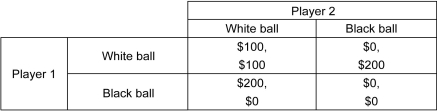 -Refer to the scenario above.Which of the following is true?
 (Multiple Choice)
4.8/5 (83)
(83) Scenario: Two friends are playing a game. The rules of the game are simple. Each player is given a bag containing a white ball and a black ball, and the two friends are asked to simultaneously draw one ball each. They are informed about their payoffs just before the game begins, which are shown in the matrix below. The first number listed in each cell is the payoff to the row player, and the second number listed is the payoff to the column player.
-Refer to the scenario above.Which of the following is true in this case?
-Refer to the scenario above.Which of the following is true in this case? (Multiple Choice)
4.7/5 (87)
(87) A Nash equilibrium occurs if each player chooses ________.
(Multiple Choice)
4.8/5 (76)
(76) Scenario: Diana and Artemis can either jointly hunt stags (adult deer) or individually hunt rabbits. Hunting stags requires cooperation, but if the two cooperate, then they get a large amount of meat. If either hunts stags alone, the chance of success is zero. Hunting rabbits is easy for an individual and even easier for if the two cooperate, but rabbits would provide smaller amounts of meat than would stags. The payoff matrix below reflects this situation. Payoffs are days' worth of meat.
 -Refer to the scenario above.Which of the following best reflects the rewards from the hunters' choices?
 (Multiple Choice)
4.8/5 (62)
(62) Scenario: The matrix below shows the payoffs to two firms when they choose between two different strategies. The first number listed in each cell is the payoff to the row player, and the second number listed is the payoff to the column player.
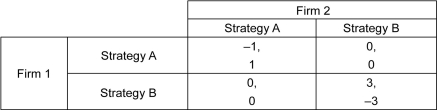 -Refer to the scenario above.What is the sum of the payoffs to the firms if both firms use strategy A?
 (Multiple Choice)
4.8/5 (90)
(90) Economist Harold Hotelling modeled a location game between two hot dog vendors on a linear beach that contained a fixed number of customers.Customers patronized the hot dog vendor closest to their position on the beach.From any initial starting point,a hot dog vendor could move closer to the center of the beach and steal some customers away from his rival.This is an example of ________.
(Multiple Choice)
4.9/5 (78)
(78) The optimal strategy of a goalie in penalty kicking is similar to that in ________.
(Multiple Choice)
4.9/5 (72)
(72) Scenario: Rita and Mike have been caught cheating on an examination. They are taken to separate rooms for interrogation. Their payoff matrix is given below. The first outcome listed in each cell is the payoff to the row player, and the second outcome listed is the payoff to the column player.
 -Refer to the scenario above.What will likely be the outcome of this game?
 (Multiple Choice)
4.7/5 (85)
(85) A strategy is called a mixed strategy if it involves choosing ________.
(Multiple Choice)
4.8/5 (75)
(75) 
Filters
- Essay(0)
- Multiple Choice(0)
- Short Answer(0)
- True False(0)
- Matching(0)