



 Chat with AI
Exam 13: Game Theory and Strategic Play

Exam 1: The Principles and Practice of Economics103 Questions
Exam 2: Economic Methods and Economic Questions94 Questions
Exam 3: Optimization: Doing the Best You Can94 Questions
Exam 4: Demand, supply, and Equilibrium185 Questions
Exam 5: Consumers and Incentives187 Questions
Exam 6: Sellers and Incentives261 Questions
Exam 7: Perfect Competition and the Invisible Hand251 Questions
Exam 8: Trade264 Questions
Exam 9: Externalities and Public Goods223 Questions
Exam 10: The Government in the Economy: Taxation and Regulation244 Questions
Exam 11: Markets for Factors of Production237 Questions
Exam 12: Monopoly295 Questions
Exam 13: Game Theory and Strategic Play199 Questions
Exam 14: Oligopoly and Monopolistic Competition264 Questions
Exam 15: Trade-Offs Involving Time and Risk147 Questions
Exam 16: The Economics of Information119 Questions
Exam 17: Auctions and Bargaining123 Questions
Exam 18: Social Economics111 Questions
Select questions type


Scenario: Consider the following non-cooperative, simultaneous-move game where each player knows her own and her opponent's payoffs. This game is called the dating dilemma. Hayley and Jack are a couple deciding what to do on a Saturday afternoon in the summer. Hayley wants to go to the Museum of Modern Art (MoMA), while Jack wants to go to a New York Mets game. Neither Jack nor Hayley will derive any benefit from going to their preferred activity without their partner. The payoff matrix for this game is presented below.
 -Refer to the scenario above.Suppose Hayley and Jack face this quandary repeatedly.What might each individual do when faced with repeated play of this game?
 (Multiple Choice)
4.9/5  (76)
(76) Suppose you and your roommate are trying to decide how to divide up the remaining slice of pizza left over from the night before.Your roommate has the following proposal.You get to divide the remaining slice of pizza,but he gets to choose which of the two pieces of pizza to consume.As a result,you decide to cut the remaining slice of pizza into equal portions.This is an example of ________.
(Multiple Choice)
4.9/5 (84)
(84) Scenario: Two rival firms are considering sponsoring an event. Each firm believes that sponsoring the event will increase its sales by a certain percentage. The payoff matrix showing the increase in sales for the firms is given below. The first number listed in each cell is the payoff to the row player, and the second number listed is the payoff to the column player.
 -Refer to the scenario above.What is likely to be the impact on Firm A's sales if Firm A decides to sponsor the event?
 (Multiple Choice)
4.8/5 (84)
(84) The following figure depicts four sequential games. Player A is the first to move and Player B is the second to move.
 -Refer to the figure above.In which game(s)would Player B strictly prefer moving first instead of moving second?
 (Multiple Choice)
4.9/5 (82)
(82) Scenario: The following table represents the game matrix for the penalty kicks in a soccer game. There are two players in the game: the kicker and the goalie. The kicker has two choices: to kick the ball to the right or to the left. The goalie also has two choice to jump to the right, or to the left. Each goal counts to +1 point for the kicker and -1 points for the goalie. The symbols in the table stand for the numerical payoff to each player. The first symbol listed in each cell is the payoff to the kicker, and the second number listed is the payoff to the goalie.
 -Refer to the scenario above.The symbol k is equal to ________,and the symbol j is equal to ________.
 (Multiple Choice)
5.0/5 (80)
(80) The following figure depicts four simultaneous-move games. The first element of each payoff cell is the payoff to Player A, and the second element is the payoff to Player B.
 -Refer to the figure above.In which of these simultaneous-move games does only player B have a dominant strategy?
 (Multiple Choice)
4.7/5 (83)
(83) Aqua Inc.and Flora Inc.are two rival firms in the market for baby care products.Both firms are considering opening a new outlet for their products.They have two alternative location choices,one in College Town (CT)and the other on Whale Street (WS).The marketing team at Flora has decided to choose the location for its outlet after Aqua chooses the location for its outlet.The game tree given below shows the payoff to each firm for its decisions.
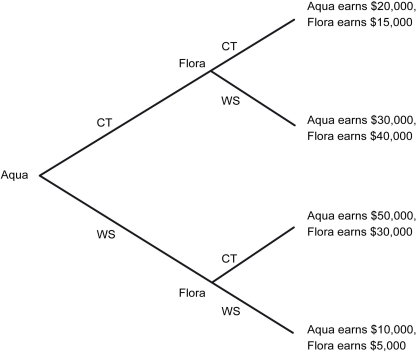 Using the process of backward induction,find out where Aqua should open its outlet.
 (Essay)
4.8/5 (70)
(70) ________ describes an individual's optimal actions in settings where interactions with others determine her well-being.
(Multiple Choice)
4.7/5 (95)
(95) A ________ is a complete plan describing how a player will act.
(Multiple Choice)
4.9/5 (88)
(88) Scenario: The following table represents the game matrix for the penalty kicks in a soccer game. There are two players in the game: the kicker and the goalie. The kicker has two choices: to kick the ball to the right or to the left. The goalie also has two choice to jump to the right, or to the left. Each goal counts to +1 point for the kicker and -1 points for the goalie. The symbols in the table stand for the numerical payoff to each player. The first symbol listed in each cell is the payoff to the kicker, and the second number listed is the payoff to the goalie.
-Refer to the scenario above.The symbol x is equal to ________,and the symbol y is equal to ________.
-Refer to the scenario above.The symbol x is equal to ________,and the symbol y is equal to ________. (Multiple Choice)
4.8/5 (69)
(69) Fast Run and Go! are two rival brands of sports apparels.The payoff matrix below shows their revenue in millions of U.S.dollars if they lower the price of their products.The first number listed in each cell is the payoff to the row player,and the second number listed is the payoff to the column player.
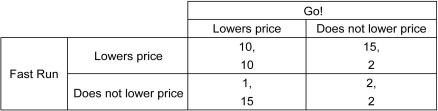 Find the Nash equilibrium for this game.
 (Essay)
4.9/5 (78)
(78) The following figure depicts four sequential games. Player A is the first to move and Player B is the second to move.
-Refer to the figure above.In which game do both players lose money in equilibrium?
-Refer to the figure above.In which game do both players lose money in equilibrium? (Multiple Choice)
4.9/5 (75)
(75) Scenario: A common game played in many MBA-level classes on microeconomic theory and strategy is the dollar auction game. In this game, the professor takes on the role of auctioneer, offering to auction off a dollar bill to the highest bidder. This is an open-outcry auction, so students just shout out their bids. The one catch to the game is that the winning bidder pays her bid (the highest bid received), but the second-highest bidder must also pay the auctioneer the amount of her highest bid.
-Refer to the scenario above.In the dollar auction,what is your equilibrium bidding strategy?
(Multiple Choice)
4.9/5 (74)
(74) Scenario: Two firms in a market sell identical goods and charge a price of $5 per unit. However, the cost of a crucial input used in producing these goods has increased. As a result, both firms are considering increasing the price of the good to $6. If the firms do not raise their prices at the same time, the firm that raises the price stands to lose market share. The payoff matrix shows the respective payoffs on the basis of the prices charged by each firm. Here, payoffs denote the number of units sold by each firm. The first number listed in each cell is the payoff to the row player, and the second number listed is the payoff to the column player.
 -Refer to the scenario above.Which of the following is true?
 (Multiple Choice)
4.8/5 (87)
(87) Scenario: To win candy bars, Tom and Sam are playing a game in which they are blindfolded and are asked to raise either their right hand or their left hand when a bell rings. The matrix below shows their payoffs in different situations. Payoff here denotes the number of candy bars they get. The first number listed in each cell is the payoff to the row player, and the second number listed is the payoff to the column player.
 -Refer to the scenario above.Tom will receive ________ if he raises his left hand and Sam raises his right hand.
 (Multiple Choice)
4.9/5 (92)
(92) Scenario: Alex puts $100 on the table. Bob chooses either to take $51 for himself and $49 for Clare or pass. If Bob passes, then Alex adds another $2 and Clare chooses either to take $52 for herself and $50 for Bob or pass. If Clare passes, then Alex adds another $2 and Bob chooses either to take $53 for himself and $51 for Clare or pass, and so on. In other words, a player chooses either to take $2 more for himself/herself or pass, and, every time a player passes, Alex adds another $2. The game ends if $200 is on the table or either Bob or Clare chooses not to pass before that. If the amount on the table reached $200, then Bob and Clare get $99.99 each (Alex takes two pennies back). The figure below shows the extensive form of this game. Bob's payoff is written first and Clare's second.
 -Refer to the scenario above.If the game reached Clare's turn with $198 on the table,she should ________.
 (Multiple Choice)
5.0/5 (101)
(101) The following payoff matrix represents a simultaneous-move game between two players: Alec and Ben. Each player has to choices: Red and Yellow. The first number in each cell is the payoff to Alec, and the second number is the payoff to Ben.
 -Refer to the table above.Which statement is true?
 (Multiple Choice)
4.7/5 (80)
(80) The following figure depicts four simultaneous-move games. The first element of each payoff cell is the payoff to Player A. The other element is the payoff to Player B.
 -Refer to the figure above.In which one of these simultaneous-play games is there no Nash equilibrium?
 (Multiple Choice)
4.9/5 (81)
(81) Scenario: The following table represents the game matrix for the penalty kicks in a soccer game. There are two players in the game: the kicker and the goalie. The kicker has two choices: to kick the ball to the right or to the left. The goalie also has two choice to jump to the right, or to the left. Each goal counts to +1 point for the kicker and -1 points for the goalie. The symbols in the table stand for the numerical payoff to each player. The first symbol listed in each cell is the payoff to the kicker, and the second number listed is the payoff to the goalie.
-Refer to the scenario above.The symbol p is equal to ________,and the symbol w is equal to ________.
-Refer to the scenario above.The symbol p is equal to ________,and the symbol w is equal to ________. (Multiple Choice)
5.0/5 (82)
(82) 
Filters
- Essay(0)
- Multiple Choice(0)
- Short Answer(0)
- True False(0)
- Matching(0)