



 Chat with AI
Exam 8: Vertebral Column

Exam 1: Preliminary Steps in Radiography33 Questions
Exam 2: Compensating Filters14 Questions
Exam 3: General Anatomy and Radiographic Positioning Terminology101 Questions
Exam 4: Upper Limb125 Questions
Exam 5: Shoulder Girdle92 Questions
Exam 6: Lower Limb143 Questions
Exam 7: Pelvis and Upper Femora53 Questions
Exam 8: Vertebral Column175 Questions
Exam 9: Bony Thorax58 Questions
Exam 10: Thoracic Viscera74 Questions
Exam 11: Long Bone Measurement10 Questions
Exam 12: Contrast Arthrography5 Questions
Exam 13: Trauma Radiography10 Questions
Exam 14: Mouth and Salivary Glands10 Questions
Exam 15: Anterior Part of Neck9 Questions
Exam 16: Abdomen30 Questions
Exam 17: Digestive System: Alimentary Canal130 Questions
Exam 18: Urinary System and Venipuncture96 Questions
Exam 19: Reproductive System11 Questions
Exam 20: Skull, Facial Bones, and Paranasal Sinuses196 Questions
Exam 21: Mammography35 Questions
Exam 22: Central Nervous System15 Questions
Exam 23: Vascular, Cardiac, and Interventional Radiography40 Questions
Exam 24: Pediatric Imaging20 Questions
Exam 25: Geriatric Radiography18 Questions
Exam 26: Mobile Radiography20 Questions
Exam 27: Surgical Radiography10 Questions
Exam 28: Sectional Anatomy for Radiographers30 Questions
Exam 29: Computed Tomography16 Questions
Exam 30: Magnetic Resonance Imaging21 Questions
Exam 31: Diagnostic Ultrasound14 Questions
Exam 32: Nuclear Medicine18 Questions
Exam 33: Bone Densitometry18 Questions
Exam 34: Radiation Oncology20 Questions
Select questions type


When the shoulder is immobile and cannot be depressed sufficiently for the cervicothoracic region lateral projection (swimmer's technique), the central ray is angled:
(Multiple Choice)
4.8/5  (88)
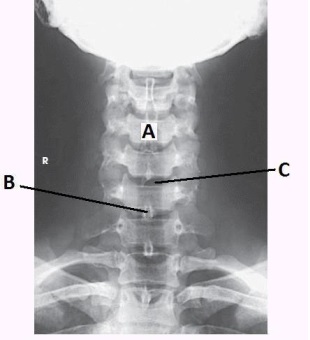
(88) 
The swimmer's technique demonstrates the cervicothoracic region in which projection?
(Multiple Choice)
4.9/5 (64)
(64) What anatomy is labeled with the letter E in the image below?
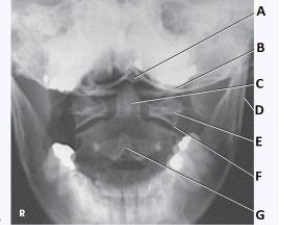
(Multiple Choice)
4.9/5 (80)
(80) Which of the following should be performed to reduce the lordotic curvature of the lumbar spine for the AP projection?
1)Flex the hips.
2)Flex the knees.
3)Flex the elbows.
(Multiple Choice)
4.8/5 (83)
(83) Where is the central ray directed for a lateral thoracic spine?
(Multiple Choice)
4.9/5 (75)
(75) To demonstrate the zygapophyseal joints of the lumbar spine, MSP of the patient is rotated _____ degrees.
(Multiple Choice)
4.8/5 (80)
(80) The angle of the articulation between the sacrum and the ilia (the sacroiliac joints) is _____ degrees.
(Multiple Choice)
4.8/5 (97)
(97) Which of the following describes the central-ray centering point for the L5-S1 lateral projection?
(Multiple Choice)
4.9/5 (75)
(75) Where is the central ray directed for a lateral cervical spine?
(Multiple Choice)
4.9/5 (82)
(82) Where is the IR centered for a hyperflexion or hyperextension lateral projection of the cervical spine?
(Multiple Choice)
4.9/5 (86)
(86) Where should the center of the IR be positioned for the "open mouth" AP projection of the atlas and axis?
(Multiple Choice)
4.9/5 (88)
(88) Occasionally, a patient may have to be placed in the prone position for a sacrum radiography, and a PA projection performed. What is the central-ray angle for this projection?
(Multiple Choice)
5.0/5 (65)
(65) One fourth of the length of the vertebral column is made up of the:
(Multiple Choice)
4.8/5 (77)
(77) How are small weights applied to the arms for the lateral projection of the cervical spine (Grandy method)?
(Multiple Choice)
4.8/5 (83)
(83) Which projections will demonstrate the right sacroiliac joint?
1)AP oblique, LPO position
2)AP oblique, RPO position
3)PA oblique, RAO position
(Multiple Choice)
4.9/5 (75)
(75) All of the joints of the vertebral column are synovial-freely movable-except one. Which joint is not?
(Multiple Choice)
4.7/5 (83)
(83) 
Filters
- Essay(0)
- Multiple Choice(0)
- Short Answer(0)
- True False(0)
- Matching(0)