



 Chat with AI
Exam 12: Child and Preadolescent Nutrition

Exam 1: Nutrition Basics70 Questions
Exam 2: Preconception Nutrition57 Questions
Exam 3: Preconception Nutrition: Conditions and Interventions42 Questions
Exam 4: Nutrition During Pregnancy62 Questions
Exam 5: Nutrition During Pregnancy: Conditions and Interventions60 Questions
Exam 6: Nutrition During Lactation53 Questions
Exam 7: Nutrition During Lactation: Conditions and Interventions60 Questions
Exam 8: Infant Nutrition57 Questions
Exam 9: Infant Nutrition: Conditions and Interventions59 Questions
Exam 10: Toddler and Preschooler Nutrition57 Questions
Exam 11: Toddler and Preschooler Nutrition: Conditions and Interventions54 Questions
Exam 12: Child and Preadolescent Nutrition56 Questions
Exam 13: Child and Preadolescent Nutrition: Conditions and Interventions53 Questions
Exam 14: Adolescent Nutrition56 Questions
Exam 15: Adolescent Nutrition: Conditions and Interventions54 Questions
Exam 16: Adult Nutrition56 Questions
Exam 17: Adult Nutrition: Conditions and Interventions57 Questions
Exam 18: Nutrition and Older Adults63 Questions
Exam 19: Nutrition and Older Adults: Conditions and Interventions59 Questions
Select questions type


Health consequences of obesity occur with increased frequency in obese children,and include all of the following EXCEPT:
(Multiple Choice)
4.9/5  (73)
(73) Using the following information,answer questions.
Jane is an 8-year-old girl that weighs 56.5 pounds (25.6 kg),is 51 inches tall,and enjoys lots of outdoor activities.Her total caloric intake is 1800 Calories per day consisting of 80 grams of fat,225 grams of carbohydrate,and 45 grams of protein.She likes vegetables and eats lots of fruit;the only food she truly dislikes is milk.
-How many grams of protein per day are recommended for Jane?
(Multiple Choice)
4.8/5 (84)
(84) According to NHANES III data,children aged _____ have the highest rates of daily television viewing.
(Multiple Choice)
4.8/5 (68)
(68) A measure of diet quality is provided by the Healthy Eating Index (HEI).According to the most recent data,the average HEI score for children ages 7 to 10 was 66.0 out of 100,indicating:
(Multiple Choice)
4.9/5 (74)
(74) Use the BMI-for-age chart as a reference for questions.
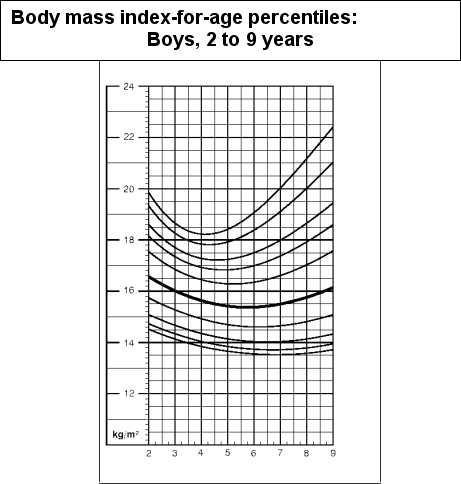 SOURCE: Entire chart developed by the National Center for Health Statistics in collaboration with the National Center for Chronic Disease Prevention and Health Promotion (2000).Only the age range from 2 to 9 years was excerpted for exam.
-The BMI for a boy who is 9 years old,weighs 90 lb (40.9 kg),and is 53 in (134 cm)tall is:
SOURCE: Entire chart developed by the National Center for Health Statistics in collaboration with the National Center for Chronic Disease Prevention and Health Promotion (2000).Only the age range from 2 to 9 years was excerpted for exam.
-The BMI for a boy who is 9 years old,weighs 90 lb (40.9 kg),and is 53 in (134 cm)tall is: (Multiple Choice)
4.7/5 (84)
(84) What are the proposed mechanisms by which television viewing contributes to obesity?
(Multiple Choice)
4.8/5 (78)
(78) Studies show that children of parents who impose authoritarian methods of control on their eating are:
(Multiple Choice)
4.8/5 (69)
(69) Parents are encouraged to do all of the following in order to increase physical activity in their children,EXCEPT:
(Multiple Choice)
5.0/5 (75)
(75) What is the recommended adequate intake of total fiber for children between the ages of 4 and 8?
(Multiple Choice)
4.9/5 (74)
(74) Older children are not as responsive to internal controls regarding energy density as younger children.
(True/False)
4.8/5 (81)
(81) 
If weight loss was needed,what would you recommend for him?
(Multiple Choice)
4.8/5 (84)
(84) Use the BMI-for-age chart as a reference for questions.
SOURCE: Entire chart developed by the National Center for Health Statistics in collaboration with the National Center for Chronic Disease Prevention and Health Promotion (2000).Only the age range from 2 to 9 years was excerpted for exam.
-Plot the BMI you calculated from the previous question on the CDC growth chart above.What is the classification for this child's weight status?
SOURCE: Entire chart developed by the National Center for Health Statistics in collaboration with the National Center for Chronic Disease Prevention and Health Promotion (2000).Only the age range from 2 to 9 years was excerpted for exam.
-Plot the BMI you calculated from the previous question on the CDC growth chart above.What is the classification for this child's weight status? (Multiple Choice)
4.8/5 (72)
(72) Potential consequences of a weight-loss program in childhood are slowed linear growth and the beginnings of an eating disorder.
(True/False)
4.8/5 (83)
(83) Which of the following foods would be the best choice for a parent trying to increase fiber in her/his child's diet?
(Multiple Choice)
4.9/5 (82)
(82) In order to participate in the National School Lunch Program (NSLP),schools must meet five major requirements.Which of the following would NOT be one of those requirements?
(Multiple Choice)
4.9/5 (86)
(86) 
Filters
- Essay(0)
- Multiple Choice(0)
- Short Answer(0)
- True False(0)
- Matching(0)