



 Chat with AI
Exam 14: Competition

Exam 1: The Web of Life68 Questions
Exam 2: The Physical Environment76 Questions
Exam 3: The Biosphere73 Questions
Exam 4: Coping With Environmental Variation:74 Questions
Exam 5: Coping With Environmental Variation: Energy71 Questions
Exam 6: Evolution and Ecology68 Questions
Exam 7: Life History69 Questions
Exam 8: Behavioral Ecology71 Questions
Exam 9: Population Distribution and Abundance80 Questions
Exam 10: Population Dynamics68 Questions
Exam 11: Population Growth and Regulation69 Questions
Exam 12: Predation70 Questions
Exam 13: Parasitism72 Questions
Exam 14: Competition74 Questions
Exam 15: Mutualism and Commensalism71 Questions
Exam 16: The Nature of Communities71 Questions
Exam 17: Change in Communities73 Questions
Exam 18: Biogeography70 Questions
Exam 19: Species Diversity in Communities72 Questions
Exam 20: Production73 Questions
Exam 21: Energy Flow and Food Webs76 Questions
Exam 22: Nutrient Supply and Cycling76 Questions
Exam 23: Conservation Biology73 Questions
Exam 24: Landscape Ecology and Ecosystem Management71 Questions
Exam 25: Global Ecology74 Questions
Select questions type


Which of the following would most likely contribute to the long-term persistence of a fugitive species?
(Multiple Choice)
4.9/5  (78)
(78) Refer to the figure.
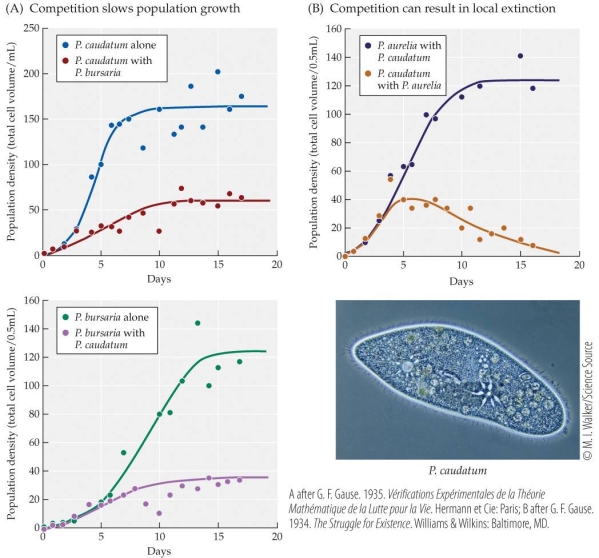 Which species (either with or without a competitor) had a population density at carrying capacity of approximately 38?
 (Multiple Choice)
4.8/5 (93)
(93) Use inequalities generated by the Lotka-Volterra competition model to determine whether two species of Paramecium (P. caudatum is "species 1" and P. aurelia is "species 2") will coexist or drive each other to extinction in the three scenarios below. In these examples, N1 = N2, and K1 = K2 = 50.
Scenario 1: Determine the outcome of the competitive interaction between P. caudatum and P. aurelia if = 0.3, and = 0.6.
Scenario 2: Determine the outcome of the competitive interaction between P. caudatum and P. aurelia if = 1.5, and = 0.6.
Based on conditions in scenario 2, answer the following questions:
a) What does K1/K2 equal?
b) Is > or < K1/K2?
c) Is > or < K1/K2?
(Essay)
4.9/5 (83)
(83) By pitting two species of worms against each other at varying densities, researchers have determined that the zero growth isocline of species A is always above that of species B. This means that
(Multiple Choice)
4.8/5 (84)
(84) Why is the barnacle Chthamalus found only in the upper regions of the intertidal zone?
(Multiple Choice)
4.8/5 (89)
(89) Two species of Drosophila have been competing in the lab for a long time. A researcher notes that over the course of time, the competition coefficients of these species have become smaller. What is the most likely explanation of this change?
(Multiple Choice)
4.7/5 (79)
(79) Use inequalities generated by the Lotka-Volterra competition model to determine whether two species of Paramecium (P. caudatum is "species 1" and P. aurelia is "species 2") will coexist or drive each other to extinction in the three scenarios below. In these examples, N1 = N2, and K1 = K2 = 50.
Scenario 1: Determine the outcome of the competitive interaction between P. caudatum and P. aurelia if = 0.3, and = 0.6.
Scenario 2: Determine the outcome of the competitive interaction between P. caudatum and P. aurelia if = 1.5, and = 0.6.
Determine how each species affects the other under Scenario 2. Answer the following questions:
a) Each individual of species 2 has the same effect on species 1 as how many individuals of species 1?
b) Each individual of species 1 has the same effect on species 2 as how many individuals of species 2?
(Essay)
4.8/5 (77)
(77) Which of the following was a finding of Tansley's experiments with bedstraw plants?
(Multiple Choice)
4.9/5 (85)
(85) The competition coefficient of one species towards itself is, by definition,
(Multiple Choice)
4.9/5 (80)
(80) Refer to the figure.
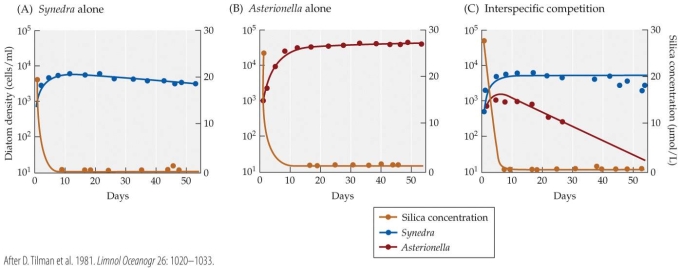 An unknown diatom is collected from a sample of sea water. The researcher is asked to grow the diatom in the laboratory and identify it based on the culture's density and silica level. At day 10, 20, and 30, the diatom density is almost 104 and silica levels are almost zero. Which species has the researcher cultured?
 (Multiple Choice)
4.7/5 (87)
(87) The competitive exclusion principle states that the _______ species prevents another species from using essential resources, causing the _______ species to become locally extinct.
(Multiple Choice)
4.9/5 (77)
(77) Which conclusion can be drawn from Brewer's experiments on pitcher plants?
(Multiple Choice)
4.9/5 (80)
(80) 
Filters
- Essay(0)
- Multiple Choice(0)
- Short Answer(0)
- True False(0)
- Matching(0)