



 Chat with AI
Exam 14: Competition

Exam 1: The Web of Life68 Questions
Exam 2: The Physical Environment76 Questions
Exam 3: The Biosphere73 Questions
Exam 4: Coping With Environmental Variation:74 Questions
Exam 5: Coping With Environmental Variation: Energy71 Questions
Exam 6: Evolution and Ecology68 Questions
Exam 7: Life History69 Questions
Exam 8: Behavioral Ecology71 Questions
Exam 9: Population Distribution and Abundance80 Questions
Exam 10: Population Dynamics68 Questions
Exam 11: Population Growth and Regulation69 Questions
Exam 12: Predation70 Questions
Exam 13: Parasitism72 Questions
Exam 14: Competition74 Questions
Exam 15: Mutualism and Commensalism71 Questions
Exam 16: The Nature of Communities71 Questions
Exam 17: Change in Communities73 Questions
Exam 18: Biogeography70 Questions
Exam 19: Species Diversity in Communities72 Questions
Exam 20: Production73 Questions
Exam 21: Energy Flow and Food Webs76 Questions
Exam 22: Nutrient Supply and Cycling76 Questions
Exam 23: Conservation Biology73 Questions
Exam 24: Landscape Ecology and Ecosystem Management71 Questions
Exam 25: Global Ecology74 Questions
Select questions type


Two hypothetical species of plants have lived in the same area for a long time. Studies show they occupy the same niche. During a severe drought, species 1 drives species 2 locally extinct. Briefly explain how the two species can coexist and why the drought caused competition between the two species, leading to species 2's local extinction.
(Essay)
4.9/5  (76)
(76) What is not an explanation for coexistence of species that use the same set of limiting resources?
(Multiple Choice)
4.8/5 (78)
(78) Use inequalities generated by the Lotka-Volterra competition model to determine whether two species of Paramecium (P. caudatum is "species 1" and P. aurelia is "species 2") will coexist or drive each other to extinction in the three scenarios below. In these examples, N1 = N2, and K1 = K2 = 50.
Scenario 1: Determine the outcome of the competitive interaction between P. caudatum and P. aurelia if = 0.3, and = 0.6.
Scenario 2: Determine the outcome of the competitive interaction between P. caudatum and P. aurelia if = 1.5, and = 0.6.
Determine the outcomes of competition between the two species under scenario 1.Answer the following questions:
a) Do species 1 and species 2 coexist?
b) Does one species drive the other to extinction? If so, which goes extinct?
(Essay)
5.0/5 (70)
(70) Brewer's study on pitcher plants showed that _______ when the plants were grown in the presence of many neighbors.
(Multiple Choice)
4.8/5 (86)
(86) Use inequalities generated by the Lotka-Volterra competition model to determine whether two species of Paramecium (P. caudatum is "species 1" and P. aurelia is "species 2") will coexist or drive each other to extinction in the three scenarios below. In these examples, N1 = N2, and K1 = K2 = 50.
Scenario 1: Determine the outcome of the competitive interaction between P. caudatum and P. aurelia if = 0.3, and = 0.6.
Scenario 2: Determine the outcome of the competitive interaction between P. caudatum and P. aurelia if = 1.5, and = 0.6.
For scenarios 1 and 2, sketch the outcome of the competitive interaction using N1 and N2 isoclines. Put species 1 on the x-axis and species 2 on the y-axis. Label the points at which your isoclines intersect the axes as K1, K2, K1/? and K2/?. Using your calculations from the questions above, indicate the stable equilibrium point with a star. The units on your graphs should range from 0 to 200, in increments of 40.
(Essay)
4.9/5 (73)
(73) Two species of birds actively fight over berries. Injuries have been observed, and the presence of one species limits the survival and reproduction of the other. What type of competition is this?
(Multiple Choice)
4.8/5 (68)
(68) Use inequalities generated by the Lotka-Volterra competition model to determine whether two species of Paramecium (P. caudatum is "species 1" and P. aurelia is "species 2") will coexist or drive each other to extinction in the three scenarios below. In these examples, N1 = N2, and K1 = K2 = 50.
Scenario 1: Determine the outcome of the competitive interaction between P. caudatum and P. aurelia if = 0.3, and = 0.6.
Scenario 2: Determine the outcome of the competitive interaction between P. caudatum and P. aurelia if = 1.5, and = 0.6.
Based on conditions in scenario 1, answer the following questions:
a) What does K1/K2 equal?
b) Is greater than (>) or less than (<) K1/K2?
c) Is > or < K1/K2?
(Essay)
4.8/5 (81)
(81) In his experiments with different competing pairs of Paramecium species, Gause found that sometimes both species persisted and sometimes only one species did. Which hypothesis did Gause propose in order to explain the cases in which both species persisted?
(Multiple Choice)
4.9/5 (67)
(67) Refer to the figure.
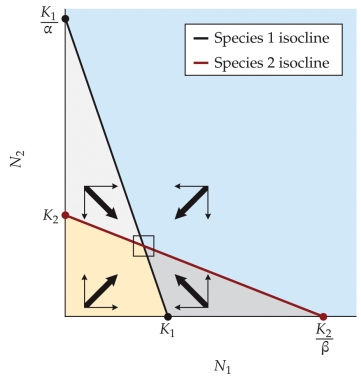 Based on the figure, what is the expected outcome of the competition between species 1 and species 2?
 (Multiple Choice)
4.7/5 (81)
(81) Two species of flour beetles, Tribolium castaneum and Tribolium freemani, are competing according to the Lotka‒Volterra equations. If the α of T. freemani on T. castaneum is 1.5, the addition of 150 T. freemani individuals would depress the T. castaneum population growth rate by the same amount as the addition of _______ T. castaneum individuals would.
(Multiple Choice)
4.9/5 (70)
(70) Two species of birds feed on berries. The birds are active at different times of the day and do not come into contact with one another. Nonetheless, the presence of one species limits the survival and reproduction of the other. What type of competition is this?
(Multiple Choice)
4.8/5 (74)
(74) Use inequalities generated by the Lotka-Volterra competition model to determine whether two species of Paramecium (P. caudatum is "species 1" and P. aurelia is "species 2") will coexist or drive each other to extinction in the three scenarios below. In these examples, N1 = N2, and K1 = K2 = 50.
Scenario 1: Determine the outcome of the competitive interaction between P. caudatum and P. aurelia if = 0.3, and = 0.6.
Scenario 2: Determine the outcome of the competitive interaction between P. caudatum and P. aurelia if = 1.5, and = 0.6.
Determine how each species affects the other under scenario 1.Answer the following questions:
a) Each individual of species 2 has the same effect on species 1 as how many individuals of species 1?
b) Each individual of species 1 has the same effect on species 2 as how many individuals of species 2?
(Essay)
4.8/5 (90)
(90) Two species are close competitors. If one species is removed from the community, the remaining species would be expected to expand its realized niche. Answer the following questions:
a) Briefly explain the difference between a fundamental niche and a realized niche.
b) Why would removal of one species affect others' realized niche?
(Essay)
4.8/5 (81)
(81) There are two pairs of competing species of ferns. Species A and species B have carrying capacities of 10,000 and 6,000, respectively. The competition coefficient of species A on species B is 0.25 and the competition coefficient of species B on species A is 2.5. Species C and species D have carrying capacities of 8,000 and 14,000, respectively. The competition coefficient of species C on species D is 0.1 and the competition coefficient of species D on species C is 0.2. Based on the Lotka‒Volterra equation, which of these pairs of species can coexist?
(Multiple Choice)
4.8/5 (69)
(69) Sequoias, considered by many to be the planet's largest tree, are a fugitive species that needs fire. Explain what benefit fire would have for fugitive species such as sequoias and how fire affects competition.
(Essay)
4.9/5 (76)
(76) Black walnut trees release chemicals that can be toxic to other plants. This phenomenon may be an example of _______, although experimental confirmation is still needed.
(Multiple Choice)
4.9/5 (86)
(86) Refer to the figure.
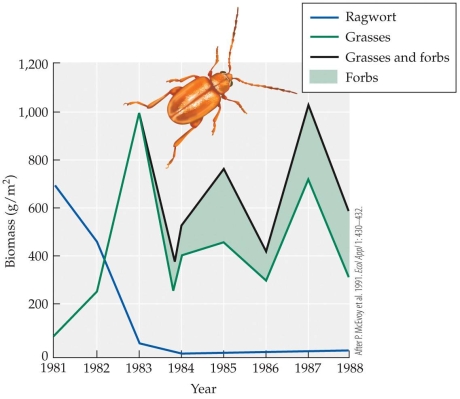 What year(s) did the biomass of grasses reach 1000 g/m2?
 (Multiple Choice)
4.9/5 (70)
(70) Based on the Lotka‒Volterra equations, which statement about carrying capacity and species coexistence is most likely true?
(Multiple Choice)
4.9/5 (82)
(82) The results of Connell's experiments with intertidal barnacles support which principle of competition?
(Multiple Choice)
4.9/5 (74)
(74) 
Filters
- Essay(0)
- Multiple Choice(0)
- Short Answer(0)
- True False(0)
- Matching(0)