



 Chat with AI
Exam 14: Competition

Exam 1: The Web of Life68 Questions
Exam 2: The Physical Environment76 Questions
Exam 3: The Biosphere73 Questions
Exam 4: Coping With Environmental Variation:74 Questions
Exam 5: Coping With Environmental Variation: Energy71 Questions
Exam 6: Evolution and Ecology68 Questions
Exam 7: Life History69 Questions
Exam 8: Behavioral Ecology71 Questions
Exam 9: Population Distribution and Abundance80 Questions
Exam 10: Population Dynamics68 Questions
Exam 11: Population Growth and Regulation69 Questions
Exam 12: Predation70 Questions
Exam 13: Parasitism72 Questions
Exam 14: Competition74 Questions
Exam 15: Mutualism and Commensalism71 Questions
Exam 16: The Nature of Communities71 Questions
Exam 17: Change in Communities73 Questions
Exam 18: Biogeography70 Questions
Exam 19: Species Diversity in Communities72 Questions
Exam 20: Production73 Questions
Exam 21: Energy Flow and Food Webs76 Questions
Exam 22: Nutrient Supply and Cycling76 Questions
Exam 23: Conservation Biology73 Questions
Exam 24: Landscape Ecology and Ecosystem Management71 Questions
Exam 25: Global Ecology74 Questions
Select questions type


Which statement about Patterson's study of the distributions of Tamias chipmunks in the southwestern United States is false?
(Multiple Choice)
4.9/5  (74)
(74) The critical feature determining whether a substance is a resource is whether it
(Multiple Choice)
4.8/5 (85)
(85) A population of Drosophila melanogaster with 10,000 individuals and a carrying capacity of 20,000 follows the logistic growth equation. Suppose that 5,000 individuals of a competitor species, Drosophila simulans, are added to the population, and that this species has an α of 0.5. One would predict that this number of competitive individuals will decrease the D. melanogaster population growth rate by the same amount as the addition of _______ D. melanogaster individuals would.
(Multiple Choice)
4.9/5 (74)
(74) The dominant saltmeadow cordgrass (Spartina patens) was planted across an elevation gradient around a stress-tolerant low marsh species, smooth cordgrass (S. alterniflora). Within six months, S. alterniflora had suppressed the stature and growth of S. patens. This is an example of
(Multiple Choice)
4.9/5 (81)
(81) Two species of sparrows are competing, and these species behave according to the Lotka‒Volterra equations. If each individual sparrow reduces the population growth rate of its own species by 0.02 per year, and it reduces the population growth rate of the other species by 0.005 per year, then the competition coefficient is
(Multiple Choice)
5.0/5 (93)
(93) Brown and Davidson's study of a desert community showed that
(Multiple Choice)
4.9/5 (75)
(75) How did Brewer manipulate the level of competition in his experiment on pitcher plants?
(Multiple Choice)
4.8/5 (68)
(68) Which observation would be the strongest evidence that character displacement is occurring?
(Multiple Choice)
4.9/5 (83)
(83) Dragonfly species A (with a carrying capacity of 1,000) and species B (with a carrying capacity of 400) are competing. The competition coefficient of species A on species B is 0.25, and the competition coefficient of species B on species A is 0.5. Dragonfly species C (with a carrying capacity of 5,000) and species D (with a carrying capacity of 10,000) are also competing. The competition coefficient of species C on species D is 0.1, and the competition coefficient of species D on species C is 0.2. Based on the Lotka‒Volterra equation, which of these pairs of species can coexist?
(Multiple Choice)
4.9/5 (74)
(74) Which statement about studies on the importance of competition in nature is false?
(Multiple Choice)
4.9/5 (81)
(81) Two species of ground crickets compete in the eastern United States. In colder areas, Allonemobius fasciatus outcompetes Allonemobius socius, but in warm areas, A. socius outcompetes A. fasciatus. This is an example of
(Multiple Choice)
4.9/5 (71)
(71) Use inequalities generated by the Lotka-Volterra competition model to determine whether two species of Paramecium (P. caudatum is "species 1" and P. aurelia is "species 2") will coexist or drive each other to extinction in the three scenarios below. In these examples, N1 = N2, and K1 = K2 = 50.
Scenario 1: Determine the outcome of the competitive interaction between P. caudatum and P. aurelia if = 0.3, and = 0.6.
Scenario 2: Determine the outcome of the competitive interaction between P. caudatum and P. aurelia if = 1.5, and = 0.6.
Determine the outcome of competition between the species under scenario 2.Answer the following questions:
a) Do the two species coexist?
b) Does one species drive the other to extinction? If so, which goes extinct?
(Essay)
4.7/5 (80)
(80) Which of the following findings from Connell's experiments with intertidal barnacles is false?
(Multiple Choice)
5.0/5 (68)
(68) Refer to the figure.
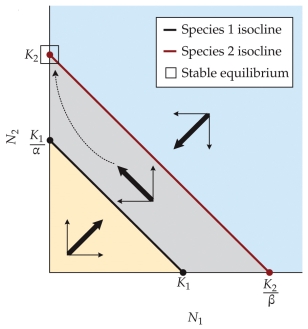 Based on the figure, what is the expected outcome of the competition between species 1 and species 2?
 (Multiple Choice)
4.9/5 (64)
(64) Refer to the figure.
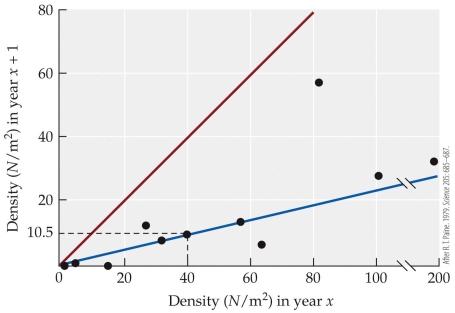 A population of sea palms in year 1 has a density of 80 N/m2. The predicted density expected in year 2 is _______ N/m2 which is _______ the exact replacement curve.
 (Multiple Choice)
4.8/5 (83)
(83) Competitive exclusion states that two organisms cannot indefinitely occupy the same niche when resources are limited. When this does occur, organisms tend to show some sort of competitive coexistence. Which of the following is an example of competitive exclusion?
(Multiple Choice)
5.0/5 (69)
(69) Suppose that, instead of the results actually obtained in Brown and Davidson's experiments, the number of rodents in the ant-excluded treatment was roughly the same as the number of rodents in the control group, and the number of ants in the rodent-excluded treatment was roughly the same as the number of ants in the control group. Which of the following would you then conclude?
(Multiple Choice)
4.9/5 (81)
(81) 
Filters
- Essay(0)
- Multiple Choice(0)
- Short Answer(0)
- True False(0)
- Matching(0)