



 Chat with AI
Exam 19: Species Diversity in Communities

Exam 1: The Web of Life68 Questions
Exam 2: The Physical Environment76 Questions
Exam 3: The Biosphere73 Questions
Exam 4: Coping With Environmental Variation:74 Questions
Exam 5: Coping With Environmental Variation: Energy71 Questions
Exam 6: Evolution and Ecology68 Questions
Exam 7: Life History69 Questions
Exam 8: Behavioral Ecology71 Questions
Exam 9: Population Distribution and Abundance80 Questions
Exam 10: Population Dynamics68 Questions
Exam 11: Population Growth and Regulation69 Questions
Exam 12: Predation70 Questions
Exam 13: Parasitism72 Questions
Exam 14: Competition74 Questions
Exam 15: Mutualism and Commensalism71 Questions
Exam 16: The Nature of Communities71 Questions
Exam 17: Change in Communities73 Questions
Exam 18: Biogeography70 Questions
Exam 19: Species Diversity in Communities72 Questions
Exam 20: Production73 Questions
Exam 21: Energy Flow and Food Webs76 Questions
Exam 22: Nutrient Supply and Cycling76 Questions
Exam 23: Conservation Biology73 Questions
Exam 24: Landscape Ecology and Ecosystem Management71 Questions
Exam 25: Global Ecology74 Questions
Select questions type


Which statement about zebra mussels in North America is true?

Free
(Multiple Choice)
4.9/5  (87)
(87) Correct Answer: Verified
A
In their tests of the extension of the intermediate disturbance hypothesis in a New England salt marsh, Hacker and Gaines found that in the low intertidal zone, physiological stress was _______ and species diversity was _______.
Free
(Multiple Choice)
4.9/5 (72)
(72) Correct Answer:Verified
VerifiedA
Which combination of attributes of a community should result in the lowest species richness?
Free
(Multiple Choice)
4.8/5 (71)
(71) Correct Answer:Verified
VerifiedB
Which one of the following factors most determines the highest possible number of species within a local community?
(Multiple Choice)
4.8/5 (70)
(70) Which statement about Huston's dynamic equilibrium model is most accurate?
(Multiple Choice)
4.8/5 (72)
(72) According to Hacker and Gaines's extension of the intermediate disturbance hypothesis, mutualisms and other positive interactions should _______ species diversity, especially at _______ levels of disturbance.
(Multiple Choice)
4.8/5 (67)
(67) Refer to the figure.
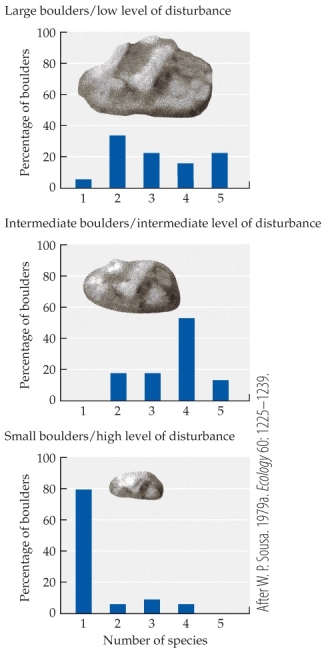 The figure depicts Sousa's test of the intermediate disturbance hypothesis. Why is boulder size associated with the level of disturbance? Do these data support or refute the intermediate disturbance hypothesis? Justify your reasoning using the figure.
 (Essay)
4.7/5 (75)
(75) According to the Menge-Sutherland model, predation affects species richness most significantly at _______ levels of environmental stress or disturbance, and competition is the most important factor at _______ levels of environmental stress or disturbance.
(Multiple Choice)
4.8/5 (84)
(84) The study of snails by Johnson et al. (2009) found that increasing species richness and
(Multiple Choice)
4.8/5 (90)
(90) The ability of a community to remain the same in terms of its structure and function despite some perturbation is known as
(Multiple Choice)
4.9/5 (84)
(84) Refer to the figures.
Figure 1
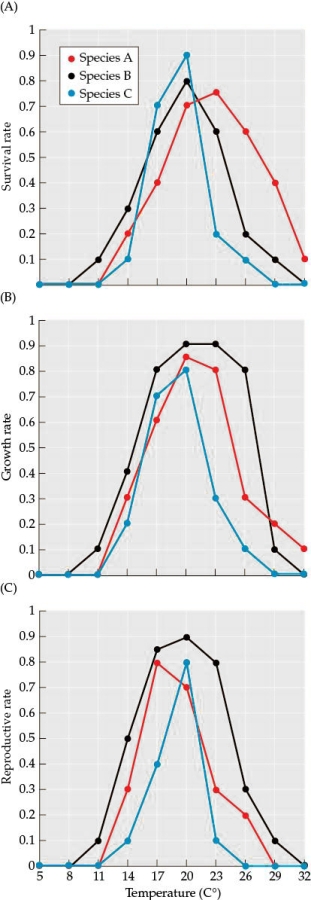 Figure 2
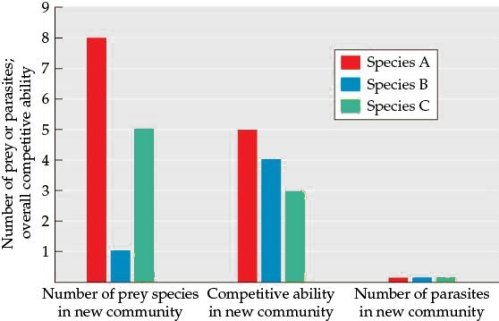 You are evaluating three snail species to determine their overall threat as invasive species to an area. You bring several individuals of each species into your lab to test their tolerance of a range of abiotic and biotic factors. Figure 1 shows how the three snail species respond to differences in average temperature and Figure 2 shows the number of prey and parasite species for each of the species in the new areas, along with how competitive each potential invasive species will be in the new community (higher numbers indicate that the species will be a more successful competitor).
-Consider Species B and C and assume that both have successfully invaded a new community. If the native species are similar to the invasive species in their resource use, what type of resource spectrum would you expect for each community that integrates these species? Provide the resource spectrum expected for each of the invaded communities, and justify your predictions.
Figure 2
You are evaluating three snail species to determine their overall threat as invasive species to an area. You bring several individuals of each species into your lab to test their tolerance of a range of abiotic and biotic factors. Figure 1 shows how the three snail species respond to differences in average temperature and Figure 2 shows the number of prey and parasite species for each of the species in the new areas, along with how competitive each potential invasive species will be in the new community (higher numbers indicate that the species will be a more successful competitor).
-Consider Species B and C and assume that both have successfully invaded a new community. If the native species are similar to the invasive species in their resource use, what type of resource spectrum would you expect for each community that integrates these species? Provide the resource spectrum expected for each of the invaded communities, and justify your predictions. (Essay)
4.8/5 (76)
(76) Refer to the figure.
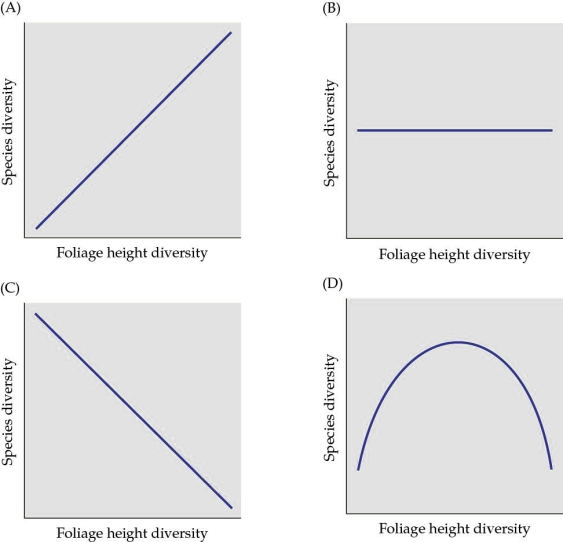 The figure is based on the studies by Robert and John MacArthur. Which figure best describes the relationship between foliage height diversity and species diversity?
 (Multiple Choice)
5.0/5 (80)
(80) What aspect of community membership do humans most impact that leads to invasive species?
(Multiple Choice)
4.8/5 (89)
(89) The first person to recognize the importance of disturbance in promoting species diversity was _______, who noted that more species persisted on a section of lawn that was mowed regularly than on one that was not mowed.
(Multiple Choice)
4.9/5 (84)
(84) Refer to the figure.
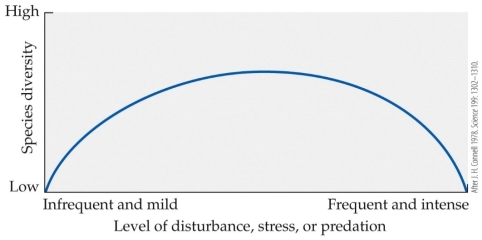 According to this representation of the intermediate disturbance hypothesis, why does diversity decline at more frequent and intense levels of disturbance?
 (Multiple Choice)
4.8/5 (87)
(87) Refer to the figures.
Figure 1
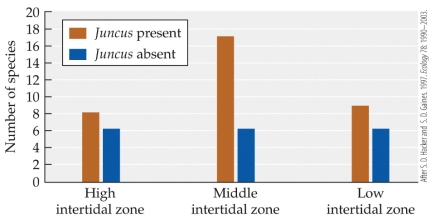 Figure 2
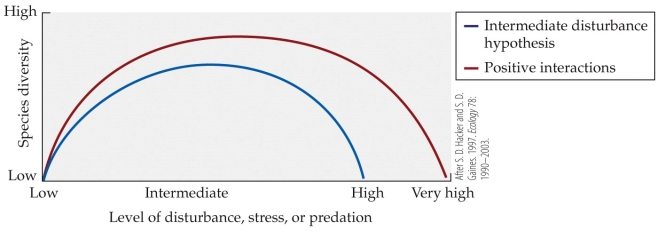 Figure 1 depicts Hacker and Gaines' tests of the role of positive interactions in the intermediate disturbance hypothesis and Figure 2 depicts their theoretical model. They experimentally explored the combined species diversity of plants and arthropods in intertidal communities that varied in disturbance and whether a facilitating rush species, Juncus, was present. What conclusions about the role of positive interactions in determining species diversity can you draw from Figure 1? Do they confirm or refute the theoretical predictions of their model? Explain your reasoning.
Figure 2
Figure 1 depicts Hacker and Gaines' tests of the role of positive interactions in the intermediate disturbance hypothesis and Figure 2 depicts their theoretical model. They experimentally explored the combined species diversity of plants and arthropods in intertidal communities that varied in disturbance and whether a facilitating rush species, Juncus, was present. What conclusions about the role of positive interactions in determining species diversity can you draw from Figure 1? Do they confirm or refute the theoretical predictions of their model? Explain your reasoning. (Essay)
4.7/5 (83)
(83) In Sousa's study of succession in intertidal boulder fields in California, disturbance was _______ proportional to the size of the boulders. The highest level of species richness occurred when disturbance was _______.
(Multiple Choice)
4.8/5 (92)
(92) Species must pass through several "filters" to become members of a community. Describe these filters and how they can act to exclude invasive species from a community. How do invasive species overcome these filters? Your answer should address how species have historically invaded new areas and how human actions have changed the way these filters affect community membership.
(Essay)
4.8/5 (84)
(84) Which statement is not an assumption of the resource partitioning theory?
(Multiple Choice)
4.9/5 (77)
(77) Refer to the figure.
Figure 8
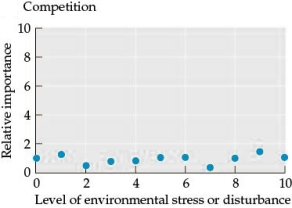 You are studying a new area to determine how disturbances affect species diversity. What could you conclude about the impact of competition if your data exhibited the pattern shown in Figure 8? According to the Menge-Sutherland model, what would this pattern tell you about resource use and recruitment in your study area?
 (Essay)
4.9/5 (73)
(73) 
Filters
- Essay(0)
- Multiple Choice(0)
- Short Answer(0)
- True False(0)
- Matching(0)