



 Chat with AI
Exam 14: Competition

Exam 1: The Web of Life68 Questions
Exam 2: The Physical Environment76 Questions
Exam 3: The Biosphere73 Questions
Exam 4: Coping With Environmental Variation:74 Questions
Exam 5: Coping With Environmental Variation: Energy71 Questions
Exam 6: Evolution and Ecology68 Questions
Exam 7: Life History69 Questions
Exam 8: Behavioral Ecology71 Questions
Exam 9: Population Distribution and Abundance80 Questions
Exam 10: Population Dynamics68 Questions
Exam 11: Population Growth and Regulation69 Questions
Exam 12: Predation70 Questions
Exam 13: Parasitism72 Questions
Exam 14: Competition74 Questions
Exam 15: Mutualism and Commensalism71 Questions
Exam 16: The Nature of Communities71 Questions
Exam 17: Change in Communities73 Questions
Exam 18: Biogeography70 Questions
Exam 19: Species Diversity in Communities72 Questions
Exam 20: Production73 Questions
Exam 21: Energy Flow and Food Webs76 Questions
Exam 22: Nutrient Supply and Cycling76 Questions
Exam 23: Conservation Biology73 Questions
Exam 24: Landscape Ecology and Ecosystem Management71 Questions
Exam 25: Global Ecology74 Questions
Select questions type


In Brown and Davidson's study of seed-eating rodents and ants in Arizona, the number of rodents _______ when ants were removed, and the number of ant colonies _______ when rodents were removed.

Free
(Multiple Choice)
4.8/5  (93)
(93) Correct Answer: Verified
A
Which statement about allelopathy is true?
Free
(Multiple Choice)
4.8/5 (96)
(96) Correct Answer:Verified
VerifiedB
In bumblebees (Bombus) species that live together, they usually have different length proboscises that allow them to collect nectar from different flowers. This is an example of
Free
(Multiple Choice)
4.8/5 (62)
(62) Correct Answer:Verified
VerifiedA
Two species of flour beetles, Tribolium castaneum and Tribolium confuum, are competing according to the Lotka‒Volterra equations. If the α of T. confuum on T. castaneum is 0.4, one can assume that the addition of 200 T. confuumi individuals would depress the population growth of T. castaneum by the same amount as the addition of _______ T. castaneum individuals would.
(Multiple Choice)
4.7/5 (95)
(95) Which of the following cannot be a resource for an organism?
(Multiple Choice)
4.8/5 (77)
(77) Which statement about zero population growth isoclines of two competing species is true?
(Multiple Choice)
4.8/5 (78)
(78) Which statement describes a finding of Wilson and Tilman's studies of the grass Schizachyrium scoparium?
(Multiple Choice)
4.8/5 (80)
(80) A population of Teleopsis (a stalk-eyed fly) with 20,000 individuals and a carrying capacity of 40,000 follows the logistic growth equation. Its growth rate under ideal low-density conditions is 0.2 per day. The addition of 30,000 houseflies is enough to bring the population growth of Teleopsis to zero. What is the competition coefficient of the effect of the housefly on Teleopsis?
(Multiple Choice)
4.7/5 (83)
(83) A population of white oak trees with 500 individuals and a carrying capacity of 1,500 follows logistic growth. Under ideal low-density conditions, its growth rate is 0.15 per year, but it faces competition from a population of 1,000 Chapman oaks with an α of 0.5. What is the expected growth of the population of white oaks in the next year?
(Multiple Choice)
4.8/5 (90)
(90) Refer to the figure.
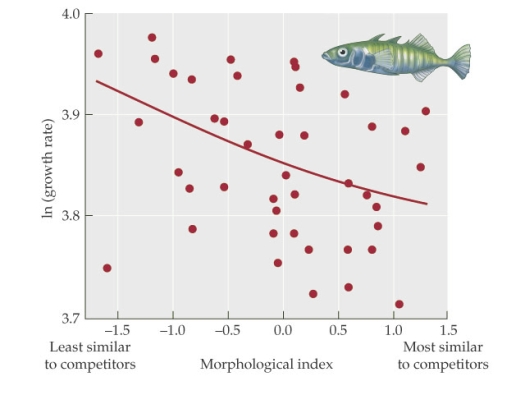 The figure shows the relationship between the growth rates (on a log scale) of individual fish and the similarity of the fish to their competitors. Assuming that populations with faster growth rates are more likely to have greater population growth, which principle or concept does the figure support?
 (Multiple Choice)
4.8/5 (73)
(73) Suppose that a species of moss cannot coexist with a superior competitor unless there is periodic disturbance. This species is also a frequent disperser. Which conclusion is most likely?
(Multiple Choice)
4.8/5 (75)
(75) Based on Paine's studies, what has allowed the sea palm to persist in shoreline areas despite the presence of a superior competitor (Mytilus)?
(Multiple Choice)
4.9/5 (88)
(88) Character displacement is likely to _______ the competition coefficients in two competing species and to _______ resource partitioning.
(Multiple Choice)
4.9/5 (85)
(85) Two similar rodent species are consistently more different from each other when they occupy the same habitat than when they live separately. What is the most likely explanation for the increased divergence when they live together?
(Multiple Choice)
4.9/5 (79)
(79) Which statement about Tilman and colleagues' studies of the diatoms Synedra and Asterionella is true?
(Multiple Choice)
4.9/5 (80)
(80) Suppose that two species of Darwin's finches live on the same island and eat seeds, but one species tends to eat larger seeds than the other one does. Based on this observation, we can conclude that these species are engaged in
(Multiple Choice)
4.7/5 (86)
(86) Refer to the figure.
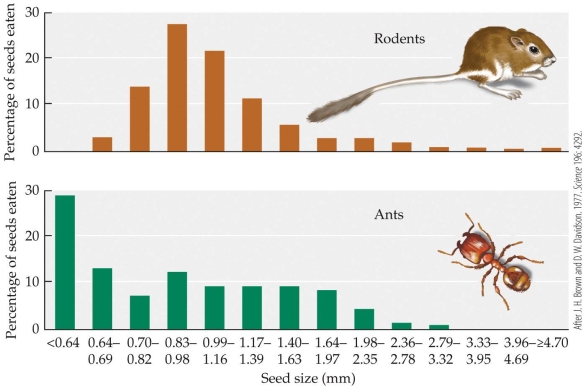 What percent of 0.99-1.16 mm seeds were eaten by rodents?
 (Multiple Choice)
4.9/5 (78)
(78) Which statement was supported by Stomp and colleagues' study of the partitioning of resources between two species of Baltic Sea cyanobacteria?
(Multiple Choice)
4.8/5 (86)
(86) Two species of grasshoppers live in the same area. They both feed on plants, but the presence of one species does not affect the survival or the reproduction of the other. What type of competition is this?
(Multiple Choice)
4.9/5 (89)
(89) 
Filters
- Essay(0)
- Multiple Choice(0)
- Short Answer(0)
- True False(0)
- Matching(0)