



 Chat with AI
Exam 23: Conservation Biology

Exam 1: The Web of Life68 Questions
Exam 2: The Physical Environment76 Questions
Exam 3: The Biosphere73 Questions
Exam 4: Coping With Environmental Variation:74 Questions
Exam 5: Coping With Environmental Variation: Energy71 Questions
Exam 6: Evolution and Ecology68 Questions
Exam 7: Life History69 Questions
Exam 8: Behavioral Ecology71 Questions
Exam 9: Population Distribution and Abundance80 Questions
Exam 10: Population Dynamics68 Questions
Exam 11: Population Growth and Regulation69 Questions
Exam 12: Predation70 Questions
Exam 13: Parasitism72 Questions
Exam 14: Competition74 Questions
Exam 15: Mutualism and Commensalism71 Questions
Exam 16: The Nature of Communities71 Questions
Exam 17: Change in Communities73 Questions
Exam 18: Biogeography70 Questions
Exam 19: Species Diversity in Communities72 Questions
Exam 20: Production73 Questions
Exam 21: Energy Flow and Food Webs76 Questions
Exam 22: Nutrient Supply and Cycling76 Questions
Exam 23: Conservation Biology73 Questions
Exam 24: Landscape Ecology and Ecosystem Management71 Questions
Exam 25: Global Ecology74 Questions
Select questions type


Refer to the figure.
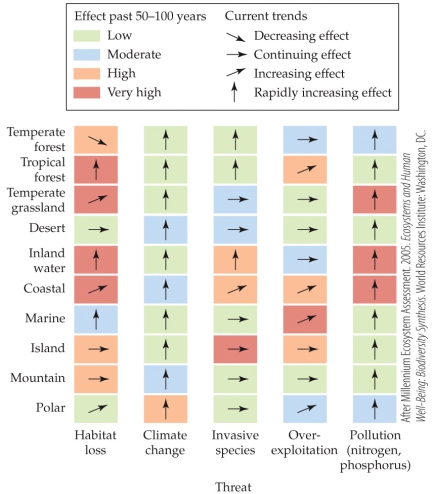 The figure shows the current level of threat faced by each biome from a variety of sources. The arrows show the direction whether the threat is decreasing, continuing, increasing, or rapidly increasing.
-In which biome does habitat loss pose a very high and rapidly increasing risk?
The figure shows the current level of threat faced by each biome from a variety of sources. The arrows show the direction whether the threat is decreasing, continuing, increasing, or rapidly increasing.
-In which biome does habitat loss pose a very high and rapidly increasing risk?
Free
(Multiple Choice)
4.8/5  (68)
(68) Correct Answer: Verified
C
Researchers have helped increase the abundance of the red-cockaded woodpecker by
Free
(Multiple Choice)
4.9/5 (74)
(74) Correct Answer:Verified
VerifiedA
Suppose the background extinction rate of birds is 5 per 1,000 years. During the twentieth century, 17 birds went extinct. The extinction rate of birds is now about how many times the background rate?
Free
(Multiple Choice)
4.9/5 (77)
(77) Correct Answer:Verified
VerifiedC
There are many threats to Earth's biodiversity, and these threats are constantly changing in type and severity. Based on currently evolving threats, what trends are likely in the future of conservation biology? That is, what fields of research and/or methods of maintaining biodiversity might become more important in the near future?
(Essay)
4.8/5 (81)
(81) For any given species or larger taxonomic group, such as mammals, extinction is most likely caused by
(Multiple Choice)
4.9/5 (89)
(89) Suppose the background extinction rate of amphibians is 8 per 1,000 years and that during the twentieth century, 20 amphibians went extinct. The extinction rate of amphibians is now about how many times the background rate?
(Multiple Choice)
4.9/5 (81)
(81) List several reasons that it might be important to preserve biodiversity. Which of these reasons do you think is most important and why?
(Essay)
4.9/5 (86)
(86) Describe some ways in which overexploitation affects biodiversity loss, with examples.
(Essay)
4.9/5 (82)
(82) In the late nineteenth and twentieth centuries, several massive losses of organisms occurred. Bison, passenger pigeons, and many other birds declined rapidly or went extinct. Most deciduous forests and prairies were replaced by agricultural fields. These changes led to
(Multiple Choice)
4.7/5 (66)
(66) Genetic rescue of endangered species would be most useful in a species that
(Multiple Choice)
4.8/5 (85)
(85) Refer to the figure.
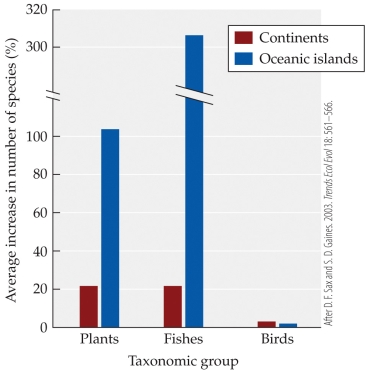 The figure shows changes in biodiversity of different groups on continents versus oceanic islands. Based on this information, it can be said that, as compared to continents, oceanic islands
 (Multiple Choice)
4.8/5 (87)
(87) Which study would best fit into the science of conservation biology?
(Multiple Choice)
4.9/5 (95)
(95) Currently, about one percent of all known species of organisms are threatened with extinction. This percentage is likely to be an underestimate because many species
(Multiple Choice)
4.8/5 (78)
(78) The vaquita, a tiny marine porpoise, is found only in the northern Gulf of California, and is the most endangered marine mammal in the world. There are only 10-15 individuals left. They are caught and killed in gillnets used to capture the totoaba, a fish that is caught illegally and sold in China. Give reasons for and against using ex situ conservation to prevent extinction of the vaquita.
(Essay)
4.9/5 (84)
(84) Biologists brought California condors back from the threat of extinction by
(Multiple Choice)
4.9/5 (79)
(79) Refer to the figure.
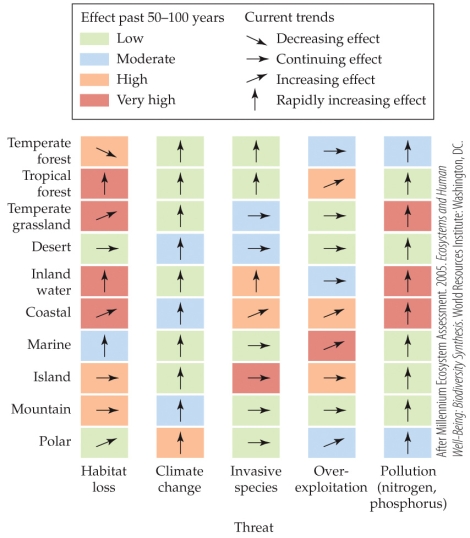 The figure shows the current level of threat faced by each biome from a variety of sources. According to the figure, what is the most serious threat now facing marine ecosystems?
 (Multiple Choice)
4.9/5 (73)
(73) Off-road mountain vehicles and mountain bikes trample various plant species in the Santa Cruz Mountains and hills of California. Although plants still persist in the area and many species are unaffected, habitat quality for many species has declined. This is an example of habitat
(Multiple Choice)
4.8/5 (81)
(81) Scientists have great difficulty determining how rapidly Earth's eukaryotic species are going extinct. This is primarily because
(Multiple Choice)
4.8/5 (69)
(69) The introduction of invasive plant species all over the world and the resulting extinction of native, endemic species has led to
(Multiple Choice)
4.8/5 (77)
(77) 
Filters
- Essay(0)
- Multiple Choice(0)
- Short Answer(0)
- True False(0)
- Matching(0)