



 Chat with AI
Exam 23: Conservation Biology

Exam 1: The Web of Life68 Questions
Exam 2: The Physical Environment76 Questions
Exam 3: The Biosphere73 Questions
Exam 4: Coping With Environmental Variation:74 Questions
Exam 5: Coping With Environmental Variation: Energy71 Questions
Exam 6: Evolution and Ecology68 Questions
Exam 7: Life History69 Questions
Exam 8: Behavioral Ecology71 Questions
Exam 9: Population Distribution and Abundance80 Questions
Exam 10: Population Dynamics68 Questions
Exam 11: Population Growth and Regulation69 Questions
Exam 12: Predation70 Questions
Exam 13: Parasitism72 Questions
Exam 14: Competition74 Questions
Exam 15: Mutualism and Commensalism71 Questions
Exam 16: The Nature of Communities71 Questions
Exam 17: Change in Communities73 Questions
Exam 18: Biogeography70 Questions
Exam 19: Species Diversity in Communities72 Questions
Exam 20: Production73 Questions
Exam 21: Energy Flow and Food Webs76 Questions
Exam 22: Nutrient Supply and Cycling76 Questions
Exam 23: Conservation Biology73 Questions
Exam 24: Landscape Ecology and Ecosystem Management71 Questions
Exam 25: Global Ecology74 Questions
Select questions type


Which of the following is not an axis used by biologists to determine whether, or to what extent, a species is rare?
(Multiple Choice)
4.8/5  (84)
(84) The red-cockaded woodpecker in the North Carolina Sandhills has been severely reduced in numbers in the last 100 years due to
(Multiple Choice)
5.0/5 (74)
(74) Compare past and present extinction rates, and predict future extinction rates based on current trends.
(Essay)
4.9/5 (69)
(69) Refer to the figure.
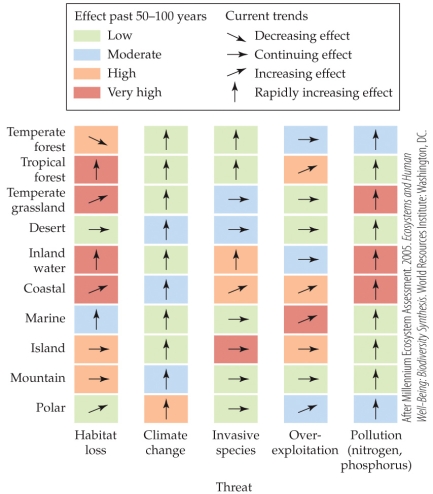 The figure shows the current level of threat faced by each biome from a variety of sources. The arrows show the direction whether the threat is decreasing, continuing, increasing, or rapidly increasing.
- In which biome is climate change currently a high or very high threat?
The figure shows the current level of threat faced by each biome from a variety of sources. The arrows show the direction whether the threat is decreasing, continuing, increasing, or rapidly increasing.
- In which biome is climate change currently a high or very high threat? (Multiple Choice)
4.8/5 (90)
(90) The grizzly bear has habitat requirements that overlap substantially with those of other endangered species. For this reason, the grizzly could best be classified as what type of species?
(Multiple Choice)
4.9/5 (81)
(81) A conservation biologist has been asked to explain why it is important to protect biodiversity. She would list all of the following reasons except for which one?
(Multiple Choice)
4.8/5 (79)
(79) For which species have ex situ conservation measures been used?
(Multiple Choice)
4.8/5 (70)
(70) The worldwide demand for ivory has led to widespread slaughter of African elephants. A ban on ivory led to poaching and a thriving illegal trade in ivory. In response, conservationists employed DNA testing to obtain forensic evidence for elephant slaughter, much as forensics experts do to solve human crimes. What is the most specific information that DNA profiles are likely to provide in crimes related to poaching and illegal trade in animals or animal parts?
(Multiple Choice)
4.9/5 (79)
(79) Refer to the figure.
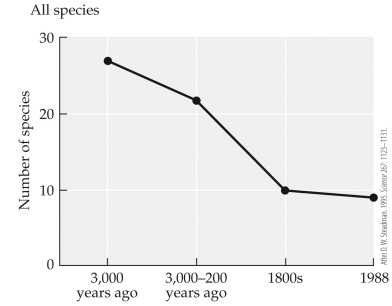 The figure shows results of Steadman's study of bird species on the Pacific Islands. According to this figure, the study demonstrated that
 (Multiple Choice)
4.8/5 (98)
(98) Given that few species are known to be directly jeopardized by climate change, why is climate change considered a major ecological threat?
(Multiple Choice)
5.0/5 (89)
(89) Refer to the figure.
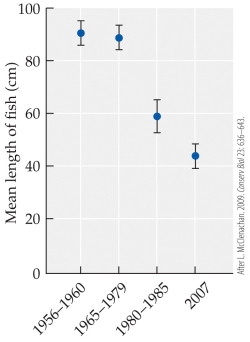 The figure shows the change in size (mean length) of predatory marine fish caught as trophy fish over a period of years off of Key West, Florida. What happened to the size of fish during this time?
 (Multiple Choice)
4.9/5 (85)
(85) Refer to the figure.
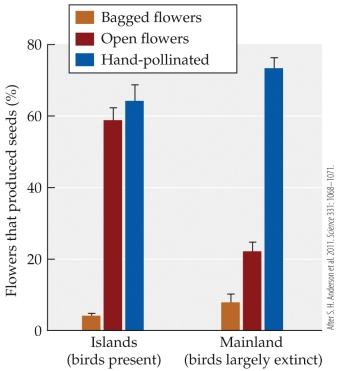 The figure documents the effects of the loss of bird pollinators on reproductive success in a New Zealand shrub. In this study, bagged flowers allow only self-pollination, open flowers allow bird pollination, and humans carry out hand pollination. Reproductive success occurs when flowers produce seeds. This study suggests that pollination by birds
 (Multiple Choice)
4.8/5 (70)
(70) Over the past few centuries, human populations and their levels of resource use have exploded. This has led to an increasing loss of biodiversity, but the causes of that loss have changed over the years. Which factor is a much greater threat to biodiversity in the United States in the twenty-first century than it was in the previous two centuries?
(Multiple Choice)
4.8/5 (74)
(74) The activity of an earthworm species increases the fertility of soils in an agricultural field. This is an example of
(Multiple Choice)
4.7/5 (71)
(71) Refer to the table.
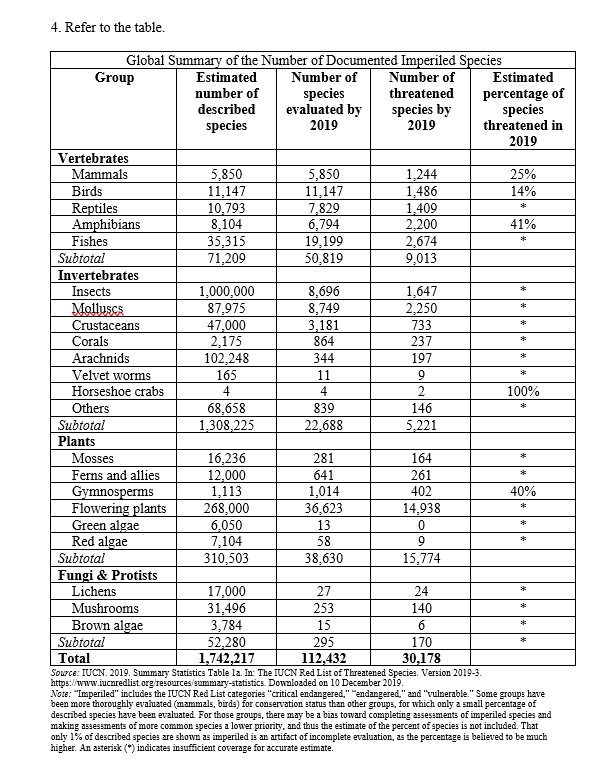 - Among the plants in the table, the total number of threatened species by 2019 is highest in the
 (Multiple Choice)
4.9/5 (79)
(79) Two genetic consequences of small population size that affect the survival of species are
(Multiple Choice)
4.9/5 (83)
(83) The horns of rhinos are used to make a powder that is believed by many to have aphrodisiac properties. Due to extensive hunting, the rhino population has been declining, making their horns even more valuable. The increasing value of the horns, in turn, has intensified the hunt for rhinos. This situation is best described as
(Multiple Choice)
4.9/5 (77)
(77) Should all rare species be protected? Why or why not? What factors should be used in making such a determination?
(Essay)
4.8/5 (78)
(78) Of the various types of surrogate species-flagship, focal, and umbrella species-which type, if any, would likely be most valuable in a conservation effort? Justify your choice.
(Essay)
4.8/5 (64)
(64) 
Filters
- Essay(0)
- Multiple Choice(0)
- Short Answer(0)
- True False(0)
- Matching(0)