



 Chat with AI
Exam 23: Conservation Biology

Exam 1: The Web of Life68 Questions
Exam 2: The Physical Environment76 Questions
Exam 3: The Biosphere73 Questions
Exam 4: Coping With Environmental Variation:74 Questions
Exam 5: Coping With Environmental Variation: Energy71 Questions
Exam 6: Evolution and Ecology68 Questions
Exam 7: Life History69 Questions
Exam 8: Behavioral Ecology71 Questions
Exam 9: Population Distribution and Abundance80 Questions
Exam 10: Population Dynamics68 Questions
Exam 11: Population Growth and Regulation69 Questions
Exam 12: Predation70 Questions
Exam 13: Parasitism72 Questions
Exam 14: Competition74 Questions
Exam 15: Mutualism and Commensalism71 Questions
Exam 16: The Nature of Communities71 Questions
Exam 17: Change in Communities73 Questions
Exam 18: Biogeography70 Questions
Exam 19: Species Diversity in Communities72 Questions
Exam 20: Production73 Questions
Exam 21: Energy Flow and Food Webs76 Questions
Exam 22: Nutrient Supply and Cycling76 Questions
Exam 23: Conservation Biology73 Questions
Exam 24: Landscape Ecology and Ecosystem Management71 Questions
Exam 25: Global Ecology74 Questions
Select questions type


Several endangered birds are under consideration for use of an ex situ conservation program to save their species. Species A lives in a relatively stable habitat but is extremely rare. Species B is also extremely rare, and lives in a habitat threatened by possible human expansion. Numbers of species C have plummeted in the last 50 years to less than a hundred individuals and the survivors live in a habitat that is declining but could be improved over time. Which of these species should conservationists choose for their ex situ program?
(Multiple Choice)
4.9/5  (75)
(75) The acidification of oceans due to carbon dioxide diffusion into the water has had serious deleterious consequences for corals and other species. For some species, however, the acidification has had little, if any, effect. Thus, the best term to describe the overall effect of ocean acidification on marine life is habitat
(Multiple Choice)
4.8/5 (71)
(71) Why is habitat loss is considered the most important threat to biodiversity? How do habitat loss, degradation, and fragmentation compare as potential threats?
(Essay)
5.0/5 (77)
(77) Refer to the figure.
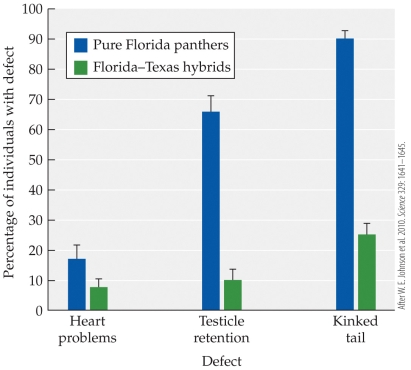 The figure depicts the results of a study of the attempted genetic rescue of the Florida panther by importing eight females from a Texas population. How did the hybridization of these two subspecies affect the occurrence of the three measured genetic defects?
 (Multiple Choice)
4.9/5 (73)
(73) Most conservation biologists think that the best approach to protecting overexploited species is to
(Multiple Choice)
4.8/5 (75)
(75) Despite the loss of the Atlantic forest habitat of Brazil, no extinctions of birds from this area have been reported. According to Brooks et al., which of the following is the most plausible explanation for the apparent lack of extinctions?
(Multiple Choice)
4.7/5 (74)
(74) Which method of estimating extinction rates can be considered a direct, rather than an indirect, method?
(Multiple Choice)
4.8/5 (73)
(73) Reductions in the population size of the graceful antelope, a hypothetical species, have led to inbreeding. Deleterious after-effects of that inbreeding are leading to further decreases in the population size of this species. This pattern is an example of a(n)
(Multiple Choice)
4.9/5 (67)
(67) The Eurasian zebra mussels found in North America are an example of a(n)
(Multiple Choice)
4.7/5 (80)
(80) Which of these is an example of habitat degradation, rather than habitat loss?
(Multiple Choice)
4.9/5 (77)
(77) The range of a species of vole starts contracting at its edges. Slowly, the contraction continues. Eventually, the population can persist only in what used to be the center of its range. Based on this information, the most likely cause of the range contraction is
(Multiple Choice)
4.9/5 (73)
(73) A highway severely inhibits movements of Florida cooters (a species of turtle) between sections of their habitat. For the cooters, this situation is one of habitat
(Multiple Choice)
4.7/5 (65)
(65) A bee pollinating an important agricultural crop is an example of
(Multiple Choice)
4.8/5 (88)
(88) 
Filters
- Essay(0)
- Multiple Choice(0)
- Short Answer(0)
- True False(0)
- Matching(0)