



 Chat with AI
Exam 23: Conservation Biology

Exam 1: The Web of Life68 Questions
Exam 2: The Physical Environment76 Questions
Exam 3: The Biosphere73 Questions
Exam 4: Coping With Environmental Variation:74 Questions
Exam 5: Coping With Environmental Variation: Energy71 Questions
Exam 6: Evolution and Ecology68 Questions
Exam 7: Life History69 Questions
Exam 8: Behavioral Ecology71 Questions
Exam 9: Population Distribution and Abundance80 Questions
Exam 10: Population Dynamics68 Questions
Exam 11: Population Growth and Regulation69 Questions
Exam 12: Predation70 Questions
Exam 13: Parasitism72 Questions
Exam 14: Competition74 Questions
Exam 15: Mutualism and Commensalism71 Questions
Exam 16: The Nature of Communities71 Questions
Exam 17: Change in Communities73 Questions
Exam 18: Biogeography70 Questions
Exam 19: Species Diversity in Communities72 Questions
Exam 20: Production73 Questions
Exam 21: Energy Flow and Food Webs76 Questions
Exam 22: Nutrient Supply and Cycling76 Questions
Exam 23: Conservation Biology73 Questions
Exam 24: Landscape Ecology and Ecosystem Management71 Questions
Exam 25: Global Ecology74 Questions
Select questions type


Which factor is not part of the growing taxonomic homogenization of Earth's biota?
(Multiple Choice)
5.0/5  (80)
(80) The cheetah has helped garner public support for various conservation projects due in part to its charismatic nature. For this reason, the cheetah could best be classified as what type of species?
(Multiple Choice)
4.8/5 (83)
(83) Tropical cloud forests are extremely biodiverse, but are strongly affected by climate change, leading to a loss of many unique species. Conservationists want to preserve a species of frog unique to the cloud forests of Costa Rica. How might demographic models help in this effort?
(Essay)
4.9/5 (77)
(77) Biologists can make population viability analysis (PVA) models more effective by
(Multiple Choice)
4.8/5 (78)
(78) The use of species‒area relationships to predict extinction rates assumes that most extinction is due to
(Multiple Choice)
4.7/5 (73)
(73) Refer to the figure.
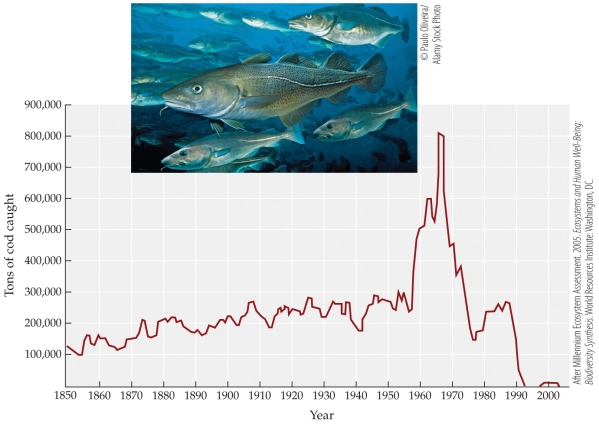 The figure shows the tons of cod caught off Newfoundland, Canada over 150 years. The spike in catch during the 1960s and 1970s, followed by the collapse of the fishery in the 1990s could be considered evidence of
 (Multiple Choice)
4.9/5 (72)
(72) Refer to the figure.
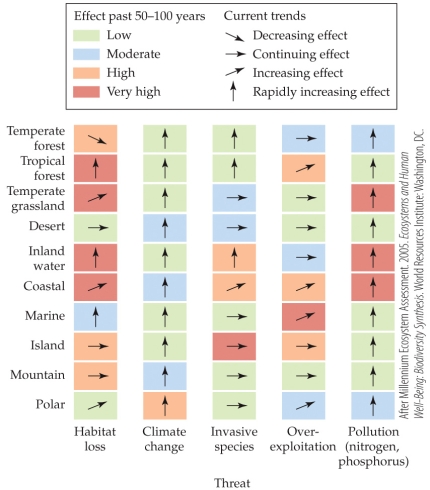 The figure shows the current level of threat faced by each biome from a variety of sources. The arrows show the direction whether the threat is decreasing, continuing, increasing, or rapidly increasing.
-Which two threats, regardless of their past effect (from low to very high) are currently showing a rapidly increasing risk in all biomes?
The figure shows the current level of threat faced by each biome from a variety of sources. The arrows show the direction whether the threat is decreasing, continuing, increasing, or rapidly increasing.
-Which two threats, regardless of their past effect (from low to very high) are currently showing a rapidly increasing risk in all biomes? (Multiple Choice)
4.9/5 (84)
(84) A conservation biologist is studying the variation that occurs in the species composition of ponds in a region. This scientist is studying which level of biodiversity?
(Multiple Choice)
4.8/5 (75)
(75) For which purpose is molecular genetic analysis not useful?
(Multiple Choice)
4.8/5 (72)
(72) Asian long-horned beetles, introduced into North America, lay their eggs in almost any available deciduous tree. The larvae eat the soft bark and sap, making it difficult for nutrients to reach other parts of the tree, then burrow into the middle of it, leaving large tunnels and weakening the tree. Adult beetles emerge from the tree by burrowing through the bark, leaving large holes. Many trees do not survive these infestations. Asian long-horned beetles thus impact native species by
(Multiple Choice)
4.9/5 (78)
(78) The Nile perch in Africa's Lake Victoria is an example of a(n)
(Multiple Choice)
4.8/5 (85)
(85) The major factor leading to the extinction of the passenger pigeon was
(Multiple Choice)
4.8/5 (69)
(69) Refer to the table.
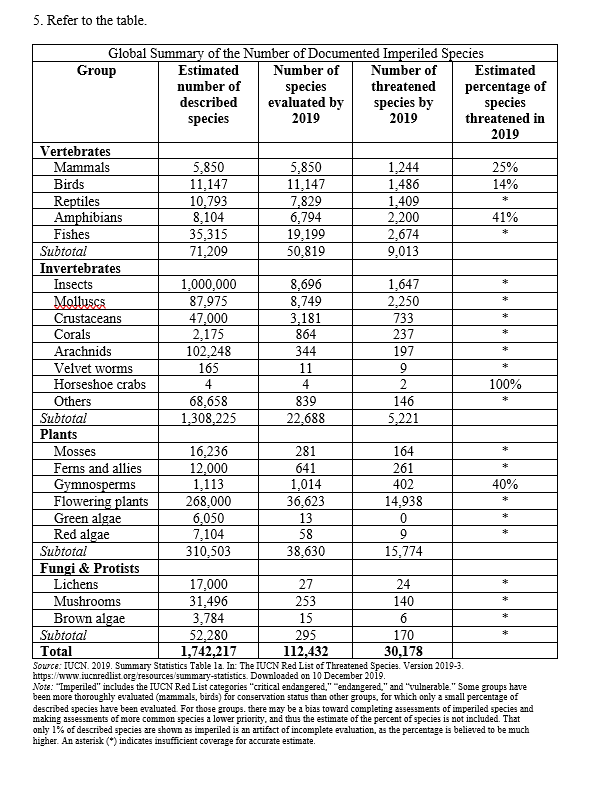 - As of 2019, out of all documented endangered species, what percentage of insects evaluated were considered threatened?
 (Multiple Choice)
4.8/5 (69)
(69) Refer to the figure.
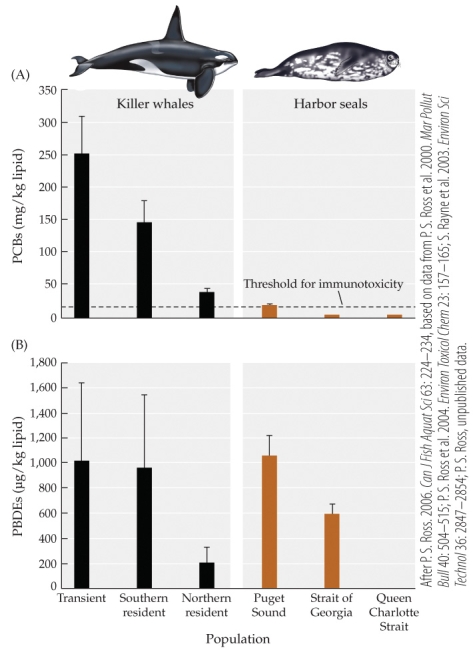 The top figure shows concentrations of PCBs in killer whales and harbor seals at several locations. The bottom figure shows concentrations of PBDEs in both groups of mammals. These persistent organic chemicals build up in animal tissues and disrupt their endocrine systems, including reproductive systems. What is the most reasonable conclusion that can be drawn regarding the effect of these chemicals based on the data in these figures?
 (Multiple Choice)
4.8/5 (87)
(87) Refer to the figure.
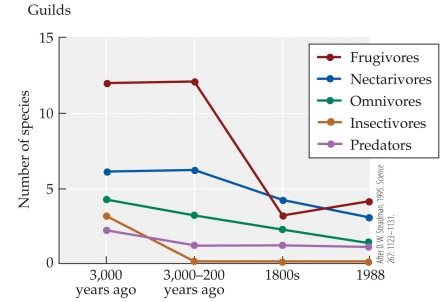 This figure shows results of Steadman's study of bird extinctions in the Pacific Islands, specifically differing rates of extinctions among different guilds of birds. Based on this information, the extinction of which guild(s) of birds probably had the greatest effect on the island's plant communities?
 (Multiple Choice)
4.8/5 (85)
(85) Describe taxonomic homogenization and give an example. How does it affect biodiversity and extinction of species?
(Essay)
4.9/5 (85)
(85) Refer to the figure.
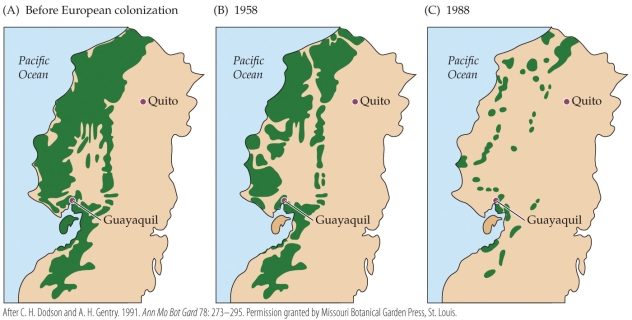 The green in the figure represents forest cover in western Ecuador at three different times. The decreasing amount of forest cover is most representative of
 (Multiple Choice)
4.8/5 (64)
(64) Which of these is an example of an anthropogenic Allee effect?
(Multiple Choice)
4.9/5 (85)
(85) An insect has habitat requirements that overlap substantially with those of other endangered species. Because this insect is well known for its beautiful coloration, efforts to protect it have garnered much support. It is thus acting as which kind of species?
(Multiple Choice)
4.8/5 (74)
(74) Population viability analysis (PVA) is useful for all of these reasons except that biologists can use it to
(Multiple Choice)
4.9/5 (84)
(84) 
Filters
- Essay(0)
- Multiple Choice(0)
- Short Answer(0)
- True False(0)
- Matching(0)