



 Chat with AI
Exam 25: Global Ecology

Exam 1: The Web of Life68 Questions
Exam 2: The Physical Environment76 Questions
Exam 3: The Biosphere73 Questions
Exam 4: Coping With Environmental Variation:74 Questions
Exam 5: Coping With Environmental Variation: Energy71 Questions
Exam 6: Evolution and Ecology68 Questions
Exam 7: Life History69 Questions
Exam 8: Behavioral Ecology71 Questions
Exam 9: Population Distribution and Abundance80 Questions
Exam 10: Population Dynamics68 Questions
Exam 11: Population Growth and Regulation69 Questions
Exam 12: Predation70 Questions
Exam 13: Parasitism72 Questions
Exam 14: Competition74 Questions
Exam 15: Mutualism and Commensalism71 Questions
Exam 16: The Nature of Communities71 Questions
Exam 17: Change in Communities73 Questions
Exam 18: Biogeography70 Questions
Exam 19: Species Diversity in Communities72 Questions
Exam 20: Production73 Questions
Exam 21: Energy Flow and Food Webs76 Questions
Exam 22: Nutrient Supply and Cycling76 Questions
Exam 23: Conservation Biology73 Questions
Exam 24: Landscape Ecology and Ecosystem Management71 Questions
Exam 25: Global Ecology74 Questions
Select questions type


Refer to the figure.
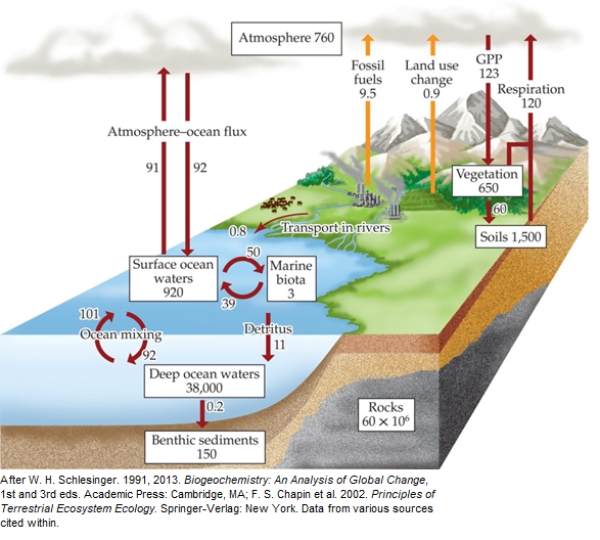 This figure is of the global carbon cycle. (Note: Boxes represent major pools of C, measured in petagrams [1 Pg = 1015 g]. Arrows represent major fluxes of C, measured in Pg per year; anthropogenic fluxes are shown in orange.)What is the net flux of carbon to the atmosphere?
Free
(Multiple Choice)
4.7/5  (78)
(78) Correct Answer: Verified
C
Refer to the figure.
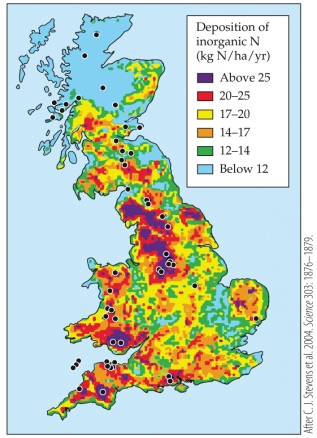 This figure shows spatial patterns of N deposition in Great Britain. What is the most likely change in carbon cycling in Great Britain as a result of changes in N cycling?
Free
(Multiple Choice)
4.9/5 (71)
(71) Correct Answer:Verified
VerifiedB
Which statement about the nitrogen cycle is false?
Free
(Multiple Choice)
4.9/5 (96)
(96) Correct Answer:Verified
VerifiedA
A reduction in aerosols in the atmosphere would tend to _______ temperatures, because aerosols _______ sunlight.
(Multiple Choice)
4.8/5 (93)
(93) Refer to the figure.
Figure 1
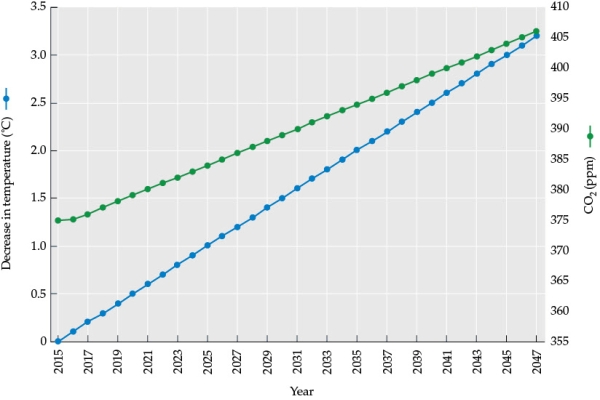 Suppose a researcher is experimenting with an invention that might affect global climate. This researcher builds a model to predict how the invention might impact global temperatures and global atmospheric composition over time. The results of the model are shown in Figure 1.
- Based on the predictions of the model, answer the following questions:
a) How would you expect this mechanism and its impact on climate to affect ecological responses to climate change?
b) Would you expect biological communities to return to pre-warming locations and pre-warming compositions?
Suppose a researcher is experimenting with an invention that might affect global climate. This researcher builds a model to predict how the invention might impact global temperatures and global atmospheric composition over time. The results of the model are shown in Figure 1.
- Based on the predictions of the model, answer the following questions:
a) How would you expect this mechanism and its impact on climate to affect ecological responses to climate change?
b) Would you expect biological communities to return to pre-warming locations and pre-warming compositions? (Essay)
4.8/5 (83)
(83) Refer to the figure.
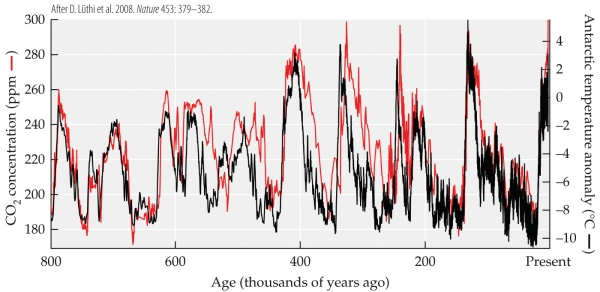 The figure shows the temperature (in °C, relative to modern temperature) and the concentrations of carbon dioxide (in ppm) and methane (in ppb) over the past 400,000 years.
- Ten thousand years ago, the concentration of carbon dioxide was about _______ times that of methane.
The figure shows the temperature (in °C, relative to modern temperature) and the concentrations of carbon dioxide (in ppm) and methane (in ppb) over the past 400,000 years.
- Ten thousand years ago, the concentration of carbon dioxide was about _______ times that of methane. (Multiple Choice)
5.0/5 (76)
(76) Select the greenhouse gas that fits the following description: It is the largest contributor to greenhouse warming. Over the course of human history, its concentration in the atmosphere has not changed much, but it varies considerably from place to place.
(Multiple Choice)
4.8/5 (89)
(89) Before the Industrial Revolution, the flux of carbon from the terrestrial to the atmospheric pools _______ the flux in the opposite direction. Today, the flux of carbon from the terrestrial to atmospheric pools _______ the flux in the opposite direction.
(Multiple Choice)
4.8/5 (75)
(75) Some of the more radical proposals to address and mitigate climate change involve geoengineering, which involves deliberately modifying Earth's climate. Evaluate how the actions listed would affect the global climate and global biogeochemical cycles by answering the questions that follow.
Option 1: Plant more trees.
Option 2: Build one or more giant reflective mirrors and send them into Earth's orbit.
Option 3: Fertilize ocean water with iron.
Option 4: Spray sulfuric acid as aerosol into the stratosphere.
-
Suppose global temperature suddenly increases by 4°C. If this sudden increase imperiled many of the species on Earth, which of the four options would decrease global temperatures most quickly and be easiest to implement on short notice?
(Essay)
4.8/5 (88)
(88) Ozone in the _______ acts as a shield protecting Earth's surface from UV radiation. Ozone in the _______ is harmful to organisms.
(Multiple Choice)
4.9/5 (72)
(72) Which if the following is not a risk factor that will increase the susceptibility of species to extinction due to climate change?
(Multiple Choice)
4.9/5 (67)
(67) Which statement best describes the effect of occlusion of phosphorus in soils on the flux of anthropogenic phosphorus from terrestrial to aquatic ecosystems?
(Multiple Choice)
4.8/5 (74)
(74) Some of the more radical proposals to address and mitigate climate change involve geoengineering, which involves deliberately modifying Earth's climate. Evaluate how the actions listed would affect the global climate and global biogeochemical cycles by answering the questions that follow.
Option 1: Plant more trees.
Option 2: Build one or more giant reflective mirrors and send them into Earth's orbit.
Option 3: Fertilize ocean water with iron.
Option 4: Spray sulfuric acid as aerosol into the stratosphere.
-
Based only on its effect on the carbon cycle, how would you expect option 1 to impact the global climate? How long would it take for the effects to be seen? How long would you expect these effects to last? What potential problems are there with this option?
(Essay)
4.9/5 (72)
(72) Refer to the figure.
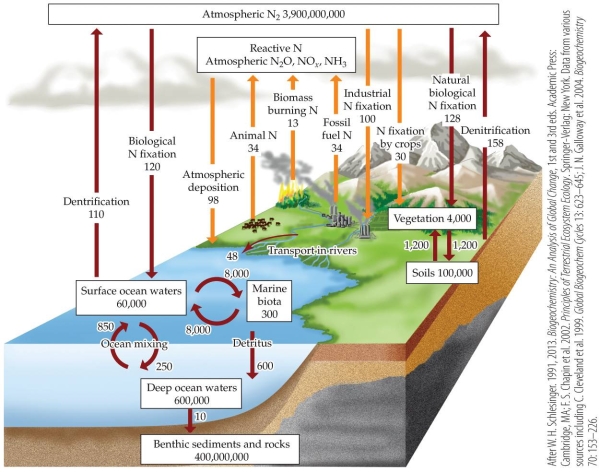 Based on the figure, N fixation by industrial methods accounts for _______% of the total fixation of N.
 (Multiple Choice)
4.8/5 (83)
(83) Advanced stages of soil acidification lead to the release from cation exchange sites of _______ ions, which are toxic to plant roots and animals.
(Multiple Choice)
4.9/5 (82)
(82) Refer to the figure.
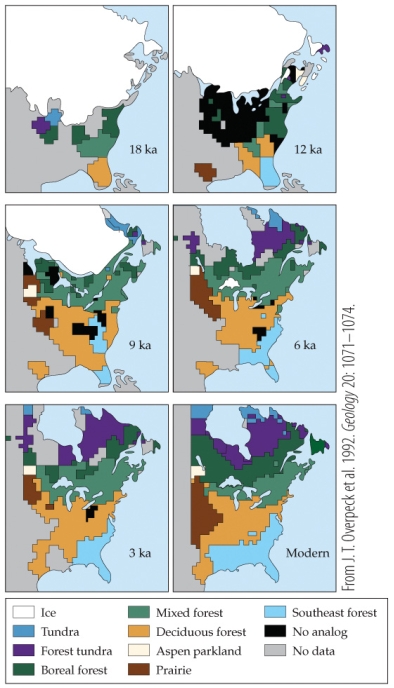 - Large-scale community changes observed historically took thousands of years. For example, it took from 18,000 years ago to 6,000 years ago for forest tundra to reach even a portion of its current geographical location. Which factor will increase the susceptibility of species to extinction due to our current, rapidly changing environment that was not present historically?
 (Multiple Choice)
4.8/5 (79)
(79) Increasing levels of carbon dioxide in oceans makes them _______ acidic. This change affects the ability of marine organisms to form protective shells made up of _______ carbonate.
(Multiple Choice)
4.8/5 (83)
(83) Some of the more radical proposals to address and mitigate climate change involve geoengineering, which involves deliberately modifying Earth's climate. Evaluate how the options listed would affect the global climate and global biogeochemical cycles by answering the question that follows.
Option 1: Plant more trees.
Option 2: Build one or more giant reflective mirrors and send them into Earth's orbit.
Option 3: Fertilize ocean water with iron.
Option 4: Spray sulfuric acid as aerosol into the stratosphere.
-
Describe two ways that option 1 would affect the carbon cycle.
(Essay)
4.8/5 (77)
(77) 
Filters
- Essay(0)
- Multiple Choice(0)
- Short Answer(0)
- True False(0)
- Matching(0)