



 Chat with AI
Exam 25: Global Ecology

Exam 1: The Web of Life68 Questions
Exam 2: The Physical Environment76 Questions
Exam 3: The Biosphere73 Questions
Exam 4: Coping With Environmental Variation:74 Questions
Exam 5: Coping With Environmental Variation: Energy71 Questions
Exam 6: Evolution and Ecology68 Questions
Exam 7: Life History69 Questions
Exam 8: Behavioral Ecology71 Questions
Exam 9: Population Distribution and Abundance80 Questions
Exam 10: Population Dynamics68 Questions
Exam 11: Population Growth and Regulation69 Questions
Exam 12: Predation70 Questions
Exam 13: Parasitism72 Questions
Exam 14: Competition74 Questions
Exam 15: Mutualism and Commensalism71 Questions
Exam 16: The Nature of Communities71 Questions
Exam 17: Change in Communities73 Questions
Exam 18: Biogeography70 Questions
Exam 19: Species Diversity in Communities72 Questions
Exam 20: Production73 Questions
Exam 21: Energy Flow and Food Webs76 Questions
Exam 22: Nutrient Supply and Cycling76 Questions
Exam 23: Conservation Biology73 Questions
Exam 24: Landscape Ecology and Ecosystem Management71 Questions
Exam 25: Global Ecology74 Questions
Select questions type


As nitrogen input increases, _______ remains nearly constant at first and then increases rapidly at higher levels of nitrogen input.
(Multiple Choice)
4.8/5  (97)
(97) In the absence of human activity, the net flux would be _______ Pg.
(Multiple Choice)
4.9/5 (71)
(71) Refer to the figure.
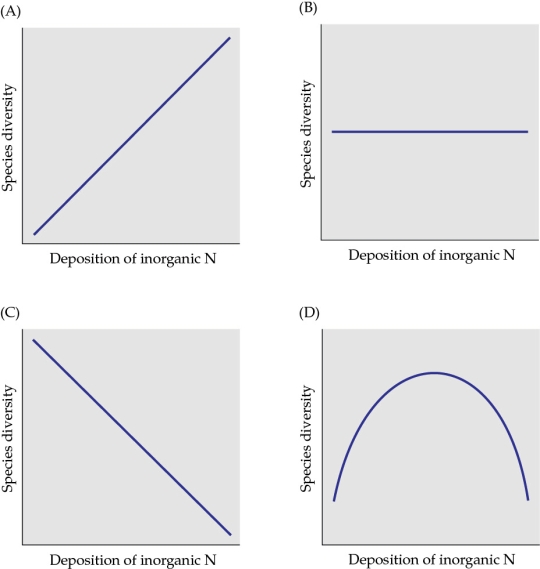 Which figure, based on the studies of grassland communities by Stevens, best describes the relationship of species diversity to varying levels of deposition of inorganic nitrogen?
 (Multiple Choice)
4.8/5 (89)
(89) Some of the more radical proposals to address and mitigate climate change involve geoengineering, which involves deliberately modifying Earth's climate. Evaluate how the actions listed would affect the global climate and global biogeochemical cycles by answering the questions that follow.
Option 1: Plant more trees.
Option 2: Build one or more giant reflective mirrors and send them into Earth's orbit.
Option 3: Fertilize ocean water with iron.
Option 4: Spray sulfuric acid as aerosol into the stratosphere.
-
Classify options 1-4 into two groups, based on the mechanisms by which they mitigate climate change. Which options would be most effective in changing atmospheric composition? Which options would be most effective in combating acid rain and ocean acidification?
(Essay)
4.8/5 (87)
(87) Refer to the figure.
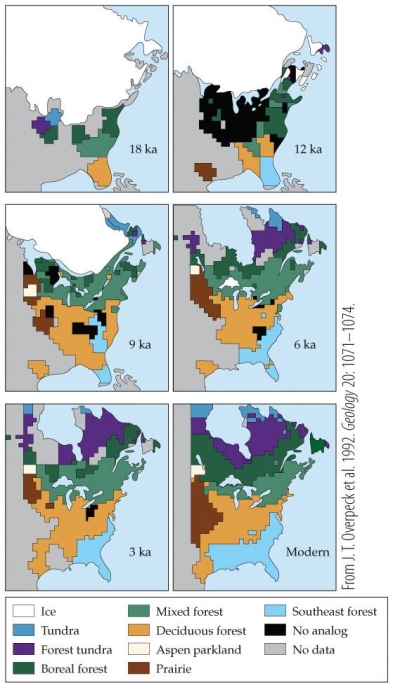 - This vegetation reconstruction shows major shifts in plant communities since the last glacial maximum 18,000 years ago. Why was there so much "No analog" community for much of the past 18,000 years?
 (Multiple Choice)
4.8/5 (87)
(87) Refer to the figure.
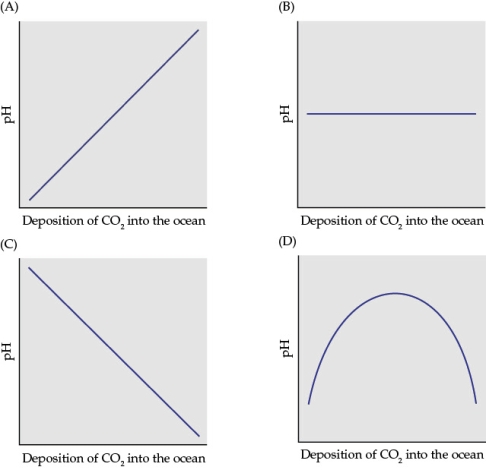 Which figure best describes the relationship between carbon intake in oceans and pH of the oceans?
 (Multiple Choice)
4.9/5 (70)
(70) In eutrophic waters, algal growth is _______, leading to _______ decomposition rates and thus _______ levels of oxygen.
(Multiple Choice)
4.9/5 (85)
(85) Aerosols are known to have a _______ effect on global temperatures. Some types of aerosols have increased in concentration recently, while others have decreased. One type of aerosol that has increased in concentration is the one associated with _______.
(Multiple Choice)
4.9/5 (87)
(87) The warming of Earth in recent decades has been most pronounced in
(Multiple Choice)
4.8/5 (84)
(84) Refer to the figure.
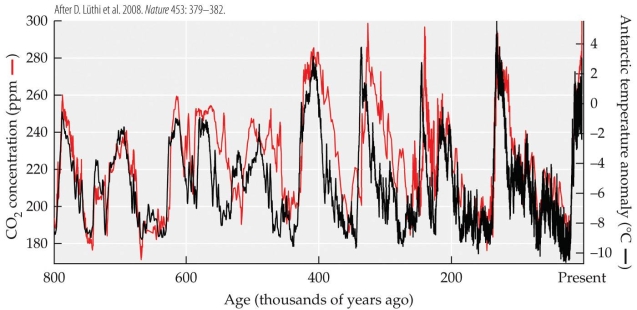 The figure shows the temperature (in °C, relative to modern temperature) and the concentrations of carbon dioxide (in ppm) and methane (in ppb) over the past 400,000 years.
- The current concentration of carbon dioxide is 404 ppm (not shown on the figure). Use the data in the figure to determine the highest carbon dioxide concentration levels that occurred over the past 400,000 years. At that point, the concentration of carbon dioxide was about _______% of the current concentration.
The figure shows the temperature (in °C, relative to modern temperature) and the concentrations of carbon dioxide (in ppm) and methane (in ppb) over the past 400,000 years.
- The current concentration of carbon dioxide is 404 ppm (not shown on the figure). Use the data in the figure to determine the highest carbon dioxide concentration levels that occurred over the past 400,000 years. At that point, the concentration of carbon dioxide was about _______% of the current concentration. (Multiple Choice)
4.8/5 (75)
(75) 
Filters
- Essay(0)
- Multiple Choice(0)
- Short Answer(0)
- True False(0)
- Matching(0)