



 Chat with AI
Exam 25: Global Ecology

Exam 1: The Web of Life68 Questions
Exam 2: The Physical Environment76 Questions
Exam 3: The Biosphere73 Questions
Exam 4: Coping With Environmental Variation:74 Questions
Exam 5: Coping With Environmental Variation: Energy71 Questions
Exam 6: Evolution and Ecology68 Questions
Exam 7: Life History69 Questions
Exam 8: Behavioral Ecology71 Questions
Exam 9: Population Distribution and Abundance80 Questions
Exam 10: Population Dynamics68 Questions
Exam 11: Population Growth and Regulation69 Questions
Exam 12: Predation70 Questions
Exam 13: Parasitism72 Questions
Exam 14: Competition74 Questions
Exam 15: Mutualism and Commensalism71 Questions
Exam 16: The Nature of Communities71 Questions
Exam 17: Change in Communities73 Questions
Exam 18: Biogeography70 Questions
Exam 19: Species Diversity in Communities72 Questions
Exam 20: Production73 Questions
Exam 21: Energy Flow and Food Webs76 Questions
Exam 22: Nutrient Supply and Cycling76 Questions
Exam 23: Conservation Biology73 Questions
Exam 24: Landscape Ecology and Ecosystem Management71 Questions
Exam 25: Global Ecology74 Questions
Select questions type


In areas such as Vermont that have a seasonal snowpack, which of the following would likely be the most acidic?
(Multiple Choice)
4.7/5  (68)
(68) Some of the more radical proposals to address and mitigate climate change involve geoengineering, which involves deliberately modifying Earth's climate. Evaluate how the actions listed would affect the global climate and global biogeochemical cycles by answering the questions that follow.
Option 1: Plant more trees.
Option 2: Build one or more giant reflective mirrors and send them into Earth's orbit.
Option 3: Fertilize ocean water with iron.
Option 4: Spray sulfuric acid as aerosol into the stratosphere.
-
What effect would option 3 (fertilizing ocean with iron) have on the carbon cycle? What outcome would create the carbon sink? Based on its effect on the carbon cycle, how would you expect option 3 to impact the global climate? What additional abiotic factor might limit the effectiveness of this option, and why? How would this additional factor influence your decision on when to implement this option?
(Essay)
4.9/5 (81)
(81) Refer to the figure.
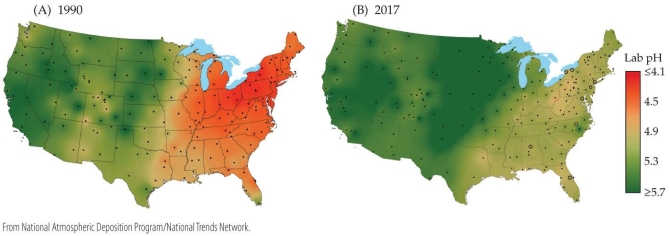 The figure shows the pH of precipitation in the United States in 1990 (left) and 2017 (right). The acidity of precipitation during both time periods was most extreme in the _______ part of the country, and the acidity of precipitation in this area _______ between 1994 and 2004.
 (Multiple Choice)
4.8/5 (82)
(82) Which of the following is not one of the currently documented ecological responses to climate change?
(Multiple Choice)
5.0/5 (81)
(81) The two major compounds in the atmosphere that are responsible for acidic precipitation are _______ and _______.
(Multiple Choice)
4.9/5 (73)
(73) The concentration of atmospheric carbon dioxide in 2016 was approximately _______ parts per _______.
(Multiple Choice)
4.7/5 (82)
(82) Refer to the figure.
Figure 2
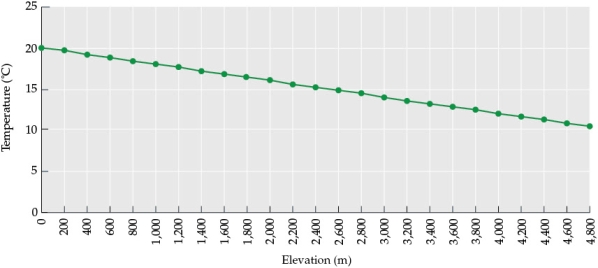 Suppose you are studying an ecological community on a mountain. The mountain has a high summit and a gradual slope. Temperatures are warm at the base of the mountain, and become increasingly cooler towards the summit, as shown in Figure 2.Answer the following questions:
a) What is the temperature difference between the base of the mountain and the summit?
b) Suppose average temperatures increase 2°C. Add a line to the graph in Figure 2 (this will be referred to as Figure 3) to indicate the new temperature at each elevation.
c) Suppose a tree species thrives between 13°C and 17°C. At what elevation would you expect to find the tree under normal temperatures? At what elevation would you expect to find the tree following the 2°C warming?
d) How do you expect the range size of the tree to change due to the change in temperature? Why?
Suppose you are studying an ecological community on a mountain. The mountain has a high summit and a gradual slope. Temperatures are warm at the base of the mountain, and become increasingly cooler towards the summit, as shown in Figure 2.Answer the following questions:
a) What is the temperature difference between the base of the mountain and the summit?
b) Suppose average temperatures increase 2°C. Add a line to the graph in Figure 2 (this will be referred to as Figure 3) to indicate the new temperature at each elevation.
c) Suppose a tree species thrives between 13°C and 17°C. At what elevation would you expect to find the tree under normal temperatures? At what elevation would you expect to find the tree following the 2°C warming?
d) How do you expect the range size of the tree to change due to the change in temperature? Why? (Essay)
5.0/5 (73)
(73) During the retreat of continental glaciers in North America during the past 18,000 years, there were some plant communities present that have no present analogs. Which of the following is not a reason that communities did not move due to changes in climate?
(Multiple Choice)
4.8/5 (85)
(85) Which organism would most likely encounter the greatest difficulty in responding to climate change?
(Multiple Choice)
4.8/5 (64)
(64) Some of the more radical proposals to address and mitigate climate change involve geoengineering, which involves deliberately modifying Earth's climate. Evaluate how the actions listed would affect the global climate and global biogeochemical cycles by answering the questions that follow.
Option 1: Plant more trees.
Option 2: Build one or more giant reflective mirrors and send them into Earth's orbit.
Option 3: Fertilize ocean water with iron.
Option 4: Spray sulfuric acid as aerosol into the stratosphere.
-
How would option 2 (reflective mirrors) function to change the global climate? What effect would this option have on the global climate? How long would it take for the effects on global climate to be seen? How long would you expect these effects to last? What are potential problems with this option?
(Essay)
4.8/5 (82)
(82) According to the studies of Nemani and colleagues, global NPP _______ during the study period (1982-1999), with the largest increase documented in the _______.
(Multiple Choice)
4.9/5 (78)
(78) Select the greenhouse gas that fits the following description: Its concentration in the atmosphere has increased substantially over the last century, and while its total contribution to the greenhouse effect is only about 30% that of CO2, its contribution on a per molecule basis is greater than that of CO2.
(Multiple Choice)
4.9/5 (70)
(70) Refer to the figure.
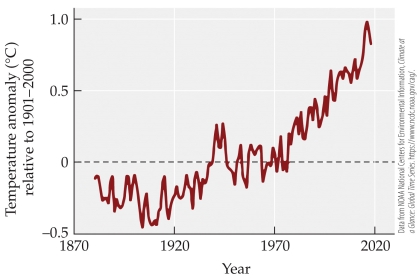 The figure shows mean annual global temperature anomalies between 1880 and 2019.
-
Between 2000 and 2019, temperatures
The figure shows mean annual global temperature anomalies between 1880 and 2019.
-
Between 2000 and 2019, temperatures (Multiple Choice)
4.8/5 (74)
(74) Some of the more radical proposals to address and mitigate climate change involve geoengineering, which involves deliberately modifying Earth's climate. Evaluate how the actions listed would affect the global climate and global biogeochemical cycles by answering the questions that follow.
Option 1: Plant more trees.
Option 2: Build one or more giant reflective mirrors and send them into Earth's orbit.
Option 3: Fertilize ocean water with iron.
Option 4: Spray sulfuric acid as aerosol into the stratosphere.
-
How would option 4 (spray sulfuric acid into the stratosphere) affect global climate? What effect would it have on greenhouse gas levels in the atmosphere? What effect would option 4 have on the sulfur cycle? What is a potential negative effect of this option?
(Essay)
4.8/5 (79)
(79) Refer to the map.

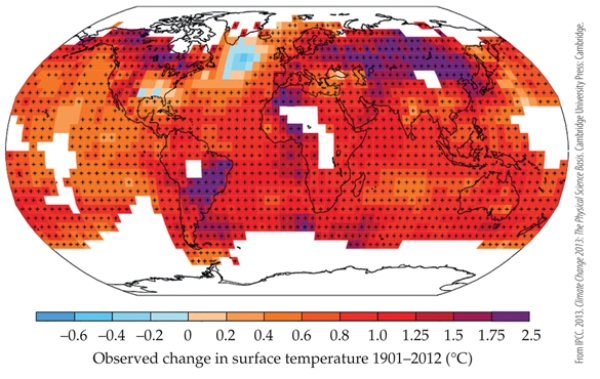 The map shows the temperature change in °C across different regions of the globe from the averages of 1901‒2012. According to the map, how much warmer is Paris in 2012 than in 1901?
 (Multiple Choice)
4.8/5 (79)
(79) Which statement about ozone in the lower atmosphere is false?
(Multiple Choice)
4.8/5 (70)
(70) 
Filters
- Essay(0)
- Multiple Choice(0)
- Short Answer(0)
- True False(0)
- Matching(0)