



 Chat with AI
Exam 19: Species Diversity in Communities

Exam 1: The Web of Life68 Questions
Exam 2: The Physical Environment76 Questions
Exam 3: The Biosphere73 Questions
Exam 4: Coping With Environmental Variation:74 Questions
Exam 5: Coping With Environmental Variation: Energy71 Questions
Exam 6: Evolution and Ecology68 Questions
Exam 7: Life History69 Questions
Exam 8: Behavioral Ecology71 Questions
Exam 9: Population Distribution and Abundance80 Questions
Exam 10: Population Dynamics68 Questions
Exam 11: Population Growth and Regulation69 Questions
Exam 12: Predation70 Questions
Exam 13: Parasitism72 Questions
Exam 14: Competition74 Questions
Exam 15: Mutualism and Commensalism71 Questions
Exam 16: The Nature of Communities71 Questions
Exam 17: Change in Communities73 Questions
Exam 18: Biogeography70 Questions
Exam 19: Species Diversity in Communities72 Questions
Exam 20: Production73 Questions
Exam 21: Energy Flow and Food Webs76 Questions
Exam 22: Nutrient Supply and Cycling76 Questions
Exam 23: Conservation Biology73 Questions
Exam 24: Landscape Ecology and Ecosystem Management71 Questions
Exam 25: Global Ecology74 Questions
Select questions type


Refer to the figure.
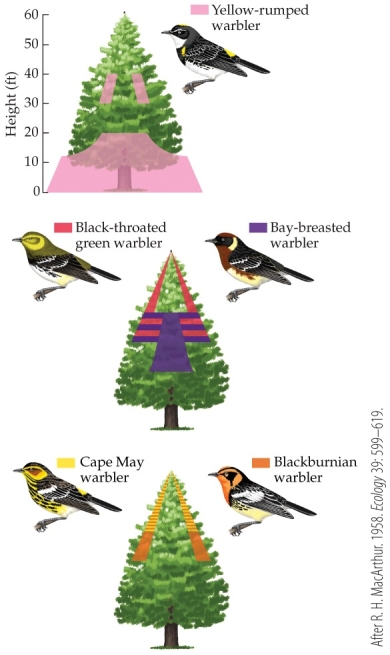 Robert MacArthur studied different species of warblers in New England forests that feed on the same prey within the tree canopy. His detailed figures of their activity within the canopy suggest that the different species
 (Multiple Choice)
4.9/5  (70)
(70) Refer to the figures.
Figure 1
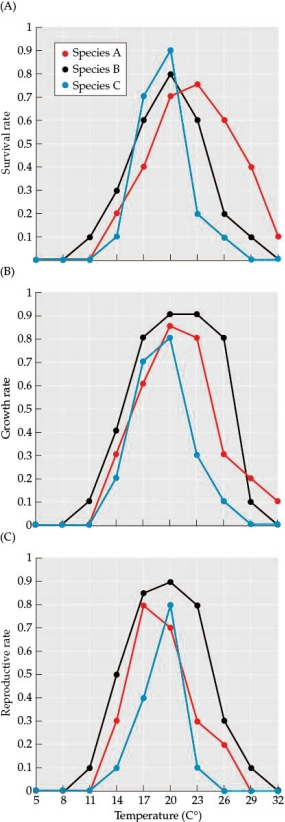 Figure 2
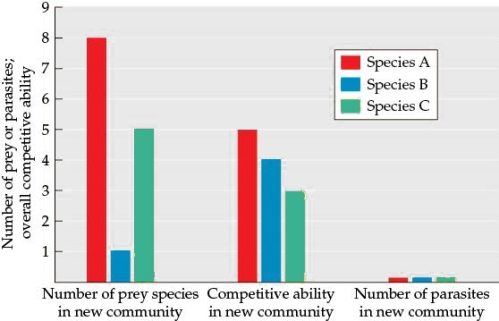 You are evaluating three snail species to determine their overall threat as invasive species to an area. You bring several individuals of each species into your lab to test their tolerance of a range of abiotic and biotic factors. Figure 1 shows how the three snail species respond to differences in average temperature and Figure 2 shows the number of prey and parasite species for each of the species in the new areas, along with how competitive each potential invasive species will be in the new community (higher numbers indicate that the species will be a more successful competitor).
-Based solely on species-level tolerances of biotic factors (Figure 2), which snail species pose(s) the least threat as an invasive species in the new area, based on the three types of data collected, and why? Which species might be most affected by biotic resistance? How would the presence or absence of predators impact the ability of the potential invasive species to compete with native species?
Figure 2
You are evaluating three snail species to determine their overall threat as invasive species to an area. You bring several individuals of each species into your lab to test their tolerance of a range of abiotic and biotic factors. Figure 1 shows how the three snail species respond to differences in average temperature and Figure 2 shows the number of prey and parasite species for each of the species in the new areas, along with how competitive each potential invasive species will be in the new community (higher numbers indicate that the species will be a more successful competitor).
-Based solely on species-level tolerances of biotic factors (Figure 2), which snail species pose(s) the least threat as an invasive species in the new area, based on the three types of data collected, and why? Which species might be most affected by biotic resistance? How would the presence or absence of predators impact the ability of the potential invasive species to compete with native species? (Essay)
4.9/5 (95)
(95) Humans impact all of the factors that determine which species end up in a local community, including those that lead to the introduction of invasive species such as the zebra mussel (Dreissena polymorpha) in the Great Lakes. Which factor did humans most impact which led to the zebra mussel's invasion of the Great Lakes?
(Multiple Choice)
4.9/5 (77)
(77) Which of the following is not a prediction of the idiosyncratic hypothesis of diversity-function relationships?
(Multiple Choice)
4.8/5 (77)
(77) In 1993, an unknown virus infecting humans was determined to be a pathogen carried by
(Multiple Choice)
4.9/5 (85)
(85) Refer to the figure.
Figure 6
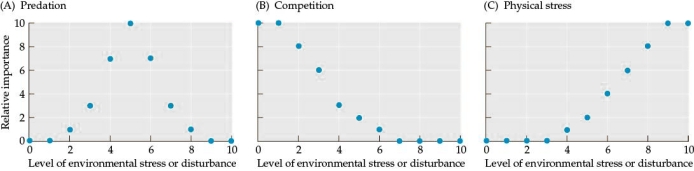 You are studying a new area to determine how disturbances affect species diversity. You study the impact of several different types of stress or disturbance on species diversity (predation, competition, and physical stress) in a community in your study area. You collect data on the relative importance of each type of stress/disturbance. The data are shown in Figure 6. Sketch a line connecting the points in the scatter plots to indicate the relationship between stress/disturbance and the relative importance of each factor in Figures A-C. Determine how your data differ from predictions of the Menge-Sutherland Model. Which factor(s) differ from predictions? On the figures, indicate a factor that differs with a curve that represents the actual prediction from the model (this will be referred to as Figure 7).
 (Essay)
4.9/5 (85)
(85) Which statement about Sale's studies of fishes in the Great Barrier Reef of Australia is true?
(Multiple Choice)
4.9/5 (85)
(85) Which of the following is not an assumption of a neutral model of species coexistence?
(Multiple Choice)
5.0/5 (84)
(84) Refer to the figure.
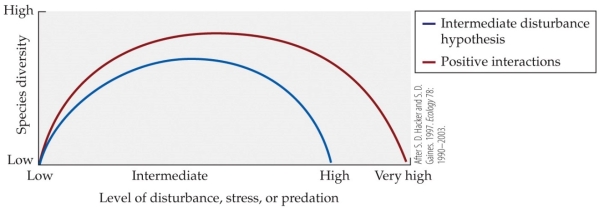 The figure illustrates Hacker and Gaines' extension of the intermediate disturbance hypothesis. Which statement does not align with the predictions of this model?
 (Multiple Choice)
4.9/5 (88)
(88) What was Hutchinson's explanation for the "paradox of the plankton"?
(Multiple Choice)
4.8/5 (89)
(89) Refer to the table.
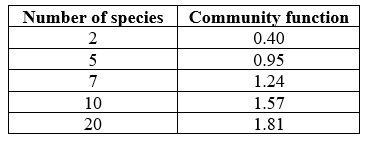 The table shows the results of experiments in which biologists manipulated the number of plant species in several fields in order to examine their effects on community function. Subsequent work found that each species had relatively similar effects on community function. These results are most consistent with the _______ hypothesis.
 (Multiple Choice)
4.9/5 (76)
(76) Refer to the figures.
Figure 1
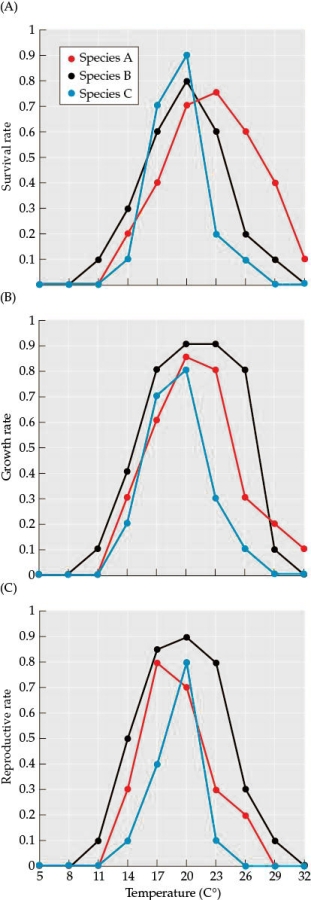 Figure 2
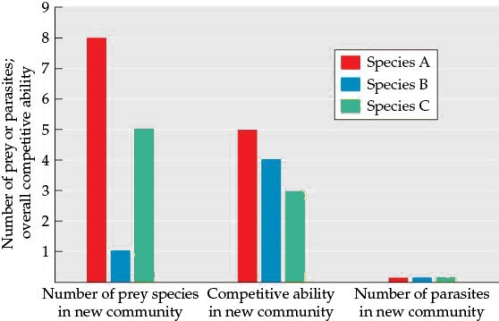 Figure 3
 You are evaluating three snail species to determine their overall threat as invasive species to an area. You bring several individuals of each species into your lab to test their tolerance of a range of abiotic and biotic factors. Figure 1 shows how the three snail species respond to differences in average temperature and Figure 2 shows the number of prey and parasite species for each of the species in the new areas, along with how competitive each potential invasive species will be in the new community (higher numbers indicate that the species will be a more successful competitor).
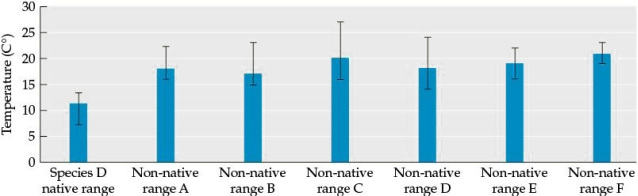
-Suppose a fourth snail species (Species D) has successfully invaded six different communities. The average summer temperatures for species D's native area and the six areas it invaded are shown in Figure 3 (columns indicate average temperatures; error bars indicate the total range of temperatures). What insight do these data provide into the biology of Species D? Compare Species D's ability to tolerate the conditions in these new areas and successfully invade the communities to the case of the Caulerpa seaweed that invaded the Mediterranean. Which factors explain how Species D was able to colonize these new areas, and how similar is this to the case of Caulerpa? Justify your answer.
Figure 2
Figure 3
You are evaluating three snail species to determine their overall threat as invasive species to an area. You bring several individuals of each species into your lab to test their tolerance of a range of abiotic and biotic factors. Figure 1 shows how the three snail species respond to differences in average temperature and Figure 2 shows the number of prey and parasite species for each of the species in the new areas, along with how competitive each potential invasive species will be in the new community (higher numbers indicate that the species will be a more successful competitor).
-Suppose a fourth snail species (Species D) has successfully invaded six different communities. The average summer temperatures for species D's native area and the six areas it invaded are shown in Figure 3 (columns indicate average temperatures; error bars indicate the total range of temperatures). What insight do these data provide into the biology of Species D? Compare Species D's ability to tolerate the conditions in these new areas and successfully invade the communities to the case of the Caulerpa seaweed that invaded the Mediterranean. Which factors explain how Species D was able to colonize these new areas, and how similar is this to the case of Caulerpa? Justify your answer. (Essay)
4.9/5 (93)
(93) Which model assumes the absence of competitive hierarchies among species?
(Multiple Choice)
4.8/5 (83)
(83) Refer to the figure.
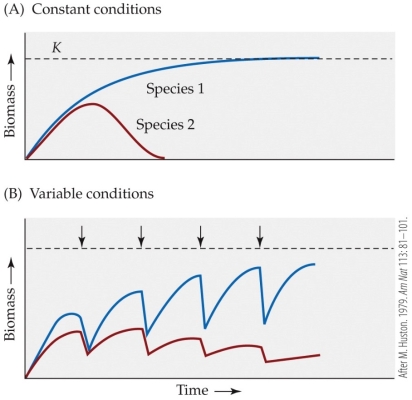 Huston expanded on Hutchinon's work by exploring the outcome of two species in competition under constant versus variable conditions. Which conclusion can be drawn from his theoretical figure?
 (Multiple Choice)
4.8/5 (79)
(79) In Wayne Sousa's tests of the intermediate disturbance hypothesis, he found that boulders in the intertidal fields of California varied in how frequently they were rolled over by waves. Which statement about boulder size in relation to disturbance is true?
(Multiple Choice)
5.0/5 (90)
(90) According to the Menge-Sutherland model, increasing recruitment tends to _______ the relative importance of predation in determining species diversity and _______ the relative importance of physical stresses.
(Multiple Choice)
4.8/5 (97)
(97) Refer to the table.
Table 1
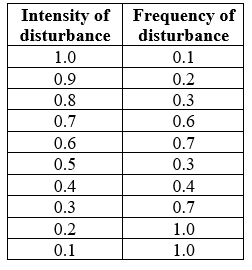 You are studying a new area to determine how disturbances affect species diversity. You collect data on the intensity and frequency of disturbances in your study area, as shown in Table 1. Use the data in the table to answer the following questions:
a) Graph the relationship between intensity of disturbance and frequency of disturbance as a scatter plot (this will be referred to as Figure 4).
b) Which type of disturbance occurs more frequently? Which type of disturbance is more unusual? Which type of disturbance occurs at moderate frequencies?
c) Based on your answer to (a) and your knowledge of Joseph Connell's disturbance hypothesis (as described in the textbook), under which condition would you expect species diversity to be highest? State the name of this hypothesis, describe your prediction, and circle this area on the scatter plot you created to answer (a) (this will be referred to as Figure 5).
d) What additional data would you require and what modifications would you make to properly examine how your study system fits the predictions of the dynamic equilibrium model?
You are studying a new area to determine how disturbances affect species diversity. You collect data on the intensity and frequency of disturbances in your study area, as shown in Table 1. Use the data in the table to answer the following questions:
a) Graph the relationship between intensity of disturbance and frequency of disturbance as a scatter plot (this will be referred to as Figure 4).
b) Which type of disturbance occurs more frequently? Which type of disturbance is more unusual? Which type of disturbance occurs at moderate frequencies?
c) Based on your answer to (a) and your knowledge of Joseph Connell's disturbance hypothesis (as described in the textbook), under which condition would you expect species diversity to be highest? State the name of this hypothesis, describe your prediction, and circle this area on the scatter plot you created to answer (a) (this will be referred to as Figure 5).
d) What additional data would you require and what modifications would you make to properly examine how your study system fits the predictions of the dynamic equilibrium model? (Essay)
4.8/5 (87)
(87) According to Hutchinson's model for coexistence of plankton species, coexistence is likely when environmental change takes place _______ the process _______.
(Multiple Choice)
4.8/5 (77)
(77) Based on examples from the text, which statement about studies of zoonotic disease transmission is false?
(Multiple Choice)
4.8/5 (76)
(76) Who was the first person to test competitive exclusion in nature?
(Multiple Choice)
4.8/5 (74)
(74) 
Filters
- Essay(0)
- Multiple Choice(0)
- Short Answer(0)
- True False(0)
- Matching(0)