



 Chat with AI
Exam 24: Landscape Ecology and Ecosystem Management

Exam 1: The Web of Life68 Questions
Exam 2: The Physical Environment76 Questions
Exam 3: The Biosphere73 Questions
Exam 4: Coping With Environmental Variation:74 Questions
Exam 5: Coping With Environmental Variation: Energy71 Questions
Exam 6: Evolution and Ecology68 Questions
Exam 7: Life History69 Questions
Exam 8: Behavioral Ecology71 Questions
Exam 9: Population Distribution and Abundance80 Questions
Exam 10: Population Dynamics68 Questions
Exam 11: Population Growth and Regulation69 Questions
Exam 12: Predation70 Questions
Exam 13: Parasitism72 Questions
Exam 14: Competition74 Questions
Exam 15: Mutualism and Commensalism71 Questions
Exam 16: The Nature of Communities71 Questions
Exam 17: Change in Communities73 Questions
Exam 18: Biogeography70 Questions
Exam 19: Species Diversity in Communities72 Questions
Exam 20: Production73 Questions
Exam 21: Energy Flow and Food Webs76 Questions
Exam 22: Nutrient Supply and Cycling76 Questions
Exam 23: Conservation Biology73 Questions
Exam 24: Landscape Ecology and Ecosystem Management71 Questions
Exam 25: Global Ecology74 Questions
Select questions type


The composite of heterogeneous elements of a landscape is known as a(n)
(Multiple Choice)
4.8/5  (66)
(66) Which of the following is not a predicted result from the doubling of the atmospheric concentration of carbon dioxide in Yellowstone National Park?
(Multiple Choice)
4.9/5 (74)
(74) Assuming all other factors are equal, which statement about the success of core natural areas as a conservation measure is false?
(Multiple Choice)
4.8/5 (83)
(83) Janzen's work converting pasturelands to tropical dry forest is an example of
(Multiple Choice)
4.8/5 (84)
(84) Refer to the figure.
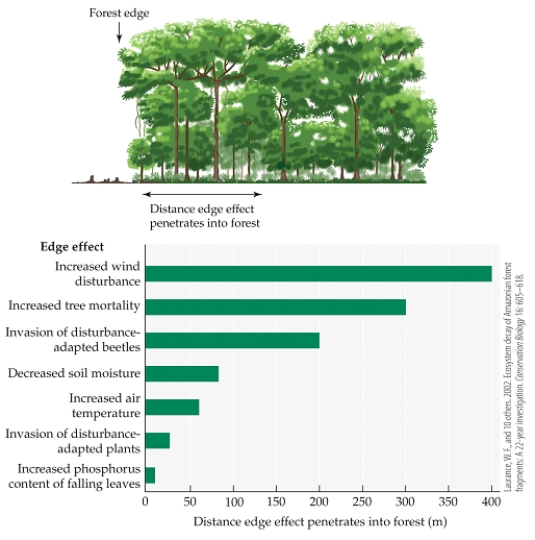 The figure shows the extent of different edge effects in Amazon rainforest fragments.
-Suppose a forest fragment is 600 m × 600 m. What fraction of the fragment would experience decreased relative humidity?
The figure shows the extent of different edge effects in Amazon rainforest fragments.
-Suppose a forest fragment is 600 m × 600 m. What fraction of the fragment would experience decreased relative humidity? (Multiple Choice)
5.0/5 (91)
(91) Refer to the figure.
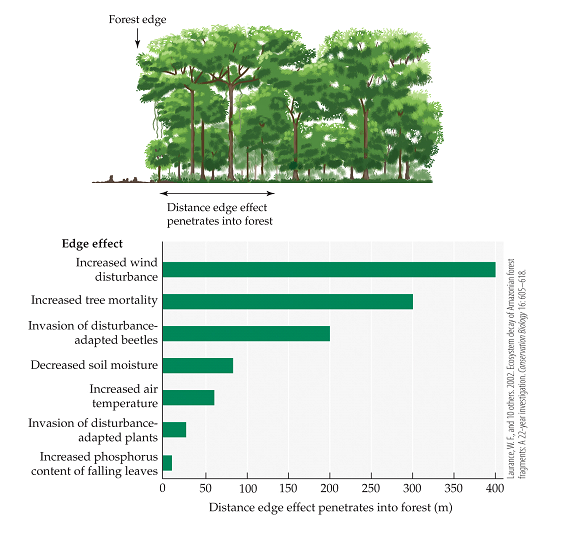 The figure shows the persistence of edge effects in Amazon rainforest fragments. Suppose a forest fragment is 500 m × 500 m. What fraction of the fragment would experience decreased relative humidity due to edge effects?
 (Multiple Choice)
4.8/5 (67)
(67) Terborgh and colleagues' studies showed that _______ were more abundant on the small and medium-sized islands in Lago Guri in Venezuela than in the remaining intact forest.
(Multiple Choice)
4.8/5 (74)
(74) Refer to the figures.
Figure 1
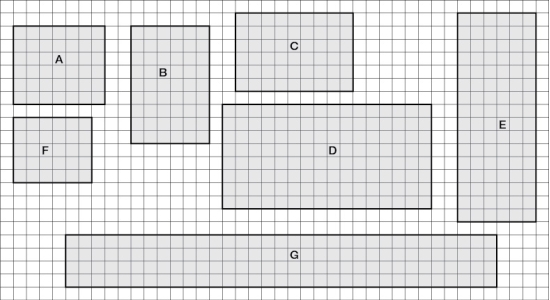 Figure 2
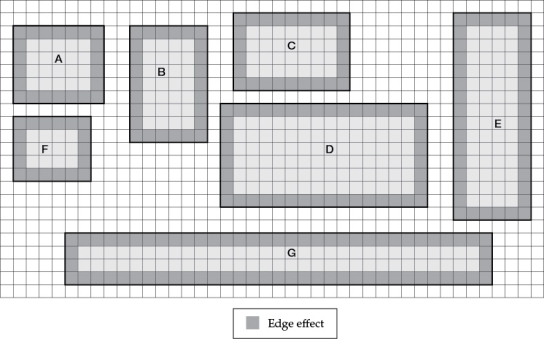 Figure 4
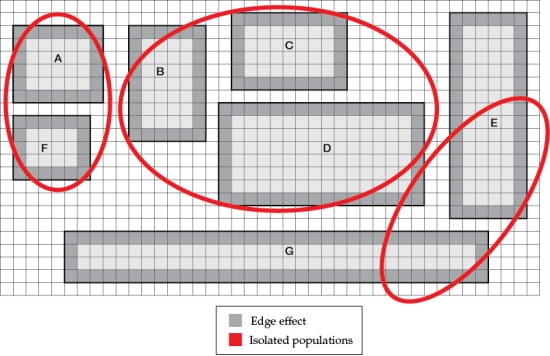 You are working with a town to develop a conservation strategy for parks (tracts) of protected land in a suburban area (parks A-G). These seven areas are depicted in Figure 1. Each square in the grid indicates an area of 1 km2.
- Refer to Figure 1 to familiarize yourself with the key aspects of the protected areas. Suppose you are the park manager in this area, and you have the option to build a limited number of habitat corridors to connect different parks to one another and reconnect the populations of birds that have been isolated from one another by the 1 km edge effect. However, your budget is limited. What is the minimum number of habitat corridors that would be required to reconnect the isolated populations of birds you (see Figure 4)? Where would you create these corridors, and why? On Figure 2, indicate the areas you would choose to create habitat corridors (this will be referred to as Figure 5).
Figure 2
Figure 4
You are working with a town to develop a conservation strategy for parks (tracts) of protected land in a suburban area (parks A-G). These seven areas are depicted in Figure 1. Each square in the grid indicates an area of 1 km2.
- Refer to Figure 1 to familiarize yourself with the key aspects of the protected areas. Suppose you are the park manager in this area, and you have the option to build a limited number of habitat corridors to connect different parks to one another and reconnect the populations of birds that have been isolated from one another by the 1 km edge effect. However, your budget is limited. What is the minimum number of habitat corridors that would be required to reconnect the isolated populations of birds you (see Figure 4)? Where would you create these corridors, and why? On Figure 2, indicate the areas you would choose to create habitat corridors (this will be referred to as Figure 5). (Essay)
4.7/5 (91)
(91) The recovery of the wolf in the upper Midwest regions of Minnesota, Wisconsin, and the Upper Peninsula of Michigan during the 1990s and 2000s was such a success, the idea of allowing the hunting of grey wolves has been considered in order to reduce depredations. Such a decision is an example of
(Multiple Choice)
4.8/5 (80)
(80) 
Filters
- Essay(0)
- Multiple Choice(0)
- Short Answer(0)
- True False(0)
- Matching(0)