



 Chat with AI
Exam 4: Embryology

Exam 1: Anatomy265 Questions
Exam 2: Behavioral Sciences178 Questions
Exam 3: Biochemistry102 Questions
Exam 4: Embryology59 Questions
Exam 5: Epidemiology, Biostatistics, and Medical Informatics94 Questions
Exam 6: Genetics88 Questions
Exam 7: Histology46 Questions
Exam 8: Immunology147 Questions
Exam 9: Microbiology and Virology330 Questions
Exam 10: Pathology817 Questions
Exam 11: Pharmacology and Toxicology509 Questions
Exam 12: Physiology339 Questions
Exam 13: Psychiatry and Psychotherapy23 Questions
Select questions type


A 1-hour-old boy is being treated in the neonatal critical care unit for tachypnea and hypoxia. Due to frequent varied decelerations, the child was delivered through cesarean section at 39 weeks gestation. A lack of prenatal care hampered the pregnancy. The baby weights 3.2 kilograms (7 lb 1 oz). A flattened nose and bilateral club feet are discovered during a physical checkup. Breath sounds are significantly reduced bilaterally. The baby is intubated and mechanically ventilated, but his oxygen levels remain unchanged. He passes away one hour later. Which of the following is most likely to be discovered during this infant's autopsy?
(Multiple Choice)
4.8/5  (87)
(87) A 5-month-old kid arrives at the clinic for right-sided scrotal hypertrophy. The growth has been present since birth and worsens when he screams or attempts to urinate. There has been no trauma or illness. The boy's parents do not feel he is in discomfort, and no darkening of the region has been observed. The enlargement is discovered on ultrasonography to be a fluid accumulation around the right testis. Which of the following is a direct result of the precise embryologic abnormality that caused this patient's condition?
(Multiple Choice)
4.9/5 (88)
(88) A 30-year-old man arrives to the emergency department complaining of acute abdominal discomfort. The patient's discomfort began yesterday and has been progressively severe. He has also acquired bilious emesis in the previous several hours. The patient has never had surgery before. The temperature is 37.8 degrees Celsius (100 degrees Fahrenheit), and the pulse rate is 110 beats per minute. During palpation, there is broad abdominal soreness with guarding. Abdominal imaging demonstrates thickening of the gut wall within a blind pouch attached to the ileum. A laparotomy is carried out. During the surgery, a fibrous band is visible connecting the pouch's end to the umbilicus. Which of the following is most likely used to make the pouch's walls?
(Multiple Choice)
4.8/5 (73)
(73) A 41-year-old lady with gravida 0 arrives at the office for a pregnancy evaluation. Her menstruation began at the age of 12, and it lasted 5 days. The patient and her spouse have been trying to conceive for a year and plan to have sexual relations within her reproductive window, according to the ovulation prediction test. She has no medical issues, no prescriptions, and no allergies. The BMI is 23 kg/m22. The vital signs and physical exam are normal. When would the -hCG level in the serum be detected if fertilization and implantation happened this cycle?
(Multiple Choice)
4.9/5 (86)
(86) A 22-year-old man visits the clinic because he has periodic dull headaches that wake him up from sleep. There are no related neurologic impairments in the patient. There is no family history of migraines. His temperature is 37.2 degrees Celsius (99 degrees Fahrenheit), his blood pressure is 140/80 mm Hg, his pulse is 60 beats per minute, and his respirations are 12 beats per minute. On physical examination, his trunk has multiple 3- to 5-cm flat, pigmented patches. On his trunk and neck, there are also many subcentimeter soft, fleshy, cutaneous tumors. Which of the following structures is most likely the source of the majority cells developing these skin tumors?
(Multiple Choice)
4.8/5 (80)
(80) A 2-month-old kid is taken to the emergency room because of increased "floppiness" and poor eating. The child was delivered in Eastern Europe to a 38-year-old lady in an uneventful vaginal birth and later relocated to the United States with his family. The parents describe their child as a "excellent baby" who seldom cries and sleeps through the night but has recently been difficult to wake up for nursing. Stool frequency has also been reduced to every other day, and they are tiny and pellet-like. A hypotonic child with a big anterior fontanelle, large tongue, and a reducible umbilical hernia is seen on physical examination. He has a low tone and is unable to stand on his own. There are no additional abnormalities found. Which of the following is the most likely cause of this patient's condition?
(Multiple Choice)
5.0/5 (97)
(97) Researchers researching neural crest cell migration in a human baby see normal activity beginning during the eighth week of embryogenesis, with a brief pause during the 12th week, when migration is generally completed. As a result of this disruption, which of the following structures is most likely to be devoid of innervation?
(Multiple Choice)
4.8/5 (81)
(81) A 3-day-old boy is brought to the ER owing to poor feeding, emesis, and lethargy over the previous 24 hours. The patient was born to a 30-year-old lady who had a normal pregnancy by straightforward spontaneous vaginal birth. The boy was released from the newborn nursery yesterday and was solely nursing until the beginning of symptoms. While he was in the newborn nursery, his stool and urine production were typical. The patient is awake and normal in blood pressure, but tachycardic and tachypneic. He seems dehydrated, with a swollen belly. During the examination, the patient vomits, and the vomitus is depicted in the display. 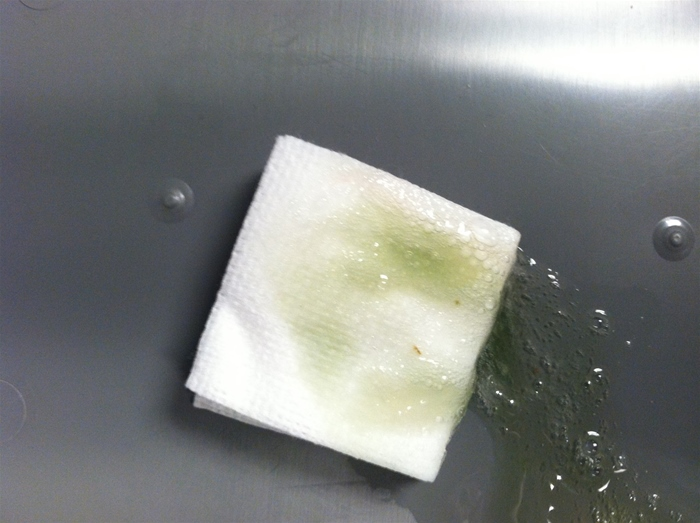 On laparotomy, fibrous bands are seen extending from the cecum and right colon to the retroperitoneum, causing extrinsic compression of the duodenum. Which of the following embryologic processes most likely failed in this patient?
 (Multiple Choice)
4.8/5 (60)
(60) Shortly after delivery, a boy is inspected in the newborn nursery. He was delivered vaginally at full term to a 40-year-old lady who had not received prenatal care. His temperature is 36.7 degrees Celsius (98 degrees Fahrenheit), his pulse rate is 132/minute, and his respirations are 38 per minute. Slanted palpebral fissures, epicanthal folds, broad nuchal folds, and a single palmar wrinkle are all visible on examination. The patient has a huge, reducible midline abdominal protrusion that is covered by skin and becomes more visible when he screams. The stump of the umbilical cord is at the middle of the protrusion. Which of the following is the most likely source of the abdominal discovery in this patient?
(Multiple Choice)
5.0/5 (79)
(79) A 32-year-old lady arrives at the office with dyspnea at 28 weeks pregnant. She has been experiencing shortness of breath when lying down but has no other symptoms. During her pregnancy, the patient had no prenatal treatment. She has a history of epilepsy, which she manages with medicine. She lives with her spouse and does not smoke, drink, or use illegal drugs. Her vaccines are current, and she does not have any allergies. The uterine size is bigger than predicted for gestational age, according to physical examination. Sonographic examination reveals significantly high amniotic fluid levels. Which of the following prenatal abnormalities is most likely to be the cause of this patient's polyhydramnios?
(Multiple Choice)
4.8/5 (68)
(68) A 15-year-old girl is brought to the office because she is experiencing amenorrhea. She has never menstruated, although her mother did at the age of 14. The patient does not have any chronic medical issues and does not use any medications. She does not smoke, drink, or use illegal drugs. The patient is the captain of her junior varsity tennis team and plays violin for her high school orchestra. She has no sexual desires. Weight is 65 kg and height is 175.3 cm (5 ft 9 in) (143.3 lb). 21.2 kg/m2 is the BMI. Secondary sexual features are fully established, according to the examination. A shorter vaginal canal with a rudimentary uterus is shown on a pelvic ultrasound. Which of the following diagnoses is more likely?
(Multiple Choice)
4.9/5 (84)
(84) Pathological alterations that can occur during embryonic kidney development are being investigated by researchers at a national foundation for prematurity and birth abnormalities. Their study focuses on the inductive signals that are exchanged between the metanephric diverticulum and metanephric blastema, which promote their development into tissues that compose the adult kidney. Which of the following adult derivatives will fail to develop if a toxic insult occurs during early fetal development that preferentially inhibits the renal structures generated by the metanephric blastema?
(Multiple Choice)
4.8/5 (92)
(92) In the nursery, a newborn boy is being assessed. The patient was delivered through cesarean section at 39 weeks gestation to a 30-year-old primigravida. The 75th to 90th percentiles are reached for head circumference, weight, and length. The fontanelle anterior is open and soft. The neck is flexible. The cardiopulmonary exam was unremarkable, and the abdomen was soft. The back looks to be ordinary. A hip test reveals no hip clicks. Both feet are flexed and adducted, with the soles pointing medially. Both feet are resistant to range of motion testing. Muscle tone is normal, and neonatal reflexes are fully functional. Which of the following types of congenital defects are most likely represented by the aberrant results on this patient's physical examination?
(Multiple Choice)
5.0/5 (88)
(88) A 32-year-old woman with gravida 4 para 0 arrives at the clinic for an examination of recurrent pregnancy loss. She has had four spontaneous abortions in a row with the same man. The patient's menstrual periods are 28 days apart, with minor bleeding for 2-3 days in between. She has no chronic medical concerns and does not use any drugs on a regular basis. The patient does not smoke, drink alcohol, or use illegal drugs. The exhibit displays the results of her hysterosalpingogram. 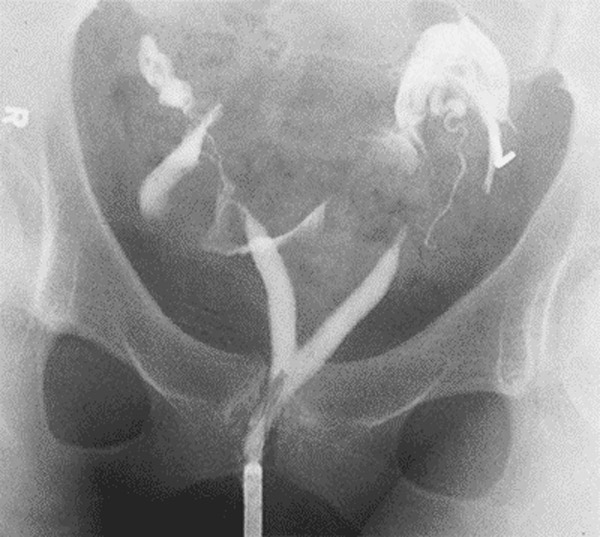 Failure of which of the following processes is the most likely underlying mechanism of this patient's condition?
 (Multiple Choice)
4.9/5 (90)
(90) Non-fusion of the urethral folds creates the labia minora and the vaginal vestibule in normal female development. Non-fusion of the urethral folds in men would most likely result in which of the following?
(Multiple Choice)
4.9/5 (81)
(81) The five measures of fetal blood oxygen saturation are: 67, 61, 56, 52, and 31%. Which of the following vessels is most likely to have the highest value?
(Multiple Choice)
4.9/5 (78)
(78) A 23-year-old man arrives to the office complaining of lethargy, loss of appetite, and nonspecific abdominal pain over the past two weeks. There has been no nausea, vomiting, changes in bowel habits, dysuria, urine frequency, or hematuria in the patient. He underwent an appendectomy at the age of 15 for acute appendicitis; his medical history is otherwise normal. He does not use smoke or alcohol and has not traveled recently. At the age of 60, his father was diagnosed with colon cancer. Normal bowel sounds and no guarding or rebound discomfort are seen on physical examination. The picture below is an abdominal CT scan taken as part of this patient's examination. 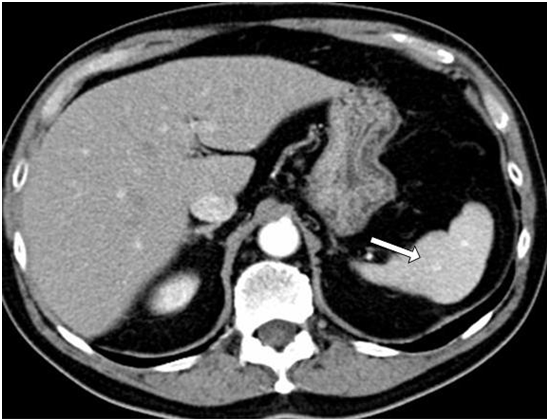 The anatomical structure indicated by the arrow originates from which of the following embryologic divisions?
 (Multiple Choice)
4.8/5 (70)
(70) A 4-week-old kid is sent to the hospital due to frequent vomiting, fussiness, and feeding resistance. The emesis started clean but turned bilious in the past three hours. The baby had been solely breastfed. His body temperature is 37.2 degrees Celsius (99.0 F). Blood pressure and pulse rate are also normal. A normal abdomen with no rebound or guarding is revealed by physical examination. An upper gastrointestinal series is obtained urgently to evaluate for malrotation and volvulus and shows normal rotation but constriction of the duodenum. A CT scan of the abdomen reveals pancreatic tissue around the duodenum. Which of the following is most likely to be the source of this patient's condition?
(Multiple Choice)
4.9/5 (82)
(82) A infant is checked in the delivery room immediately after a 38-year-old lady gives birth vaginally. Bipolar disorder and persistent hypertension affected the mother's pregnancy, which was worsened by sporadic prenatal care. The mother's interview displays forced and disjointed discourse. "I take my prescribed medications when I remember," she says, adding, "I have an excellent memory, and I took the meds the majority of the time throughout the pregnancy." She admits to smoking cigarettes on occasion, but changes the subject when asked if she took any other substances while pregnant. The infant has a nondysmorphic face and a mass covering the lower spine that is covered by a patch of hair, according to an examination. Which of the following maternal interventions could have most likely prevented this neonate's abnormalities?
(Multiple Choice)
4.7/5 (94)
(94) 
Filters
- Essay(0)
- Multiple Choice(0)
- Short Answer(0)
- True False(0)
- Matching(0)