



 Chat with AI
Exam 4: Embryology

Exam 1: Anatomy265 Questions
Exam 2: Behavioral Sciences178 Questions
Exam 3: Biochemistry102 Questions
Exam 4: Embryology59 Questions
Exam 5: Epidemiology, Biostatistics, and Medical Informatics94 Questions
Exam 6: Genetics88 Questions
Exam 7: Histology46 Questions
Exam 8: Immunology147 Questions
Exam 9: Microbiology and Virology330 Questions
Exam 10: Pathology817 Questions
Exam 11: Pharmacology and Toxicology509 Questions
Exam 12: Physiology339 Questions
Exam 13: Psychiatry and Psychotherapy23 Questions
Select questions type


A 32-year-old man arrives to the emergency room with a one-day history of severe abdominal discomfort, nausea, and vomiting. His agony is persistent and spreads all the way to his back. He admits to having "had a few drinks" with some buddies a few days earlier. Laboratory tests show that amylase and lipase levels are considerably high. An abdominal CT scan reveals pancreas divisum, a common congenital defect caused by the inability of the ventral and dorsal pancreatic primordia's pancreatic ductal networks to merge during development. The ventral pancreatic primordium gives rise to which of the following pancreatic structures?
(Multiple Choice)
4.9/5  (91)
(91) Following an easy pregnancy, a newborn is delivered vaginally at 38 weeks gestation. The neonate is in respiratory distress immediately after birth. A physical examination reveals cyanosis, tachypnea, and poor perfusion. The patient is intubated as soon as possible, and mechanical ventilation is started. In addition, a nasogastric tube is placed. Auscultation reveals asymmetric aeration with diminished left-sided breath sounds. The abdomen has a scaphoid shape. The display includes a chest x-ray. 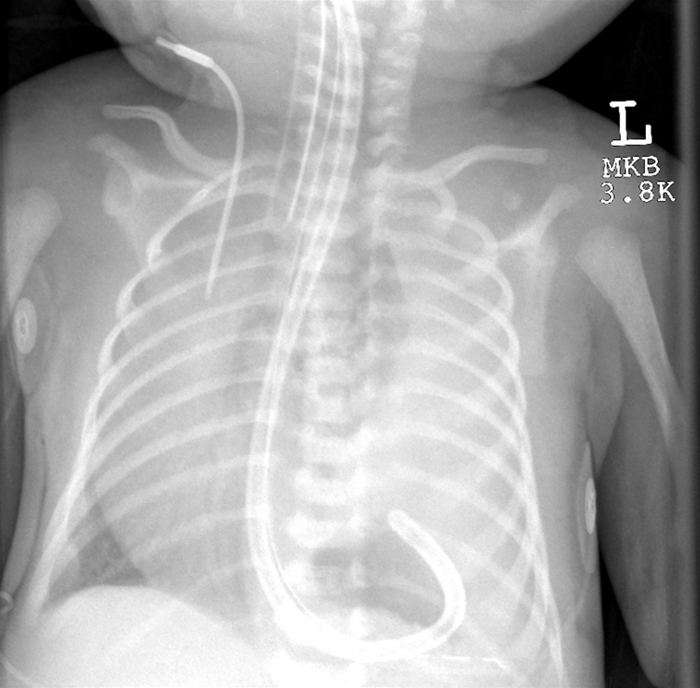 Which of the following is the most likely cause of this patient's respiratory distress?
 (Multiple Choice)
4.8/5 (74)
(74) A 55-year-old man was admitted to the hospital due to the suspicion of having sepsis. The patient was diagnosed with pneumonia in a private clinic, 3 days ago. During the previous days, his temperature was not controlled by regular antipyretics. On examination, his blood pressure is 80/50, his pulse is 110/min and regular and his temperature is 40 C. During the evaluation, a central catheter was placed, that passes through the structure indicated by the arrow in the image. What is the origin of this structure?
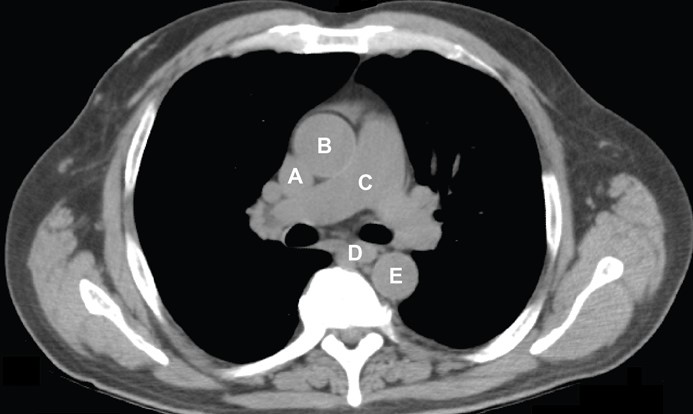
(Multiple Choice)
4.9/5 (85)
(85) A 37-year-old woman is sent to the emergency room after experiencing abrupt right arm weakness and trouble speaking. Although she has no relevant medical history, she uses oral contraceptives. The examination reveals a decline in right upper extremity strength as well as expressive aphasia. Cardiac auscultation is completely normal. A brain MRI demonstrates an acute infarction in the left frontal lobe. An etiology is determined by further examination. During an echocardiogram, bubbles are visible flowing into the left side of the heart after agitated normal saline is injected into a peripheral vein. Which of the following is the most likely source of this patient's observed finding?
(Multiple Choice)
4.8/5 (90)
(90) A 41-year-old lady with gravida 0 arrives at the office for a pregnancy evaluation. Her menstruation began at the age of 12, and it lasted 5 days. The patient and her spouse have been trying to conceive for a year and plan to have sexual relations within her reproductive window, according to the ovulation prediction test. She has no medical issues, no prescriptions, and no allergies. The BMI is 23 kg/m22. The vital signs and physical exam are normal. When would the -hCG level in the serum be detected if fertilization and implantation happened this cycle?
(Multiple Choice)
4.8/5 (95)
(95) A 35-year-old woman, gravida 2 para 1, arrives at the office for a prenatal exam. The patient claims she had been using condoms for birth control and had became pregnant inadvertently. Her last period was two months ago, and home pregnancy tests came back positive. She did not take prenatal vitamins. The patient has a 5-year-old daughter who was born following a smooth pregnancy. She has a history of rheumatoid arthritis, and methotrexate treatment helps her joint discomfort. There are no additional medical issues or drugs that the patient is taking. She does not smoke, drink, or use illegal drugs. Vital signs are normal, and a physical examination reveals no abnormalities. Serum Beta-hCG is elevated, and transvaginal ultrasonography shows a normal gestational sac and embryo. This patient's unborn child is at the greatest risk for which of the following congenital defects?
(Multiple Choice)
4.8/5 (61)
(61) After a car accident, a 38-year-old woman is taken to the emergency room. She was not hurt in the crash, but she insists she did not notice the automobile that hit her along the front side of her vehicle. The patient also reported experiencing everyday migraines and not having menstruated in 4 months. There is bitemporal hemianopsia but no other abnormalities on physical examination. A brain MRI is depicted below. 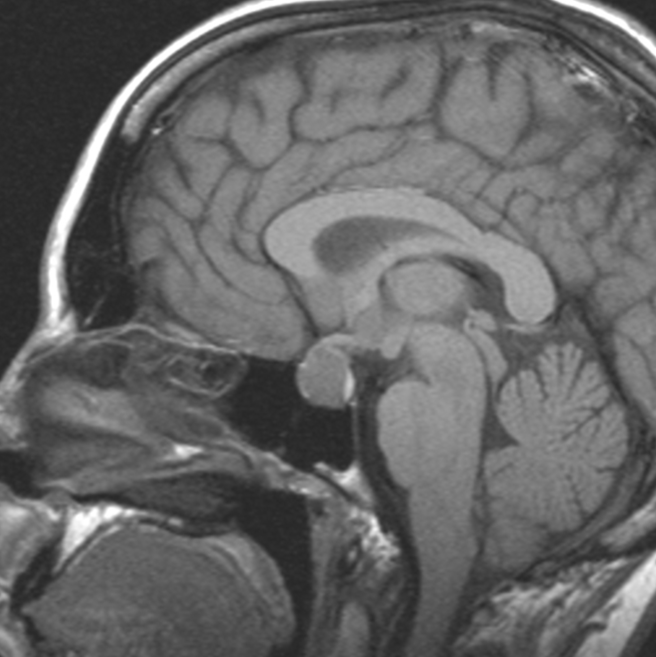 This patient's lesion most likely originates from which of the following embryologic layers?
 (Multiple Choice)
5.0/5 (75)
(75) At 12 weeks gestation, a 40-year-old woman with gravida 5, para 0, aborta 4, presents to the emergency department with vaginal bleeding, midline pelvic discomfort, and severe nausea and vomiting. She has had four previous first-trimester miscarriages. A 16-week-sized uterus is discovered during a pelvic check. A vaginal speculum examination reveals dark crimson blood. A -hCG level of more than 100,000 mIU/mL is detected, and an ultrasound reveals no baby and a uterine cavity filled with many tiny cysts. In the operating theater, the patient undergoes dilatation and curettage, and a friable mass of tissue composed of multiple thin-walled cysts is evacuated from her uterus. Which of the following karyotypes would most likely be revealed by tissue examination?
(Multiple Choice)
4.9/5 (86)
(86) A 33-year-old man arrives at the clinic after experiencing episodic headaches for many months, which are accompanied by perspiration and anxiety and disappear spontaneously within 15-30 minutes. He has no other medical issues and does not use any medications. His sibling just underwent hyperparathyroidism surgery. The blood pressure is 180/110 mm Hg and the pulse rate is 102/min. The laboratory findings reveal that the serum electrolytes and renal function are normal. An abdominal CT scan indicates a tumor in the right adrenal gland. Which of the following cells shares an embryological origin with the tissue causing this patient's present condition?
(Multiple Choice)
4.7/5 (72)
(72) The parents of a 3-week-old kid with umbilical discharge bring him to the clinic. His postnatal history was straightforward, with the chord shriveling about 14 days of life. Vital indicators are typical. A minor reducible umbilical hernia, little clear to straw-colored drainage from the umbilicus, and erythema around the region are discovered during an examination of the area. The following are the laboratory results: 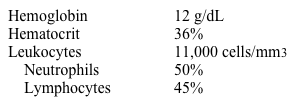 Which of the following is the most likely cause of this child's condition?
 (Multiple Choice)
4.9/5 (82)
(82) Due to recurrent vomiting and reluctance to feed, a 3-day-old child is taken to the emergency room by her parents. Vomiting started early in the morning and has been greenish-yellow in hue. There is no blood in the emesis. The baby appeared to be dehydrated. Her heart rate is 175 beats per minute, and her blood pressure is normal. Following the completion of the first assessment, the infant will have a laparotomy. A normal-looking duodenum, the lack of a substantial section of jejunum and ileum, and the remains of the distal ileum looping around a slender vascular stalk are among the findings. Which of the following intrauterine processes is most likely to be at the root of this patient's condition?
(Multiple Choice)
4.8/5 (81)
(81) A 34-year-old primigravida walks in for a normal prenatal assessment at 18 weeks gestation. The patient's pregnancy was straightforward. She takes a prenatal vitamin every day, and her test results have been normal so far. Personal and family medical histories for the patient are unremarkable. A comprehensive prenatal ultrasound performed during the appointment showed unilateral hydronephrosis. Male external genitalia can also be seen. Which of the following is the most likely location of fetal hydronephrosis if it is caused by obstruction?
(Multiple Choice)
4.8/5 (86)
(86) A 35-year-old woman with gravida 2 para 1 walks in for an usual prenatal appointment. Her first kid was born with a hydrocele and first and second toe syndactyly. Except for a multivitamin, the patient has no severe medical concerns and is not on any drugs. The lungs are clean, and the first and second heart sounds are normal. The abdomen is nontender and soft. Uterine size, fetal mobility, and fetal heart activity are all within normal ranges. During the 18th week of pregnancy, the patient has an amniocentesis. Acetylcholinesterase levels in amniotic fluid are elevated. Which of the following procedures is most likely to have failed in this patient's amniocentesis results?
(Multiple Choice)
4.8/5 (75)
(75) Because of respiratory problems, an infant is transported to the neonatal intensive care unit shortly after birth. The baby was born on time, and there were no difficulties during pregnancy or delivery. After the patient has been stabilized, a thorough physical examination is undertaken. The neonate's jaw is undeveloped, and his zygomatic bones are hypoplastic. A gene mutation causes aberrant development of the first and second pharyngeal arches, according to genetic tests. Which of the following structures in this patient is most likely abnormal?
(Multiple Choice)
4.9/5 (83)
(83) A 16-year-old obese primigravida girl arrives to the ER in active labor. The patient did not undergo prenatal care or take prenatal vitamins in order to conceal her pregnancy from her family. Her fetal heartbeat is undetectable, and she vaginally delivers a stillborn child. The stillborn has multiple dysmorphic characteristics, including narrowly set eyes and a midline lump consistent with a proboscis. An autopsy of a fetus reveals merged cerebral hemispheres, a missing forebrain fissure, and a single intracranial ventricle. Which of the following mechanisms is most likely to explain these findings?
(Multiple Choice)
4.8/5 (82)
(82) A 6-hour-old kid is having feeding challenges in the newborn nursery. The patient was delivered through cesarean section at 39 weeks gestation to a 33-year-old primigravida owing to fetal heart tracing failure and late decelerations. Although the Apgar scores were 8 and 9, an examination revealed an infant who was drooling and coughing excessively. At rest, cardiac, respiratory, and abdominal tests are normal. When the newborn tries to nurse, he experiences many bouts of coughing and perioral cyanosis, with an oxygen saturation of 85% on room air. Which of the following is most likely to be the source of this patient's condition?
(Multiple Choice)
5.0/5 (87)
(87) A 1-week-old kid is brought to the ER with poor eating, lethargy, and odd "muscle motions" involving the left thumb and hand during the previous two days. The patient's mother had adequate prenatal care, had a normal pregnancy, and did not use any drugs other than prenatal vitamins. The infant's vital signs are normal, but cuff blood pressure measurement reveals remarkable bending of the left wrist and thumb and extension of the fingers. A hypoplastic mandible, low-set ears, bifid uvula, and cleft palate are discovered during a physical examination. An x-ray of the chest shows reduced soft-tissue attenuation in the right anterior mediastinum. Which of the following embryonic structures is most likely affected by these findings?
(Multiple Choice)
4.9/5 (69)
(69) A 5-year-old youngster is brought to the office by his parents for cyanosis examination with no effort. The youngster has experienced instances of "turning blue" that began in infancy and are now becoming more regular. Throughout the episodes, the youngster squats because it makes him "feel better." The boy's family recently emigrated to the United States, and he had never received a medical examination previous to this visit. A significant right ventricular impulse and a loud systolic murmur are discovered during physical examination. Which of the following embryological events is the most likely cause of this patient's condition?
(Multiple Choice)
4.9/5 (88)
(88) A 35-year-old man visits the emergency room with recurrent stomach discomfort. He was involved in a full-speed collision with another player during a soccer game yesterday. He was experiencing generalized abdomen pain at the time but did not seek medical attention until this morning, when the agony seemed to grow. A CT scan of the abdomen is obtained as part of the patient's examination, as illustrated in the image below. It is found that his damage affects an organ that is primarily fed by a foregut artery, despite the fact that the organ itself is not a foregut derivation. Which of the following organs in this patient is most likely to be injured? 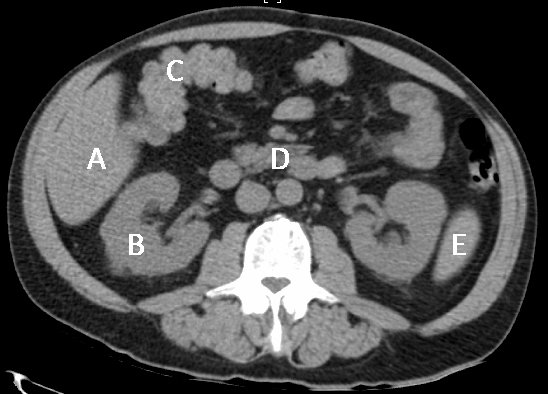
(Multiple Choice)
4.8/5 (76)
(76) A 3-year-old girl is evaluated in the pediatric clinic due to exercise intolerance. The patient can not play with her peers, due to the shortness of breath and exercise intolerance. On examination, the patient was found to have continuous machinery murmur below the clavicle. Additionally, she has strong bounding pulses peripherally. The patient presentation involves an artery derived from which of the following embryological structures?
(Multiple Choice)
4.9/5 (71)
(71) 
Filters
- Essay(0)
- Multiple Choice(0)
- Short Answer(0)
- True False(0)
- Matching(0)