



 Chat with AI
Exam 3: Psychiatry

Exam 1: Medicine2 k Questions
Exam 2: Pediatric723 Questions
Exam 3: Psychiatry336 Questions
Exam 4: Surgery563 Questions
Exam 5: Obstetrics & Gynecology469 Questions
Select questions type


A 3-year-old girl is brought to the clinic for evaluation after she hit a teacher for putting banana slices on her plate. Her mother says, "She's never been aggressive before, but she has always been particular about food. She likes bread and pasta but screams if I put avocados or broccoli on her plate. She's always been pretty easy to take care of-she stacks blocks on her own for hours at a time, which allows me to focus on my 6-week-old." The patient recently started preschool after the birth of a baby sister. She was born at full term without complications and has no significant medical history. The patient is able to kick a ball, draw a circle, pedal a tricycle, and say 4-word phrases. Vitals signs are normal, and she is tracking adequately on growth curves. During the evaluation, the patient sits in the corner of the room playing with blocks. She does not follow her mother's gaze when she points to other toys in the office. When the physician tries to examine her, she begins screaming and rocking backward and forward. Which of the following best explains this patient's behavior?
(Multiple Choice)
4.7/5  (73)
(73) A 62-year-old woman is hospitalized for cellulitis and prescribed antibiotic pharmacotherapy. On the morning following admission, the patient becomes diaphoretic, tremulous, anxious, and tachycardic. A few hours later, she has a generalized tonic-clonic seizure. Medical history is significant for depression, chronic hepatitis C virus infection, multiple substance use disorders, hypertension, and hyperlipidemia. The patient is minimally adherent to medication. Temperature is 37 C (98.6 F), blood pressure is 139/87 mm Hg, pulse is 103/min, and respirations are 16/min. Examination is significant for persistent anxiety, tremulousness, and diaphoresis. Laboratory results are as follows: 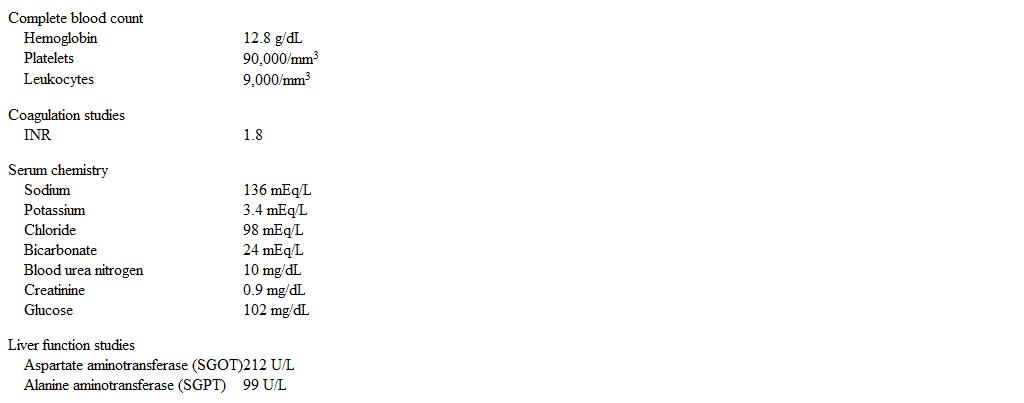 Which of the following is the most appropriate pharmacotherapy for this patient's condition?
 (Multiple Choice)
4.8/5 (82)
(82) A 35-year-old man with schizophrenia is brought to the mental health clinic by his parents. They say that his prescription for risperidone ran out, and they are worried because he is not sleeping well, is hardly eating, and has not showered for the past several weeks. The patient reluctantly admits to hearing voices telling him to "do bad things." However, he becomes guarded and refuses to elaborate when asked to describe what the voices say or whether he has followed their directives. The patient has a history of 4 psychiatric hospitalizations and a suicide attempt a year ago. He lives with his elderly parents and is unemployed. On mental status examination, the patient is noted to be unkempt and malodorous. He is highly anxious, makes no eye contact, and paces around the room. At one point, he whispers something while staring out the window. The patient's speech is tangential and sometimes difficult to follow. When asked about suicidal or homicidal ideation, he shakes his head to indicate "no." Which of the following is the most appropriate next step in management of this patient?
(Multiple Choice)
4.9/5 (83)
(83) An 11-year-old boy is brought to the office by his mother for assessment of behavioral issues. His mother explains that he has "not been himself" since starting middle school a few months ago. The patient has become increasingly argumentative with his parents and becomes irritable with his siblings for no clear reason. He spends most of his time in his bedroom and comes out only to eat dinner, quickly returning to his room after only a few bites. He watches TV late into the night due to restlessness, struggles to fall asleep, and then complains that he is tired the next day. The patient used to regularly attend soccer practice and spend time with friends afterward but recently said that he is "bad at" the sport and wants to quit the team. A teacher has expressed concern that his grades have dropped from a B to a C average, that he is not engaged in class, and that his work has become "sloppy." When interviewed without his mother present, the patient says, "I just wish people would leave me alone." The patient does not use alcohol or illicit drugs. Vital signs are normal, and physical examination shows no abnormalities. He makes poor eye contact and fidgets with his clothes. Which of the following is the most likely diagnosis in this patient?
(Multiple Choice)
4.9/5 (78)
(78) A 25-year-old woman, gravida 1 para 1, comes to the office with her husband for an 8-week postpartum visit. The pregnancy and delivery were normal and without complications. The patient says, "I'm exhausted and sleep deprived but doing okay." Her husband is concerned about her extreme fatigue; he says she has gotten weaker and unsteady over the past week. He also says she has not been holding the baby as often and rarely goes upstairs to the nursery. The patient reports no depressed mood or appetite changes. Medical history is unremarkable. Blood pressure is 126/84 mm Hg, and pulse is 80/min. On physical examination, the patient appears tired. There is no scleral icterus, and the mucous membranes are pink and moist. The thyroid is not enlarged. Heart and lung sounds are normal, and the abdomen is soft and nontender. There is bilateral lower extremity weakness, left side more than right. Knee reflexes are increased bilaterally. Genital examination shows the episiotomy site has healed, and there is no vaginal discharge. Which of the following is the most appropriate next step in management?
(Multiple Choice)
4.8/5 (91)
(91) An 82-year-old woman is evaluated for confusion and hallucinations while hospitalized. The patient was brought to the hospital by her daughter 2 days ago after she slipped and fell at home while walking up the stairs. She was found to have a left hip fracture and underwent open reduction with internal fixation with no complications. The patient's postoperative pain has been well controlled; however, she has been increasingly anxious and irritable since the day after the surgery. Today, the patient has difficulty attending to conversations with staff. She appears disoriented and distracted by visual hallucinations. The patient has a long-standing history of hypertension, insomnia, anxiety, and mild cognitive impairment. She has no history of alcohol or illicit substance use. Her daughter is unsure of the patient's home medications. The patient is afebrile, blood pressure is 160/98 mm Hg, pulse is 106/min, and respirations are 18/min. Pulse oximetry is 94%. She is tremulous, but the examination is otherwise nonfocal; the surgical wound appears to be healing well. Which of the following is the most likely cause of this patient's new symptoms?
(Multiple Choice)
4.9/5 (88)
(88) A 27-year-old man is brought to the office by his wife due to her concern that "he has not been himself" for the past 3 weeks. She says that he seems sad and withdrawn and has difficulty sleeping, little desire for food, and no energy or interest in looking for work or participating in any activities. The patient was hospitalized 6 months ago after he became aggressive toward his wife. He tried to choke her when she confronted him about staying up all night, gambling away their savings, and investing a large sum of money in a start-up internet company that soon went bankrupt. At that time, the patient spoke very rapidly and was convinced that he had a brilliant plan to achieve world peace. He has experienced several similar episodes of elevated, irritable mood with increased energy over the past 2 years that responded to pharmacotherapy. Which combination of medications is the most appropriate maintenance therapy for this patient?
(Multiple Choice)
4.8/5 (79)
(79) A 32-year-old man is brought to the office by his wife for an evaluation after he was placed on probation at work for frequent absences and arguing with his boss. She says, "I'm not surprised it came to this. For the past 9 months he has had unpredictable mood swings. Sometimes he is irritable and paranoid about his coworkers stealing his job, and other times he is quiet and withdrawn." The wife adds that the patient recently had an outburst during a staff meeting in which he accused the company of hacking into his personal computer; he had to be restrained from throwing punches at a colleague. At today's visit, the patient is cooperative but tense, irritable, and talkative. He is physically restless, mildly tremulous, diaphoretic, and hypervigilant. His speech is pressured and difficult to interrupt. He says, "This is all an unfair plot to get rid of me, and now my wife is involved. I have contributed more to this company than anyone and my business plan is pure genius." Temperature is 37 C (98.6 F), blood pressure is 160/100 mm Hg, pulse is 105 /min, and respirations are 16/min. Pupils are dilated and reactive to light. Which of the following is the most likely explanation for this patient's behavior?
(Multiple Choice)
4.8/5 (60)
(60) A 79-year-old man with Parkinson disease for the past 3 years comes to the office due to poor appetite, weight loss, increased generalized weakness, "difficulty thinking," and impaired sleep over the past 4 months. The patient has become increasingly isolated as his functional abilities have declined and says, "I don't want to live like this anymore. I hope God takes my life already." He is still able to live alone but has stopped seeing his friends and no longer enjoys spending time with his family. The patient has no psychiatric history. He does not use tobacco or alcohol. His only medication is pramipexole. Temperature is 36.7 C (98 F), blood pressure is 144/88 mm Hg, pulse is 74/min, and respirations are 14/min. Examination shows right hand greater than left resting tremor; generalized muscle rigidity; and a slow, shuffling gait, none of which are new. On mental status examination, the patient's affect is blunted and his mood is depressed. He is oriented, states the months of the year backwards very slowly with 2 mistakes, and recalls 3 of 3 items in 5 minutes. Which of the following is the most likely explanation of the patient's new symptoms?
(Multiple Choice)
5.0/5 (84)
(84) A 27-year-old man comes to the office for postdischarge follow-up of a recent psychiatric hospitalization for a depressive episode with suicidal ideation. The patient's depressive episode remitted with intensive inpatient psychotherapy and the initiation of a new medication regimen 1 month ago. The patient has been home for a week and is feeling well. He has a history of migraine headaches, bipolar disorder, and tobacco use disorder. Family history is significant for major depressive disorder in his father. Temperature is 37.5 C (99.5 F), blood pressure is 110/75 mm Hg, pulse is 72/min, and respirations are 14/min. Examination is significant for a maculopapular rash over the patient's left scapula. The patient is unaware of the rash, and discharge paperwork from the previous week does not document any rash. Which of the following medications is the most likely cause of this patient's condition?
(Multiple Choice)
4.8/5 (75)
(75) A 32-year-old woman is brought to the emergency department by police for agitated behavior at work. The patient, who works as an assistant editor at a publishing company, did not show up to work for the previous 2 days. This morning, on arrival in the office, she yelled, "I've written the next bestselling novel!" She then demanded a meeting with the company president to present her plan to launch a nationwide tour for the book. Her coworkers attempted to usher her into the conference room to talk, but she became angry, kicked over a trash can, and threw multiple vases against the wall. The patient has no psychiatric history. Throughout the evaluation, she is hypervigilant and restless. Temperature is 37 C (98.6 F), blood pressure is 158/92 mm Hg, pulse is 102/min, and respirations are 16/min. She appears diaphoretic; pupils are dilated. The patient speaks rapidly and loudly. She says, "They don't appreciate my genius. I'm too good for them." Which of the following is the most likely diagnosis?
(Multiple Choice)
4.7/5 (59)
(59) A 15-year-old boy is brought to the office due to unusual behavior. The patient's mother reports that his behavior began to change 2 months ago, when he started withdrawing from his friends and losing interest in his classes and school activities. During this time, his grades declined, and he spent hours each day developing a code in which certain colors had specific, personal meanings. His mother says, "He insists on wearing the same blue shirt every day. He doesn't even wash it anymore." The patient refuses to ride in the family's gray car because "only primary colors are good." His mother has heard him talking to himself late at night and worries that he is not getting enough sleep. The patient does not use alcohol or illicit drugs. Medical and family history are unremarkable. Vital signs are within normal limits. The patient is tracking appropriately on growth curves. On physical examination, the patient is wearing a stained blue shirt and jeans. Cardiopulmonary examination is normal, and the abdomen is soft and nontender with no hepatosplenomegaly. Neurologic examination is unremarkable. The patient makes minimal eye contact and is slow to respond, but he becomes eager to describe his color system when asked about it. Which of the following is the most likely diagnosis for this patient?
(Multiple Choice)
4.8/5 (84)
(84) A 34-year-old woman comes to the office with her husband due to behavioral changes over the past 6 weeks. The husband says, "She's not an angry person, but ever since she was in a car accident, little things seem to set her off. She yells and honks at people for not using their turn signals and gets upset when we have to wait for a table at restaurants." The patient describes difficulty sleeping due to thoughts "swirling" in her head and feeling panicked every time she wakes up. She does not use illicit substances or take any medications. The patient sustained a wrist fracture in a motor vehicle collision 2 months ago; medical history is otherwise unremarkable. Family history is significant for a brother diagnosed with bipolar disorder. Vital signs and physical examination, including neurological examination, are within normal limits. On mental status examination, the patient appears restless and tired. Which of the following is the best next step in management of this patient?
(Multiple Choice)
4.9/5 (70)
(70) A 15-year-old, previously healthy boy is brought to the clinic by his mother due to declining academic performance and change in behavior. The mother says that the patient used to be a straight A student but has been struggling to keep up in class for the last 3 months. He has also been uncharacteristically moody and irritable. She says, "I recently saw him talking to a wall, but when I asked him about it, he told me to mind my own business." When interviewed privately, the patient says he has been hearing voices at times but is unable to understand what they are saying. Vital signs are within normal limits. Growth tracks above the 60th percentile. Facial expressivity is diminished. The patient's voice is soft, and he has excess saliva. Motor examination shows increased tone in the arms and a mild tremor. Mental status examination is significant for an irritable affect and minimal eye contact. The most likely cause of this patient's underlying condition is an abnormality in which of the following physiologic processes?
(Multiple Choice)
4.8/5 (73)
(73) A 28-year-old man comes to the office due to anxiety. The patient was recently promoted at work, requiring a move from the 2nd to the 15th floor of his office building. He says, "Every time I have to take the elevator to my new office, my heart starts pounding and I can't catch my breath. I am having panic attacks on a daily basis." The patient is distracted at work, spending at least an hour worrying about leaving the building. At night he needs 2-3 hours to fall asleep due to worries about his work performance. The patient has had similar episodes in the past and notes that he has been fearful of heights since adolescence, when he learned that his cousin suffered severe injuries from a fall. He has no other medical or psychiatric history. Which of the following is the most appropriate treatment for this patient's condition?
(Multiple Choice)
4.9/5 (82)
(82) A 15-year-old girl is brought to the clinic by her mother, who became concerned after hearing her daughter vomit in the bathroom on 2 separate occasions last week. The patient is preparing for a debate competition and says that she occasionally vomits from nervousness before an event. She describes intense pressure to perform well in school and gain admission to a prestigious college. Her mother adds that the patient is very self-conscious and frequently worries that her classmates dislike her and that her school uniform makes her stomach look "huge." The patient takes no medications and has no drug allergies. Temperature is 36.2 C (97.2 F), blood pressure is 112/68 mm Hg, pulse is 60/min, and respirations are 16/min. BMI for age is at the 4th percentile. The patient appears slightly anxious and wears baggy clothing. Physical examination shows dental caries, bilateral parotid gland enlargement, scars on the dorsum of the right hand, and a scaphoid abdomen with normal bowel sounds. Which of the following is the most likely diagnosis?
(Multiple Choice)
4.8/5 (77)
(77) A 37-year-old woman comes to the office due to low energy and fatigue. She recently received a promotion at work and was very excited and motivated at first, but she now finds herself procrastinating and having difficulty concentrating. Her mother was recently diagnosed with thyroiditis, and the patient requests a blood test to see if she has it as well. Further history indicates that the patient has had unpredictable "mood swings" for many years, consisting of periods of low energy and "up periods" in which she feels more energetic, confident, and optimistic. These periods vary in length from days to weeks and have no clear relationship to situations in her life. The patient engaged in cutting and self-induced vomiting during her sophomore year in high school but has not exhibited these behaviors since. She has no history of major depressive episodes or psychosis. She uses marijuana "to relax" several times a month, drinks 1 or 2 glasses of wine several times a week, and has tried cocaine twice. The patient takes no medications. Temperature is 37 C (98.6 F), blood pressure is 120/70 mm Hg, and pulse is 64/min. Physical examination shows no abnormalities. Mental status examination shows a sad affect and some lapses in concentration, although the patient brightens easily. Which of the following is the most likely diagnosis?
(Multiple Choice)
4.8/5 (81)
(81) A 74-year-old man comes to the office for a scheduled follow-up after hospitalization for a myocardial infarction 4 weeks ago. The patient has had no new cardiac symptoms and has adhered to his outpatient medication regimen. When asked how he has been, he says, "I just don't feel like my old self." The patient's usual routine has been "disrupted" since he was discharged; he is not meeting with friends and has not been able to read the newspaper all the way through. He naps on his couch during the day and wakes up earlier than he wants to in the morning. The patient's medical history includes diet-controlled diabetes mellitus, hypertension, and obesity. Medications include aspirin, metoprolol, atorvastatin, lisinopril, and sublingual nitroglycerin as needed. Vital signs are within normal limits. Physical examination is unremarkable except for moderate obesity. He reports low mood and appears slowed and subdued. The patient declines psychotherapy. Which of the following is the most appropriate pharmacotherapy?
(Multiple Choice)
4.9/5 (72)
(72) A 28-year old woman comes to the office for follow-up due to depression. She was started on fluoxetine after developing low mood, loss of interest in activities, fatigue, hypersomnia, and carbohydrate craving for 4 weeks. After 8 weeks of treatment, the patient feels partially better but continues to struggle with low energy and weight gain. Although she functions adequately at work, she spends the rest of her time at home, feeling too tired and unmotivated to go out with friends or exercise. The patient has a history of antidepressant treatment for recurrent depressive episodes that start in the late fall and improve by the spring, when she feels significantly better. She usually stops taking medication for several months until the depression returns again. Physical examination is unremarkable. Which of the following is the most appropriate next step in management of this patient?
(Multiple Choice)
4.9/5 (87)
(87) An 11-year-old boy is brought to the office by his mother for a routine examination. She is worried that her son will be laughed at or bullied because of some unusual behaviors. The boy has a 4-year history of episodes in which he clears his throat, grimaces, and blinks his eyes. He has also recently started shrugging his left shoulder, which his mother fears is very noticeable to others. His medical history is otherwise unremarkable. The boy is having difficulty in math but is earning passing grades in other subjects. He has a few friends at school but prefers to play the piano and clarinet by himself after school. The mother notes that his shoulder movements stop when he plays a musical instrument. Physical examination is unremarkable with the exception of sporadic left-sided shoulder shrugs. Which of the following disorders is most likely to develop in this boy?
(Multiple Choice)
4.7/5 (91)
(91) 
Filters
- Essay(0)
- Multiple Choice(0)
- Short Answer(0)
- True False(0)
- Matching(0)