



 Chat with AI
Exam 3: Psychiatry

Exam 1: Medicine2 k Questions
Exam 2: Pediatric723 Questions
Exam 3: Psychiatry336 Questions
Exam 4: Surgery563 Questions
Exam 5: Obstetrics & Gynecology469 Questions
Select questions type


A 25-year-old woman is brought to the emergency department by coworkers following a 15-minute episode of chest pain, shortness of breath, and sweating that started while she was giving a presentation. She is very anxious and says, "It happened so suddenly; my heart was pounding, and I felt like I was going to pass out." The patient first had a similar episode 3 months ago prior to giving a presentation at work and has had a number of episodes since then-while socializing with friends, before taking a flight to visit her parents, and while relaxing at home with her roommate. Now she constantly worries about having another episode. The patient is extremely anxious about speaking in public and has called in sick twice to avoid giving presentations, fearing that the symptoms will recur. She has a history of a benign childhood heart murmur, asthma, and hypothyroidism. Medications include levothyroxine and an albuterol inhaler that she uses infrequently. Temperature is 37 C (98.6 F), blood pressure is 130/85 mm Hg, pulse is 98/min, and respirations are 18/min. Examination shows mild end-expiratory wheezing over the left lower lobe and no other abnormalities. White blood cell count is 9,800/mm3 and TSH level is 4.2 µU/mL. Which of the following is the most likely diagnosis?
(Multiple Choice)
4.9/5  (83)
(83) A 62-year-old woman comes to the office due to insomnia and depressed mood. She describes feeling angry and sad since her husband of 35 years unexpectedly announced that he wanted a divorce 2 months ago. She says, "I was devastated because I thought we had a pretty good marriage, better than most. My whole life has been turned upside down. I can't even think about going on dates at my age." The patient stays up well past her usual bedtime worrying about living alone and supporting herself financially. She recently started drinking wine before bedtime to help her fall asleep. Although she was regularly eating lunch with friends, she has canceled multiple times because she "can't bear to go through the whole story again and again." She has no suicidal ideation. The patient is tearful when discussing the divorce but brightens when asked about her grandchildren. Which of the following is the most likely diagnosis?
(Multiple Choice)
4.9/5 (80)
(80) A 21-year-old man with a history of schizophrenia is brought to the emergency department by his parents for agitation. Over the last month, the patient has exhibited increasingly odd behavior at home, such as accusing the FBI of sending him threatening messages through the radio. Earlier today, he threatened to kill himself and barricaded his bedroom door so that FBI agents would not find him. The patient has been taking olanzapine daily for the past 3 months under the supervision of his parents. Despite treatment, he has been unable to return to school or work and has persistent delusions of reference as well as recurrent episodes of paranoia, self-isolation, and poor hygiene. The patient has had multiple hospitalizations for similar behavior. He was initially treated with haloperidol, which resulted in muscle spasms and an inability to sit still; the patient was then switched to risperidone with minimal improvement of psychotic symptoms. Physical examination and laboratory evaluation are unremarkable. On mental status examination, he appears restless and makes minimal eye contact. Olanzapine is stopped and a new pharmacotherapy is planned. Which of the following is the most appropriate treatment for this patient?
(Multiple Choice)
4.8/5 (68)
(68) A 44-year-old woman comes to the office due to worsening anxiety. Prior to starting her new job 3 months ago, the patient had not suffered from anxiety or any other psychiatric condition. She experiences the demands of her new job as overwhelming and disproportionate to the support and resources she has available at work. Around the same time that she started her new job, the patient began to suffer sudden episodes of palpitations, sweating, pounding headache, and panicky feelings that have recurred every few days for no apparent reason. The patient was also recently diagnosed with hypertension that has only slightly improved with antihypertensive medication. Temperature is 37.2 C (99 F), blood pressure is 184/86 mm Hg, pulse is 91/min, and respirations are 14/min. BMI is 23 kg/m2. The patient appears anxious, mildly tremulous, and diaphoretic on examination. Laboratory results are as follows: 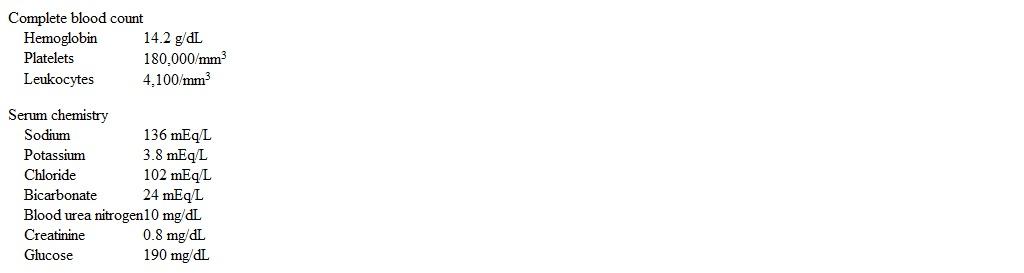 Which of the following is the most likely explanation for this patient's symptoms?
 (Multiple Choice)
4.9/5 (86)
(86) A 55-year-old woman comes to the office due to insomnia and fatigue that began shortly after her divorce was finalized a year ago. The patient used to sleep 7-8 hours without difficulty; however, over the past year she has had increasing difficulty falling asleep and started drinking 2-3 glasses of wine before bedtime to help. Despite falling asleep more quickly, she has recently started to regularly wake up around 3:00 AM. Her symptoms have progressively worsened and she now lies awake for several hours in the middle of the night, thinking and worrying about her future, but she rarely experiences anxiety during the day. She reports mild difficulty with concentration and no change in appetite. The patient experiences occasional brief sadness and loneliness. She has recently started showing up late for work and has stopped attending her weekly exercise class. Medical history includes hypothyroidism, treated with levothyroxine, and gastroesophageal reflux disease, diagnosed 3 months ago and treated with ranitidine. Temperature is 37.2 C (99 F), blood pressure is 140/90 mm Hg, pulse is 90/min, and respirations are 12/min. Physical examination shows a mild tremor but no other abnormalities. Laboratory results are as follows: 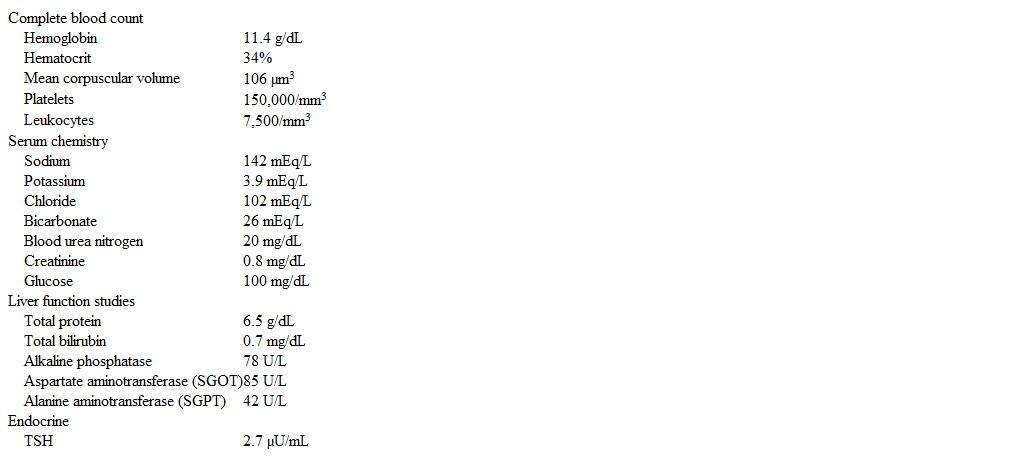 Which of the following is the most likely diagnosis in this patient?
 (Multiple Choice)
4.8/5 (84)
(84) A 35-year-old businesswoman comes to the office due to poor energy. She says, "Although I have no energy, I still can't sleep and am up most of the night. I drag myself to work but barely get anything done because I have no motivation and can hardly concentrate. I'm a horrible wife and mother. I don't want to go out anymore or do anything. All I want to do is hide in my room and get into bed." The patient has a history of 3 prior episodes of depression beginning at age 18. She was also hospitalized 3 years ago for aggressive behavior following an arrest for unauthorized use of her company's funds to finance a personal business venture. At that time, she had excessive energy, slept 2 hours a night, and believed that she had a brilliant idea that would revolutionize the computer industry. The patient has no history of drug or alcohol abuse. There is a family history of depression in her mother, who responded well to tricyclic antidepressants. Mental status examination is remarkable for psychomotor retardation, frequent tearfulness, depressed mood, and suicidal ideation. Which of the following is the most appropriate pharmacotherapy?
(Multiple Choice)
5.0/5 (83)
(83) A 15-year-old girl is brought to the office by her mother for evaluation of moodiness and behavioral concerns over the past year. Her mother says, "She always stays out past curfew. I've already tried grounding her, but she doesn't seem to care. When I ask her to do household chores, she gets extremely annoyed and slams her bedroom door in my face." The patient is failing multiple classes at school and blames her grades on "boring teachers" and being unfairly penalized for handing in assignments late. A few months ago, the patient was sent to the principal's office after refusing to put away her cell phone during a test. When the principal said her phone would be confiscated, she started arguing and impulsively cursed at him, resulting in suspension from school. Family history is significant for bipolar disorder in the patient's maternal aunt and depression in her sister. Physical examination shows no abnormalities. On mental status examination, the patient is irritable and sarcastic, frequently interrupting when her mother is speaking. Which of the following is the most likely diagnosis?
(Multiple Choice)
5.0/5 (80)
(80) A 42-year-old man comes to the office due to depression, weight loss, poor concentration, and insomnia. He feels overwhelmed by his troubled marriage and his wife's comments about his failure to provide for the family. The patient asks that the physician not speak with his wife. He has had suicidal thoughts and wished for death over the past month but has no intent or plan for self-harm. He is diagnosed with depression and sent home with a prescription for an antidepressant. Three days later, the patient's wife calls the physician and demands to know the status of her husband's treatment. She says, "I know he comes to the clinic. What are you giving him? I am the mother of his children, and I have the right to know. Let me tell you a few things about him-he is late for work almost every day and I wouldn't be surprised if he is fired soon. All he does on weekends is sleep and he is totally useless when it comes to helping with the kids." Which of the following is the most appropriate response to the patient's wife?
(Multiple Choice)
4.8/5 (74)
(74) A 40-year-old woman is brought to the emergency department after her boyfriend found her sleeping on the couch with an empty bottle of alprazolam by her side. Earlier today, he received a text message from her that said, "Goodbye, nothing matters anymore." When he attempted to contact her by phone, she did not answer. He drove to her apartment and found that she was difficult to arouse and was slurring her speech. He reports that the patient was very depressed after he brought up the idea of ending their 6-year relationship a month ago. He says, "I saw her about once a week since then, and she seemed to be getting thinner each time. Last week, she told me she was afraid of being fired because she's been late to work 3 days in a row and is only completing about half the amount of work that she usually does." He reports that the patient has had depression on and off throughout her life, but he has also seen her with periods lasting days to weeks when she is unusually upbeat and confident in her abilities. He says, "She would go into the office at 6 AM, get twice as much work done by noon, and go out dancing at night until 1 AM." On physical examination, the patient is mildly sedated and cries throughout the interview. Vital signs are normal. Which of the following is the most likely diagnosis?
(Multiple Choice)
4.8/5 (77)
(77) A 4-year-old boy is brought to the office for a routine visit. He has no medical problems and started preschool 3 weeks ago. The mother is concerned about his adjustment to school as he wants to stay home like his baby sister, frequently takes a long time to get dressed, and becomes upset when dropped off at school. On the first day of school, she was embarrassed when her son stomped his feet, yelled, "Take me home," and wrapped his arms around her legs, physically preventing her from leaving the classroom. The teacher reports that the boy settles down a few minutes after the mother leaves. He is shy but plays with the other children and participates in all class activities. The boy's sleep and appetite are normal, although he refuses to eat anything with peas in it. His growth and developmental milestones are within normal range. Which of the following is the most likely explanation for the boy's behavior?
(Multiple Choice)
4.7/5 (68)
(68) A 17-year-old girl is brought to the emergency department by her parents due to worsening depression. The patient was diagnosed with major depressive disorder and started on escitalopram 3 months ago. Her symptoms had improved on escitalopram but worsened 5 days ago after she was caught cheating on a test at school. Since then, the patient has felt worthless and has started having thoughts of killing herself. The parents share that her suicidal thoughts worsen at night and that she "works herself up," crying and repeatedly apologizing for "being a horrible daughter." The patient says, "I made one mistake, and now my life is ruined. No college is going to accept me." Family history is significant for bipolar disorder in her mother. The patient has been taking increasing amounts of the mother's clonazepam to help her fall asleep. Vital signs are within normal limits. Physical examination is unremarkable. On mental status examination, the patient's hair and clothes are unkempt. She is tearful and makes poor eye contact. Her thought process is linear and organized. Which of the following is the most important factor in assessing this patient's suicide risk?
(Multiple Choice)
4.9/5 (79)
(79) A 32-year-old woman is brought to the office by her husband due to his concern about her increasing social withdrawal. The patient prefers to stay at home. When she must run errands, she insists that her husband accompany her. She stopped working 2 years ago due to severe episodes of anxiety that would occur unpredictably for no apparent reason. Since that time, the patient has continued to experience these episodes several times a week and has become more socially isolated due to fears of having another episode. She avoids seeing her friends except for the rare occasions when they come to her home. The patient feels badly that she is no longer working and contributing to the household finances. She has occasional difficulty falling asleep and problems with concentration. Although she is not looking for work, she keeps her home clean, cooks nightly, and enjoys watching television. Which of the following is the most likely cause of this patient's social withdrawal?
(Multiple Choice)
4.8/5 (80)
(80) A 37-year-old man is brought to the emergency department (ED). Police found the patient running into traffic, yelling obscenities at drivers, slamming his body against passing cars, and trying to break windshields with a beer bottle. A witness described him as having "crazy rage." In the ED, the patient remains combative with police and 4 officers are needed to restrain him. He is disoriented, continues to yell, and appears to be responding to internal stimuli. Temperature is 37.2 C (99 F), blood pressure is 190/96 mm Hg, pulse is 142/min, and respirations are 20/min. Examination shows clear lung fields. The abdomen is soft and nontender. Extraocular movements and cranial nerves are intact. Upper and lower limb deep tendon reflexes are 3+ bilaterally. Serum laboratory results are normal and urine toxicology is negative. While in the ED, the patient has a seizure and is treated with benzodiazepines for both the seizure and the agitation. He is admitted to the medical service and treated supportively. The patient remains psychotic for the next 2 days, but his symptoms then begin to subside and eventually resolve. Which of the following is the most likely explanation for this patient's presentation?
(Multiple Choice)
4.8/5 (68)
(68) A 71-year-old man comes to the office due to "strange visions." He lives alone and has not seen a doctor in 30 years. The patient says, "I started seeing children playing in my yard in the evenings about 2 months ago. What's weird is that my closest neighbors are 2 miles away, and I rarely have anyone visit." He says that this was not too disturbing; however, about a month ago, he started seeing animals scampering throughout his house despite not owning any pets, which caused more alarm. The patient is not forgetful and still drives, goes grocery shopping, prepares meals, and takes care of chores around the house. He says his energy is "not what it used to be," and he has lost his balance a few times but has not fallen. The patient also states that he does not like to socialize but adds that he has "always been like that." He is unaware of any medical diagnoses. Temperature is 37.1 C (98.8 F), blood pressure is 138/89 mm Hg, pulse is 78/min, and respirations are 14/min. The patient scores 29 of 30 (normal: ≥26) on the Montreal Cognitive Assessment. Gait is steady but slow. He has a tremor at rest that is most prominent in the right hand. Reflexes are 3+ on the right and 2+ on the left, and there is resistance to passive movement in all limbs that is worse on the right. Which of the following is the most likely diagnosis in this patient?
(Multiple Choice)
4.8/5 (82)
(82) A 25-year-old woman comes to the office due to abdominal bloating, headache, fatigue, weight gain, mood swings, and decreased libido. She says, "The symptoms last about a week and then seem to subside, but they always come back again." During these episodes, her appetite increases and she craves sweet and salty foods. The episodes have been occurring for years. The patient has a history of depression as a teenager that responded well to cognitive-behavioral therapy and a family history of bipolar disorder in a maternal uncle. She has no recent change in sleep pattern or interest in activities, or feelings of hopelessness or guilt. She takes no medications and physical examination is normal. Complete blood count, serum chemistries, pregnancy test, and TSH levels are within normal limits. Which of the following is the most appropriate next step in management of this patient?
(Multiple Choice)
4.8/5 (80)
(80) A 33-year-old man is hospitalized for depression with psychotic features. The patient had been on outpatient phenelzine therapy for major depressive disorder but stopped taking the medication 3 weeks ago because he did not feel that it was helping. Two days ago, he was brought to the emergency department due to worsening depressive symptoms and new auditory hallucinations. He was started on citalopram and risperidone and admitted to the inpatient psychiatric unit. He has not been receiving any other medications. This morning, he was found to have acute-onset confusion and high fever. Temperature is 39.4 C (102.9 F), blood pressure is 160/80 mm Hg, pulse is 118/min, and respirations are 16/min. On examination, the patient is disoriented and unable to attend to the interview. He has severe muscle stiffness but no hyperreflexia. The remainder of the examination is within normal limits. Laboratory tests are ordered, but results are not yet available. Which of the following is the most likely provisional diagnosis in this patient?
(Multiple Choice)
4.8/5 (83)
(83) A 32-year-old man is brought to the emergency department due to confusion and fever for 2 days. Medical history is significant for bipolar disorder diagnosed a year ago. The patient has been treated with lithium and an antipsychotic medication, and the doses have not changed over the last 2 months. In the emergency department, temperature is 38.8 C (101.8 F), blood pressure is 160/100 mm Hg, pulse is 116/min, and respirations are 22/min. Pulse oximetry is 99% on room air. The patient is not oriented to time, place, or person. Mucous membranes are dry. The lungs are clear to auscultation. Muscle tone is markedly increased. Deep tendon reflexes are 2+. Mild dysarthria and hand tremors are present. Laboratory results are as follows: 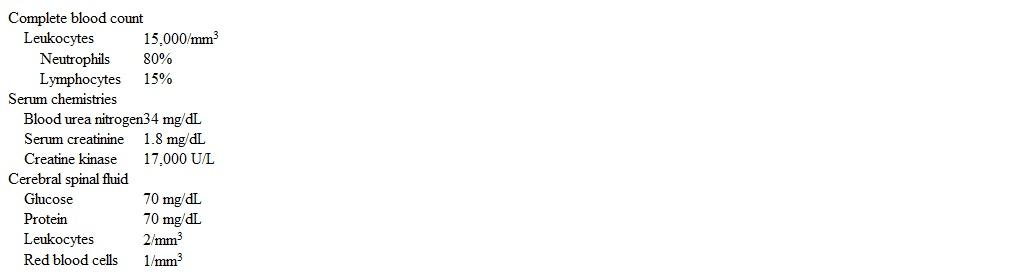 Serum lithium level is 0.9 mEq/L (normal: 0.6-1.2). Which of the following is the most appropriate next step in management of this patient?
 (Multiple Choice)
4.9/5 (94)
(94) A 31-year-old man is brought to the office by his father due to behaving bizarrely and hearing voices. Over the past month, the patient has locked his bedroom door at night and has refused to drink the tea that his mother prepared. He believes that she has been replaced by an imposter and is trying to poison him. When interviewed alone, the patient says, "People are trying to control me through a chip that was implanted in my brain." The patient was hospitalized for an acute psychotic episode at age 27. He was successfully treated with haloperidol, but he discontinued the medication after experiencing muscle spasms in his neck, restlessness, and difficulty sitting still. Medical issues include type 2 diabetes mellitus and seasonal allergies. Physical examination is unremarkable and urine drug screening is negative. Which of the following is the most appropriate pharmacotherapy for this patient?
(Multiple Choice)
4.7/5 (77)
(77) A 61-year-old woman comes to the office accompanied by her daughter due to headaches. The headaches occur 2 or 3 times a week and feel like "a band around my head that someone is constantly tightening." The patient also reports excessive tiredness, restless sleep, and decreased appetite, attributing these symptoms to aging. She has no visual disturbances, dizziness, vomiting, weakness, or other neurologic symptoms. The patient experienced similar headaches a few years ago; after they restarted 2 months ago, she was persuaded by her daughter to get evaluated. The daughter mentions that her mother moved in with her a few months ago due to recent unemployment and financial concerns. Since moving, the patient has not been going out with friends and says, "I get anxious driving from my daughter's house because I don't know the roads." She was diagnosed with type 2 diabetes mellitus 2 years ago; hemoglobin A1c was 5.8% 2 months ago. Medications include metformin and ibuprofen as needed. Medical history is otherwise noncontributory. Vital signs are within normal limits, and physical examination is unremarkable. Which of the following is the most appropriate next step in management of this patient?
(Multiple Choice)
4.8/5 (86)
(86) A woman brings her 17-year-old son to the office for evaluation of his behavior. She reports that he is failing most of his classes despite being smart, and she is worried he will not graduate from high school. He has skipped school regularly since the sixth grade and frequently lies to his mother about his whereabouts. The patient says his teachers are not as smart as he is, and he refuses to do any homework because it is a "waste of time." He has been suspended several times for fighting and was once caught stealing a wallet from the teachers' lounge. The patient uses alcohol and marijuana but is unwilling to say how often. He has tried cocaine but feels it made him "too hyper." His mother reports he often stays out past curfew and has come home intoxicated a few times. The patient sits in an exaggerated slump and appears annoyed about being brought to the appointment. He argues with his mother throughout the evaluation, and his responses to the physician are short and sarcastic. Which of the following is the most likely explanation for the patient's behavior?
(Multiple Choice)
4.8/5 (88)
(88) 
Filters
- Essay(0)
- Multiple Choice(0)
- Short Answer(0)
- True False(0)
- Matching(0)