



 Chat with AI
Exam 3: Psychiatry

Exam 1: Medicine2 k Questions
Exam 2: Pediatric723 Questions
Exam 3: Psychiatry336 Questions
Exam 4: Surgery563 Questions
Exam 5: Obstetrics & Gynecology469 Questions
Select questions type


A 32-year-old man is brought to the emergency department by police after he fell in an empty parking lot while shouting at people who are not visible. He hears two distinct voices telling him to kill himself. The patient frequently perceives voices coming from the radio and television when they are off. He is certain that special government operatives spy on him and follow him everywhere. The patient is unable to describe how long his symptoms have been present. When asked about his psychiatric history, he says he is not ill but has a surgically implanted chip that controls his thoughts. The patient's medical history is unremarkable and he reports that he does not use alcohol or illicit drugs. Physical examination is significant for a bruise on his forehead, which he cannot recall acquiring. Mental status examination shows a flat affect and disconnected thoughts. Routine laboratory testing, urine toxicology, and a CT scan are obtained. When contacted, the patient's mother reports that he has been hearing voices since age 12 and recently stopped taking his medication. Which of the following neuroimaging findings is most likely to be present in this patient?
(Multiple Choice)
5.0/5  (72)
(72) A 67-year-old man comes to the office with his wife due to increasing difficulty performing his job over the past year. He has become more irritable at work and has gotten into arguments with his boss for the first time in 20 years. His office has become increasingly cluttered as he refuses to throw things out, and he has forgotten to submit numerous recent assignments. His wife describes him as withdrawn, emotionally detached, and "not the man I married." She says, "Recently, he wants to eat the same meal every day and has lost interest in golf, which used to be one of his favorite pastimes." The patient has a history of hypertension and hyperlipidemia. He has a 30-pack-year smoking history. The patient scores 25/30 on the Montreal Cognitive Assessment (normal: ≥26). The remainder of the physical examination is normal. Which of the following is the most likely diagnosis in this patient?
(Multiple Choice)
4.9/5 (84)
(84) A 27-year-old man comes to the office due to new-onset depression symptoms. The patient recently earned his master's degree but has struggled to find employment. Over the last 3 months, he has developed worsening dysphoria and often struggles to get out of bed in the morning. He sleeps 14-16 hours each night, feels exhausted throughout the day, has very little appetite, and feels profoundly hopeless and worthless. The patient used to enjoy playing guitar and socializing with friends but has been unable to enjoy these activities recently. He has no history of anxiety or depression and does not use alcohol or other recreational substances. His father has a history of generalized anxiety disorder. The patient takes no medications and has no known drug allergies. Physical examination is within normal limits. A decision is made to start fluoxetine. Which of the following side effects should the physician discuss with this patient prior to prescribing this medication?
(Multiple Choice)
4.8/5 (54)
(54) A 75-year-old man is brought to the office by his wife due to worsening psychosis. The patient has a history of Parkinson disease treated with carbidopa-levodopa and pramipexole. Dosages of both medications were increased 6 months ago to target worsening tremor and bradykinesia, resulting in significant improvement in motor symptoms. However, over the ensuing months, the patient began experiencing paranoia and hallucinations. He has been verbally assaultive toward the mail carrier, claiming that she is stealing from him. The patient has also been observed talking to himself and is often distracted by visual stimuli that are invisible to others. Dose reduction of his antiparkinson medications resulted in significant rebound motor symptoms, requiring resumption of the prereduction doses. Temperature is 36.7 C (98 F), blood pressure is 118/82 mm Hg, and pulse is 62/min. The patient appears suspicious of the examiner and mumbles to himself throughout the examination. Mild rigidity, tremor, and gait instability are present. Which of the following is the most appropriate next step in management of this patient?
(Multiple Choice)
4.7/5 (65)
(65) A 37-year-old man is brought to the emergency department after his brother called the police to report aggressive and disruptive behavior. The brother is worried the patient "took something" that caused him to become violent. The patient appears intoxicated on arrival and attempts to punch several staff members. He is given intramuscular lorazepam and is admitted to the hospital under involuntary status. Temperature is 37.3 C (99.1 F), blood pressure is 138/70 mm Hg, and pulse is 96/min. Physical examination shows a 4-cm laceration on the left forearm with no active bleeding. An hour after admission, the surgical resident examines the patient and recommends wound irrigation and closure. The patient refuses the procedure and says, "I need to sleep. You can come back when I wake up." Which of the following is the most appropriate next step in management of this patient?
(Multiple Choice)
4.7/5 (88)
(88) A 38-year-old man with schizoaffective disorder is brought to the emergency department due to a 5-day history of malaise, loss of appetite, nausea, and abdominal pain. The patient was hospitalized 2 months ago for a manic episode with delusions and hallucinations, and his medication regimen was changed. Since discharge, his psychiatric condition has improved. He has no history of medical illness and does not drink alcohol or use illicit drugs. Temperature is 37.8 C (100 F), blood pressure is 100/65 mm Hg, and pulse is 98/min. Abdominal examination reveals right upper quadrant tenderness. Neurologic examination shows a fine bilateral hand tremor. On mental status examination, the patient appears drowsy but responds to questions. He is oriented to person, place, and year but not month or day. He has no suicidal ideation or auditory hallucinations, and no delusions are elicited. Laboratory results are as follows: 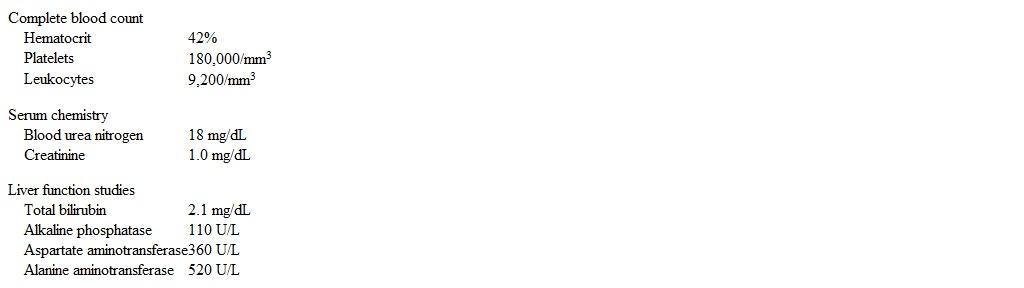 Which of the following medications is most likely responsible for the findings in this patient?
 (Multiple Choice)
4.9/5 (75)
(75) An 18-year-old woman comes to the office due to difficulty sleeping and fatigue. The patient started attending college 2 months ago and lives alone in an apartment near campus. For the past month, she has been increasingly anxious at night and thinks that someone is going to break into her home despite living on the eighth floor in a safe neighborhood. The patient makes sure to check that the front and balcony doors are secure every night and locks her bedroom door before going to bed. She wakes up multiple times a night when her air conditioner turns on or when she hears street noises and often has difficulty falling back asleep. The patient struggles to stay awake during class and is worried that her lack of sleep is beginning to affect her grades. She feels tense when walking alone on campus and spends time with friends only during the day. Vital signs are within normal limits. Physical examination shows no abnormalities. She appears anxious and reports that her mood has been okay. Which of the following is the most likely diagnosis?
(Multiple Choice)
4.8/5 (91)
(91) A 56-year-old woman comes to the office for a follow-up. Six months ago, the patient was diagnosed with major depressive disorder during an evaluation for low energy, poor sleep, weight gain, and difficulty concentrating at work. She was initially treated with escitalopram, but her depressive symptoms were only slightly improved after 2 months of treatment. Her medication was switched to venlafaxine, which was subsequently titrated to maximal therapeutic dosage over the course of 3 months. The patient reports that her depression has improved with treatment, although she still has occasional insomnia. Her energy has increased back to baseline level; she now feels motivated to exercise and has lost 5 pounds. The patient has no other medical conditions and takes no other medications. She does not use tobacco, alcohol, or illicit drugs. Which of the following should be monitored at this visit?
(Multiple Choice)
4.9/5 (92)
(92) A 12-year-old girl is brought to the office by her mother for an annual examination. The mother is concerned about her daughter's weight and restrictive diet, frustrated that "she won't eat certain things that I prepare for the rest of the family." The patient has not eaten red meat since age 11. Six months ago, she decided to stop eating chicken and fish after becoming involved with an animal rights group. The patient spends time researching vegetarian recipes to ensure she obtains all the nutrients she needs and prepares most of her own meals. She has fruit for breakfast and prepares her own lunch and dinner, typically eating foods such as beans, tofu, yogurt, and vegetables with rice or pasta. The mother adds that her daughter's room is "always a complete mess," and that her daughter can be moody and irritable at times, especially when they argue about her diet or the way she dresses. The patient maintains average grades, plays in the school band, and practices regularly with a dance team. She has no medical issues and takes a daily multivitamin. Menarche has not occurred. She weighs 55 kg (121.2 lb) and is 162.5 cm (5 ft 4 in) tall. Vital signs are normal. Examination shows a muscular build, Tanner stage 4 secondary sexual characteristics, and no abnormal findings. When seen without her mother, the patient says she is not concerned about her weight and feels good about her health. She is angry that her family is not more supportive of her beliefs and diet. Which of the following is the most appropriate next step?
(Multiple Choice)
4.9/5 (88)
(88) A 38-year-old woman comes to the office for follow-up of major depressive disorder. She was first seen 2 weeks ago for low mood and irritability, loss of interest, difficulty falling and staying asleep, decreased appetite, and poor concentration at work. At that time, she was started on a therapeutic dosage of escitalopram and weekly psychotherapy. The patient had mild nausea for several days after starting the medication but is now tolerating it without difficulty. She says, "I'm afraid the medication isn't working as well anymore. At first my sleep and appetite were better, but for the past few days I feel like I might be slipping back to where I started." The patient reports that she is stressed because her husband is away on business this week and her father was recently hospitalized for a stroke. Mental status examination shows a mildly depressed mood and sad affect. Which of the following is the most appropriate next step in pharmacological management?
(Multiple Choice)
4.8/5 (75)
(75) A 71-year-old woman is brought to the emergency department by her daughter due to severe fatigue, poor appetite, and a 5-kg (11-lb) weight loss over the past month. The patient's daughter says, "It's been 3 months since my dad died from colon cancer. We've all had a hard time dealing with that, but my mom is just not herself-I've never seen her like this before. She is convinced she is dying and lies in bed most of the day. She used to enjoy going out with friends and would offer to babysit her grandchildren and cook for us. Now, she eats only when I bring over meals I have prepared for her." The patient says, "My insides are rotting away from cancer. I deserve to die for all the terrible things I said to my husband over the years." Physical examination shows no abnormalities. Mental status examination demonstrates orientation to person, place, and time as well as psychomotor slowing and restricted range of affect. The patient has no suicidal ideation. Laboratory evaluation and imaging studies are unremarkable. Which of the following is the most likely diagnosis?
(Multiple Choice)
4.8/5 (81)
(81) A 19-year-old man comes to the university health center after being referred by his professor. The patient says his professor "got annoyed" after he requested several extensions for his first writing assignment. He says, "I've gone through multiple rough drafts, but I need to make sure I submit something great. I don't want my name on just anything." The patient repeatedly mentions that he was valedictorian of his high school class because he was "the most diligent and dedicated student." He developed his own method of test preparation, which includes spending a few hours every morning planning out his daily study schedule. The patient studies alone in the library every evening after classes and on the weekends. He was invited to join a study group but declined because the other students refused to adopt his approach. The patient lives alone and denies having any hobbies because they are a "waste of time." Which of the following best explains this patient's behavior?
(Multiple Choice)
4.8/5 (88)
(88) A 26-year-old man with bipolar I disorder comes to the office for a follow-up visit. He experienced his first manic episode 7 years ago and responded well to lithium. The patient became noncompliant with his medication after his condition improved and then experienced a second manic episode 9 months later. Over the next 5 years, he experienced 3 additional manic episodes, 2 depressive episodes, and a suicide attempt. Since his most recent hospitalization for a manic episode a year ago, he has remained on lithium and has had no depressive, manic, or hypomanic signs or symptoms. The patient also has no medication side effects, and lithium levels confirm that he is compliant. Today, he inquires about the possibility of discontinuing lithium as he has been very stable over the past year and prefers not to "be dependent on medication." There is a history of bipolar disorder in a maternal aunt. Which of the following is the most appropriate recommendation for this patient's condition?
(Multiple Choice)
4.7/5 (71)
(71) A 17-year-old girl comes to the office due to "disturbing images" she has seen over the past year. She says, "I'd be standing in the kitchen helping my mother chop vegetables, and terrible images of stabbing her in the back with a knife would pop into my head." The patient is overwhelmed with anxiety each time this occurs, resulting in putting the knife down and running out of the kitchen. She describes counting down from 5 to 1 several times to try to "get rid" of the thoughts, but this has not been helpful. The patient has no medical history, and physical examination is unremarkable. Mental status examination shows a tense and anxious affect; she becomes tearful when discussing how she would never want to hurt her mother. She reports no depressed mood or suicidal ideation. Which of the following is the most appropriate management for this patient?
(Multiple Choice)
4.8/5 (90)
(90) A 26-year-old man is brought to the emergency department by a colleague due to anxiety. The patient experienced a 15-minute episode of chest pain, shortness of breath, and dizziness prior to giving a presentation at a regional meeting. He says, "My girlfriend used to help me prepare for all of my meetings. She always knew what to say and how to handle everything. I can't manage at work without her." His girlfriend broke up with him 2 weeks ago after a 9-year relationship. The patient's colleague, who has known him since high school, says, "He did everything to make her happy. He let her choose his car and agreed to get a cat even though he's allergic." The patient reports feeling "lost and on edge" since that time and has avoided leaving his apartment. He is anxious about driving on his own and is planning to move in with his parents when his lease expires. The patient denies prior episodes of chest pain, shortness of breath, or dizziness and has no significant medical history. Family history is significant for generalized anxiety disorder in his mother. Vital signs are within normal limits, and physical examination is noncontributory. ECG is normal. Which of the following is the most likely diagnosis in this patient?
(Multiple Choice)
4.8/5 (77)
(77) A 19-year-old man with mild intellectual disability is brought to the office by his mother for a follow-up visit. The patient has worked at the post office for more than a year without difficulty, but his supervisor recently expressed concern about poor performance and a change in behavior. The mother says that the patient has been somewhat sad and nervous around the house lately but has no difficulty with sleep or appetite. The patient continues to go to work and spend time with his family, although he is not as interactive as usual. He avoids eye contact during the interview and appears anxious. When asked questions directly, the patient responds mostly with single-word answers, a departure from his usual friendly and talkative demeanor. The mother says, "He seems like he's depressed. He'd probably feel better if he started on an antidepressant." Which of the following is the most appropriate next step in management?
(Multiple Choice)
4.8/5 (80)
(80) A 24-year-old man is brought to the emergency department by his wife due to bizarre behavior. She noticed a change in his behavior shortly after he started a fasting diet 4-5 days ago. He has become irritable and moody and has been snapping at his wife and children. The patient says that he is being haunted by large, shadowy figures that "come from another world and are trying to take me with them." He has anxiety, is sleeping less than usual, and has stopped going to work. The patient also has abdominal pain, constipation, and a tingling sensation in his fingertips. Medical history includes major depression and gastroesophageal reflux disease. His father also suffered from unexplained psychiatric episodes. The patient does not use tobacco, alcohol, or illicit drugs. His medications include omeprazole and acetaminophen. Temperature is 36.7 C (98.1 F), blood pressure is 140/80 mm Hg, pulse is 110/min, and respirations are 16/min. The abdomen is soft, bowel sounds are decreased, and there is no rebound tenderness or rigidity. Neurologic examination is within normal limits except for decreased sensation in the fingertips and mild weakness in the right arm. Which of the following is the most likely diagnosis in this patient?
(Multiple Choice)
4.9/5 (68)
(68) A 46-year-old woman with alcohol use disorder comes to the office for follow-up. The patient has a prolonged history of heavy alcohol use and was hospitalized 6 months ago due to alcohol-induced pancreatitis. She stopped drinking after the hospitalization but restarted following a fight with her husband a month ago. Her daughters convinced her to stop again, and she has had no drinks for the past 2 weeks. The patient reports no anxiety or shakiness but has had occasional cravings and is afraid that she may relapse again. She has no other medical conditions, takes no medications, and does not use tobacco or illicit drugs. Vital signs are within normal limits, and physical examination shows no abnormalities. In addition to psychosocial interventions, which of the following is the most appropriate pharmacotherapy for this patient?
(Multiple Choice)
5.0/5 (77)
(77) A 42-year-old man comes to the office for a follow-up. He has a history of gastroesophageal reflux disease, hypertension, and alcohol use disorder. Last year, the patient was hospitalized for acute gastritis. During the hospitalization, he went into alcohol withdrawal that was treated with chlordiazepoxide. The patient was abstinent for 2 weeks following discharge but then started drinking 2 or 3 beers several times a week. Over the past several months, he has been drinking 6-10 beers daily. The patient says, "I want to cut down, but the cravings are too strong." He fears he will lose his job and family if he continues to drink. He has had a history of alcohol abuse since age 14 and has smoked 1.5 packs of cigarettes daily for the past 12 years. The patient does not use illicit drugs. There is a family history of alcohol abuse in his mother and heroin abuse in his brother. Vital signs and physical examination are within normal limits. In addition to psychosocial interventions, which of the following is the most appropriate pharmacotherapy for this patient's alcohol use disorder?
(Multiple Choice)
4.9/5 (64)
(64) A 41-year-old woman agrees to talk with the physician at her husband's insistence. She says, "I've always had trouble throwing things away, especially magazines, newspapers, and old clothes. I constantly worry that I may need the items again or will want something after throwing it out." Her husband is concerned that the large piles in their house continue to grow, making it difficult to move around or find a place to sit. He says, "The house has become unlivable; we never have friends or family over because it is too embarrassing. Maybe she acts this way because she was poor growing up, but I don't know how we can continue to live like this." The patient has attempted to clean rooms or throw things away on many occasions but always becomes severely anxious at the thought of parting with various items. She has no problems with sleep, appetite, concentration, or motivation. Which of the following is the most appropriate next step in management?
(Multiple Choice)
4.8/5 (67)
(67) 
Filters
- Essay(0)
- Multiple Choice(0)
- Short Answer(0)
- True False(0)
- Matching(0)