



 Chat with AI
Exam 3: Psychiatry

Exam 1: Medicine2 k Questions
Exam 2: Pediatric723 Questions
Exam 3: Psychiatry336 Questions
Exam 4: Surgery563 Questions
Exam 5: Obstetrics & Gynecology469 Questions
Select questions type


A 17-year-old boy is brought to the emergency department by his parents due to a recent change in behavior. The patient was previously polite and soft-spoken, but he has become intermittently irritable, impatient, and rude over the past few weeks. His parents initially dismissed his new behavior as a "phase"; however, they grew more concerned last night when they discovered that he had stolen money from their wallets and later found him pacing in his room at 4:00 AM. When questioned by his father about his strange behavior, the patient said, "I have to be careful because I'm being followed by CIA agents." He has no medical conditions. His father has chronic pain and insomnia, for which he takes oxycodone and diphenhydramine. Temperature is 36.6 C (97.9 F), blood pressure is 164/98 mm Hg, pulse is 124/min, and respirations are 18/min. On physical examination, the patient appears fearful. He is sweating profusely and his pupils are dilated. He is observed in the emergency department for several hours, his condition improves, and he is discharged to the care of his parents. Which of the following is the most likely diagnosis for this patient?
(Multiple Choice)
4.8/5  (72)
(72) A 20-year-old woman comes to the office due to "feeling low" for the past 2 months. The patient says, "All I do is sleep and cry. I lost my job last week and now I have to move in with my parents. I feel like a failure." She is upset that she has gained weight and says, "My junk food cravings have gotten worse, but I've been too tired to go to the gym to make up for it." The patient does not use alcohol or illicit drugs and takes no medications. Medical history is insignificant. Temperature is 36.7 C (98.1 F), blood pressure is 106/69 mm Hg, pulse is 90/min, and respirations are 16/min. On physical examination, the thyroid is normal to palpation. The lungs are clear to auscultation and heart sounds are normal. The abdomen is soft and nontender. Laboratory results are as follows: 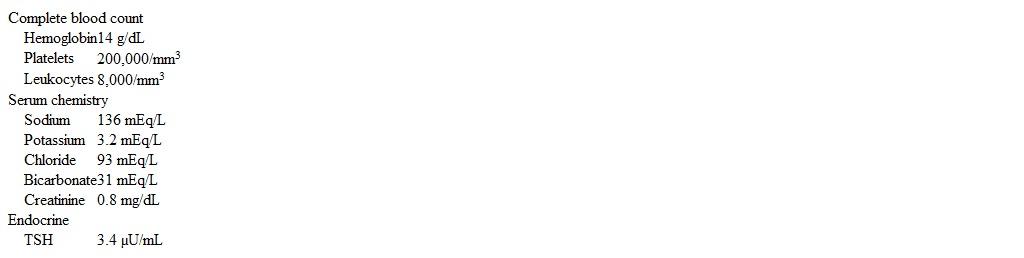 Which of the following medications would be contraindicated in this patient?
 (Multiple Choice)
5.0/5 (79)
(79) A 15-year-old boy is brought to the office by his parents due to concern about a change in his behavior. Over the past 3 months he has become more withdrawn, spending more time alone and turning down opportunities to socialize with his friends. He is frequently moody and irritable. The patient feels unmotivated at school and seems unconcerned that his grades have dropped. His parents believe that his behavior changed after he was rejected by a girl, who subsequently called him a "loser" on social media. When seen alone, the patient says, "I don't think I will ever get over this girl," who he believes was his "soul mate." He uses marijuana occasionally but does not use alcohol. Physical examination is normal apart from a 2.7-kg (6-lb) weight loss since his last visit. He says, "I feel pretty down. I would consider talking to someone or taking medication but don't want to worry my parents." Which of the following is the most appropriate step prior to initiating treatment for this patient?
(Multiple Choice)
4.8/5 (91)
(91) A 20-year-old woman is brought to the emergency department by police at 2:30 AM after she was caught attempting to scale a fence at the White House. The patient appears highly agitated and paces around the examination room. She has just flown in from out of state to "meet with the president about a foolproof plan for eliminating worldwide terrorism." The patient has barely slept for the past week due to her intensive work on this plan. She speaks rapidly but periodically stops to shout, "I'm going to sue all of you for interfering with my right to meet with the president." She refuses a cup of water offered by a nurse, flinging it across the room. The evaluation has to be stopped when the patient begins banging on the door and demanding to leave. Family history is significant for major depression in her mother. Temperature is 37 C (98.6 F), blood pressure is 148/84 mm Hg, pulse is 98/min, and respirations are 22/min. Urine drug screen is negative. Administration of which of the following medications is the most appropriate next step in management of this patient?
(Multiple Choice)
4.9/5 (72)
(72) A 58-year-old woman brings her elderly father to the office for a checkup. He has multiple medical issues, including diabetes, chronic pulmonary disease, and urinary incontinence. While the physician is seeing her father, the woman confides to the office receptionist that she reluctantly quit her job after her father moved in with her. He is no longer able to live independently, and she resents having to care for him. The father was mostly absent during the daughter's childhood due to business travel, and he divorced her mother when the daughter was 13 years old, with only sporadic contact with his children afterward. She also wishes her siblings would help care for him more. When her father comes out of the examination room, the daughter is extremely attentive to him, asking if the visit went okay and if he is comfortable and repeatedly offering to get him a drink of water before they return home. Which of the following defense mechanisms best explains this woman's behavior toward her father?
(Multiple Choice)
4.7/5 (66)
(66) A 21-year-old woman is brought to the emergency department by her roommate. During a first date a week ago, the patient blacked out after a single glass of wine. She woke up naked in her date's apartment and could not remember how she got there. The patient has been anxious and embarrassed about the event and reluctantly told her roommate what happened after she was found crying in the bathroom today. She does not want to involve the police because she wants to "move on." The patient's last menstrual period was 3 weeks ago. Vital signs are normal and physical examination is unremarkable. Urine pregnancy testing is negative. The patient is prescribed emergency contraception and postexposure prophylaxis for sexually transmitted infections. Which of the following is the best next step in management of this patient?
(Multiple Choice)
4.8/5 (91)
(91) A 36-year-old woman comes to the office due to difficulty losing weight over the past several months. The patient says, "I typically lose 1 or 2 pounds in the first week of dieting, but by the second week I lose control and start eating bags of cookies and potato chips." These episodes are followed by a few days of fasting and exercising excessively. The patient is upset about her weight and appearance but has no persistent sadness. She enjoys her work and socializing with friends and family. The patient has no medical conditions, but her menstrual cycle is irregular. Weight is 67 kg (147.7 lb) and height is 160 cm (5 ft 3 in). BMI is 26.2 kg/m2. Blood pressure is 100/70 mm Hg and pulse is 86/min. Physical examination shows dry skin but is otherwise unremarkable. The patient has a full range of affect and no suicidal ideation. Laboratory results are as follows: 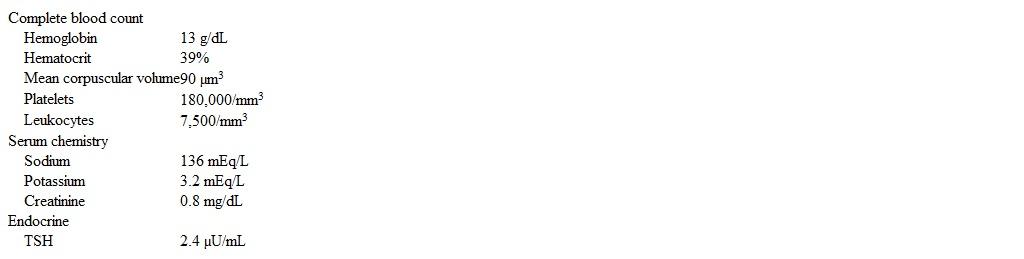 The diagnosis is discussed, and the patient asks if any medications are available for treatment. Which of the following is the most appropriate recommendation?
 (Multiple Choice)
4.8/5 (82)
(82) A 32-year-old man is brought to the emergency department by his mother. She says that he has stayed up late every night for the past week, praying and shouting that he is "the Messiah." The patient speaks rapidly without interruption and believes that he has special powers to end all wars and save humankind. He shakes his head in response to voices, saying that there is a fight between good and evil and that he must "drown out the devil." The patient has had a history of psychiatric illness since his early 20s, when he was discharged from the military due to severe depression and suicidal ideation. At that time, he heard voices blaming him for all the suffering in war. He has been hospitalized for several depressive episodes over the past 10 years. Between hospitalizations, he has had periods lasting for several months during which his mood is stable, but he has continued to hear the voices of God and the devil. The patient lives with his mother and is able to work stocking groceries, but he spends most of his time at home alone. He has been prescribed risperidone, but his mother is unsure if he takes it regularly. Which of the following is the most likely diagnosis?
(Multiple Choice)
4.7/5 (84)
(84) A 42-year-old man is brought to the emergency department by his wife after he assaulted her. She says that he has not slept or eaten for days; he became agitated and started accusing her of plotting with her former boyfriend to murder him. The patient also believes that the FBI is out to get him and that there are bugs crawling under his skin. He had a prior psychiatric hospitalization 8 months ago when he was admitted for paranoid delusions and visual hallucinations. The patient was a successful stockbroker but has been unemployed for the past 2 years. He is uncooperative with the evaluation, speaks rapidly and loudly, gets up to pace during the interview, and shouts, "I don't trust any of you; you're in this together." Examination shows a thin, diaphoretic man with poor grooming and dentition. He clenches his teeth, picks at his skin, and has multiple sores on his face and body. Temperature is 37.8 C (100 F), blood pressure is 140/90 mm Hg, pulse is 104/min, and respirations are 20/min. Which of the following is the most likely diagnosis in this patient?
(Multiple Choice)
4.7/5 (82)
(82) A 28-year-old woman is brought to the emergency department by her boyfriend due to bizarre behavior over the past week. The patient abruptly quit her job as a congressional aide, saying, "My boss was trying to sabotage me because she's jealous of my intellect. The job was beneath me anyway. The time has come for me to run for public office myself." She feels annoyed and exclaims that she needs to leave immediately so that she can organize her campaign. The patient yells at her boyfriend for bringing her to the hospital; a minute later, she hugs him and tearfully says, "I can't imagine my life without you." She rarely drinks alcohol and does not use illicit substances. The patient has no history of psychiatric or medical illness. Blood pressure is 130/90 mm Hg and pulse is 88/min. BMI is 26 kg/m2. Physical examination shows no abnormalities. On mental status examination, the patient is easily agitated when interrupted and jumps from one topic to another. Which of the following is the most likely diagnosis in this patient?
(Multiple Choice)
4.8/5 (86)
(86) A 58-year-old woman comes to the office due to depressed mood and hopelessness for the past 2 months. She has no interest in her hobbies or exercising and feels emotionally detached from her family and friends. The patient awakens every night at 2 AM and is up for the day at 4 AM. Her appetite is poor, and her children and husband have to remind her to eat. Her symptoms have caused her to take a leave of absence from work, and she has difficulty sustaining her attention to read a book or follow a television program. She has no suicidal thoughts. The patient has a history of depression beginning at age 22 and has had 5 lifetime episodes of major depression with one psychiatric hospitalization following a suicide attempt at age 32. She has not been hospitalized since then. Previous treatments have included paroxetine, escitalopram, and venlafaxine. She is not on any medication currently. Major depressive disorder is diagnosed, and the patient is started on venlafaxine as she recalls having an excellent response to this medication in the past. At her 2-week follow-up, she is showing signs of improvement. Which of the following is the most appropriate treatment plan for this patient?
(Multiple Choice)
4.9/5 (92)
(92) A 46-year-old man is hospitalized due to suicidal ideation and hearing voices. The patient has become increasingly depressed over the past month and has been unable to work. Last week he told his wife that he was "tormented by voices" and that "death would be a relief." She brought him to the hospital after she found him staring at a blank screen on the television and not responding to her questions. The patient was prescribed risperidone, lithium, and escitalopram by his psychiatrist, but his wife is unsure if he takes them regularly. He has a history of bipolar disorder since age 18 with multiple hospitalizations for both manic and depressive episodes. His other medical problems are hypercholesterolemia and seasonal allergies. Temperature is 37 C (98.6 F), blood pressure is 125/80 mm Hg, pulse is 68/min, and respirations are 12/min. Routine laboratory results are within normal limits, lithium level is within therapeutic range, and a toxicology screen is negative. During the evaluation, the patient stares blankly and is mute and motionless. He resists all instructions to move. When the physician lifts the patient's arm, it remains in the exact same position after she lets go. Which of the following is the most appropriate next step in management?
(Multiple Choice)
5.0/5 (76)
(76) A 33-year-old woman comes to the office due to low mood and anxiety for the past 5 weeks. The patient broke up with her boyfriend 6 weeks ago and was recently passed over for a promotion at work. She says, "Nothing ever works out for me. I'm never going to find anyone at my age, and the people getting promotions are all younger than me." The patient has been "stress eating" on the weekends but reports no weight changes and continues to work out regularly. She has difficulty falling asleep and often lies awake at night worrying about her future. The patient likes having dinner with her friends but says, "I miss having a boyfriend to spend time with." The patient has no psychiatric history. Vital signs are within normal limits. Physical examination is unremarkable. She appears tearful and tends to look at the floor while speaking; she has no suicidal ideation. Which of the following is the most appropriate management for this patient?
(Multiple Choice)
4.7/5 (72)
(72) A 46-year-old man is brought from jail to the emergency department after a suicide attempt. The patient was arrested earlier today for possession of drugs and shortly afterward was found trying to strangle himself with a shoelace. He was unconscious for a few seconds until the shoelace was cut from his neck. On arrival, the patient is alert and fully oriented. Vital signs are within normal limits. Physical examination shows ligature marks on the neck but is otherwise normal. Urine drug screening is positive for cocaine and opiates. CT scan of the head and neck reveals no abnormalities. The patient is admitted for psychiatric treatment. A few hours later, he becomes restless and anxious and reports feeling nauseous. Temperature is 37.7 C (99.9 F), blood pressure is 138/90 mm Hg, and pulse is 100/min. The patient appears flushed and diaphoretic. Heart and lung sounds are normal. Physical examination shows no other abnormalities. ECG demonstrates sinus tachycardia. Complete blood count and comprehensive metabolic panel are normal. Which of the following is the most appropriate next step in management of this patient?
(Multiple Choice)
4.8/5 (76)
(76) A 19-year-old woman comes to the university health center due to "feeling cold all the time." She wears sweaters despite the warm weather and sleeps with multiple blankets at night. The patient also states that she has had difficulty losing weight and wonders if a thyroid problem could be causing her symptoms. She says, "I go to the gym at least 5 times a week, but I feel like I'm stuck at the same weight. I've even cut bread from my diet because it was making me constipated." Menarche was at age 12, and the patient's last menstrual period was 2 months ago. Family history is significant for Graves disease in her mother and Sjögren syndrome in her maternal grandmother. Temperature is 36.2 C (97.2 F), blood pressure is 80/50 mm Hg, pulse is 38/min, and respirations are 16/min. BMI is 15 kg/m2. The patient is alert and cooperative but appears tired. Laboratory results are as follows: 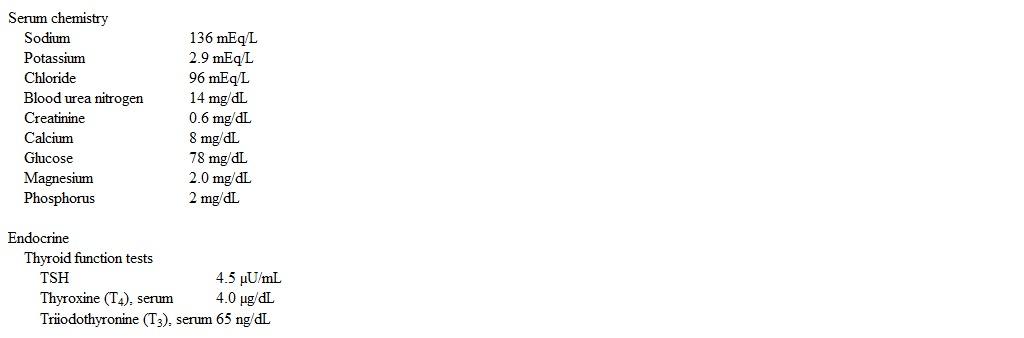 Oral electrolyte supplements are administered. Which of the following is the best next step in management?
 (Multiple Choice)
4.9/5 (85)
(85) A 73-year-old man comes to the office due to increasing forgetfulness over the past 6 months. He says, "My mind used to be quite sharp, but now I can't even concentrate to read a book or newspaper. I'm afraid I'm developing dementia like my father." The patient reports he has been losing sleep and has little energy and motivation. He recently took a leave of absence from work because he could no longer concentrate on details and complete his paperwork. His medical history includes hypertension, hypercholesterolemia, diabetes, benign prostatic hyperplasia, and transient ischemic attack. Family history is significant for hypertension and diabetes (mother) and Alzheimer disease (father). The patient does not smoke and drinks wine only occasionally. Vital signs are unremarkable, and physical examination is normal except for slowed speech and movements. The patient declines to perform a serial sevens assessment and says, "I just can't do it." CT scan of the head is normal. Which of the following is the most likely cause of this patient's cognitive impairment?
(Multiple Choice)
4.7/5 (78)
(78) 
Filters
- Essay(0)
- Multiple Choice(0)
- Short Answer(0)
- True False(0)
- Matching(0)