



 Chat with AI
Exam 3: Psychiatry

Exam 1: Medicine2 k Questions
Exam 2: Pediatric723 Questions
Exam 3: Psychiatry336 Questions
Exam 4: Surgery563 Questions
Exam 5: Obstetrics & Gynecology469 Questions
Select questions type


A 5-year-old girl is brought to the office by her parents due to problems at school. The patient's teachers report that she is very quiet in class. When she does talk, she frequently uses the wrong verb tense and is occasionally teased by peers. Her parents report that she was slow to speak as a toddler, but they were not overly concerned as they had assumed that she was quiet and shy. The girl has a friend with whom she plays after school. The patient is able to dress herself, skip, tie her shoelaces, and draw a triangle. Physical examination, audiologic testing, and laboratory evaluation are normal. On examination, the girl is initially shy but warms up as the interview progresses. The patient's speech is clear, but her vocabulary is limited and she uses simple sentences. She is able to count to 10 slowly. Which of the following is the most likely diagnosis for this patient?
(Multiple Choice)
4.9/5  (82)
(82) A 16-year-old boy comes to the office with a lengthy history of frequent episodes in which he "swears uncontrollably at others," according to his mother. The episodes are accompanied by blinking, grunting, and grimacing. The patient has tried habit reversal therapy with limited benefit and has been treated with guanfacine for the past year. His mother is concerned that, despite the medication, these episodes have progressively worsened, and she fears that he is bullied at school. The symptoms have affected his ability to take tests and socialize with others, leading to increased isolation and worsening academic performance. She asks if there is another medication that could help control his symptoms. Which of the following is the most appropriate pharmacotherapy for this patient?
(Multiple Choice)
4.8/5 (76)
(76) A 42-year-old man comes to the clinic for excision of a mole on his left forearm. He says, "I've had this mole since my youth. I acquired it from wearing sunscreen that was chemicalized with toxins to improve absorption." The patient would like the mole removed because his colleague is "sending negative zings that could cause it to enlarge." A colleague complimented his work at a staff meeting a few weeks ago, and he is now concerned that this individual is jealous of him and wishes him harm. The patient has worked as a filing clerk for the same company since college and does not have close relationships. On physical examination, he is dressed in yellow suit pants and a t-shirt. A 3-mm symmetric nevus with well-defined borders is visualized on the left arm. The patient makes minimal eye contact, has a constricted affect, and speaks in a formal manner. Which of the following is the most likely diagnosis in this patient?
(Multiple Choice)
4.9/5 (64)
(64) A 32-year-old man is admitted to the hospital after being found standing on the edge of a bridge. He appears severely depressed and says that his life is over. The patient is in financial ruin, and his wife recently left him and took their children. He is crying, is unable to sleep, has no appetite, and continues to express hopelessness and suicidal thoughts. He was taking phenelzine for depression but stopped the medication a month ago due to adverse effects. In the hospital, the patient is given sertraline. The next day, after calling his wife, he becomes agitated and starts to blame himself for destroying his life and family. The patient is given olanzapine for worsening agitation during the first 3 days, after which he is noticeably calmer but unable to get out of bed. He appears confused and does not respond to questions appropriately. The patient is diaphoretic. Temperature is 40.1 C (104.2 F), blood pressure is 167/97 mm Hg, and pulse is 112/min. As staff members attempt to get him out of bed, they notice that his arms and legs are stiff and difficult to bend. Which of the following is the most likely cause of this patient's symptoms?
(Multiple Choice)
4.8/5 (82)
(82) A 28-year-old fourth-year medical student is brought to the emergency department by 3 hospital security officers after causing a disturbance in the medical director's office. On questioning, the student says that he has developed a "simple cure for cancer." He is extremely excited about this discovery but is perplexed that the medical director does not take him seriously. He says that this discovery will be praised in the medical and scientific communities and will result in a Nobel Prize. The patient has "endless energy" and "a million ideas" in his head. He has difficulty focusing on answering questions at times and becomes irritable and hostile when efforts are made to redirect him. Medical history is significant for depression at age 19. Family history is significant for adult polycystic kidney disease in his father. Temperature is 37 C (98.6 F), blood pressure is 142/82 mm Hg, pulse is 104/min, and respirations are 20/min. Review of systems and physical examination are otherwise unremarkable. Laboratory results are as follows: 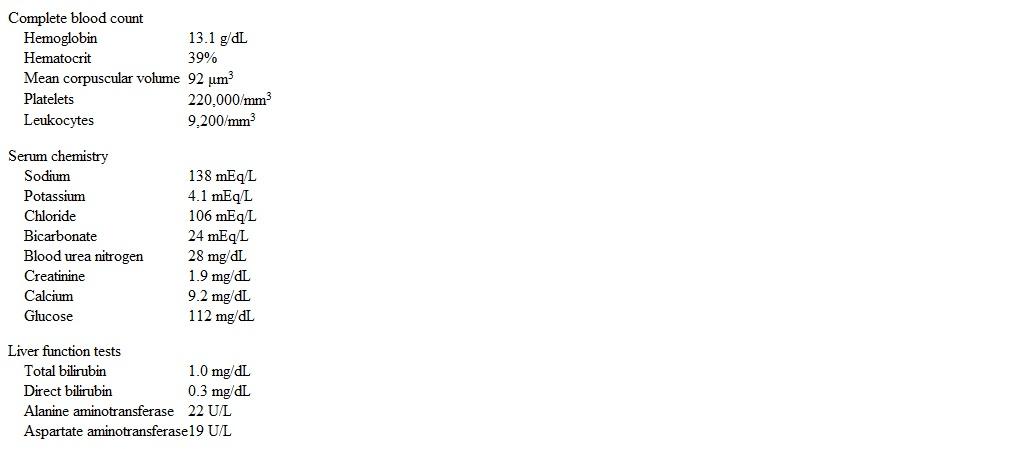 Urine drug screen is negative. Which of the following medications is most appropriate for long-term management of this patient's illness?
 (Multiple Choice)
4.9/5 (78)
(78) A 17-year-old girl is brought to the office by her mother, who is concerned about her daughter's weight loss and mood changes. The girl has lost 4.5 kg (10 lb) in the last 2 months and has been uncharacteristically irritable. The mother says that she has suddenly become a "picky eater" and that she now often refuses to eat, insisting that she is "just not hungry." She also worries that her daughter is not sleeping enough. When questioned about these concerns, the patient denies having any problems and says that she feels "fine" and just has lots of energy. She adds, "Isn't it healthy to be thin and fit? I don't understand what my mother is worried about." The patient's height is 157.5 cm (5 ft 2 in) and weight is 47.6 kg (105 lb). Physical examination shows a thin body habitus, erythema of the nasal mucosa, and mild facial acne. Which of the following is the most likely diagnosis?
(Multiple Choice)
4.9/5 (75)
(75) A 7-year-old girl is brought to the office by her mother, who is concerned about her behavior. Over the past month, the girl has awakened almost every night, come into her parents' room, and insisted on sleeping the remainder of the night in their bed. The girl wakes up abruptly in a panicky sweat, crying and screaming, "I'm so scared; monsters are chasing me." She breathes rapidly and shakes but is able to calm down after being consoled by her parents and hugging a favorite stuffed animal. She started a new school 2 months ago. Although the girl is shy, she enjoys school and has several good friends. She is eating normally and plays on a soccer team. Examination shows no abnormalities. Which of the following is the most likely diagnosis?
(Multiple Choice)
4.9/5 (76)
(76) A 25-year-old woman comes to the office due to weight gain. The patient has gained 4.5 kg (10 lb) since breaking up with her boyfriend and starting a stressful job 4 months ago. She says, "I hate the way I look. I try to limit my portions, but several times a week I end up eating a whole bag of cookies or a quart of ice cream in one sitting, even if I'm not hungry. My stomach is so bloated that I can't fit into my clothes. It is so depressing." The patient has had abdominal discomfort but no nausea or vomiting. Her weight is always fluctuating although she has tried numerous diets over the years. She also does 45 minutes of aerobic exercise 3 times a week. The patient prefers to eat alone because she feels embarrassed and "out of control." She feels guilty about her behavior, and her self-esteem is low. The patient is 160 cm (5 ft 3 in) tall and weighs 60 kg (132 lb). BMI is 23.4 kg/m2. Which of the following is the most likely diagnosis?
(Multiple Choice)
4.8/5 (72)
(72) A 54-year-old man comes to the office due to chronic fatigue, decreased concentration, and depressed mood that began about a year ago. The patient says, "I think it all began last year when my wife and I started to fight more than usual. I was having a hard time concentrating at work and was eventually fired, which caused a lot of financial stress that spilled over into our marriage. Pretty soon, my wife started sleeping in the guest room; she said it was because my snoring was getting worse, but I think she was just sick of me." The patient acknowledges sleeping very poorly and awakening multiple times each night. He struggles to look for a new job because he feels so tired throughout the day. He has a history of hypercholesterolemia and hypertension. He has no known psychiatric history. Medications include hydrochlorothiazide and lovastatin. The patient drinks alcohol socially, although he has been avoiding social gatherings recently despite previously enjoying being around others. He is 175 cm (5 ft 9 in) tall and weighs 118 kg (260 lb); blood pressure is 140/85 mm Hg and pulse is 78/min. Physical examination shows no other abnormalities. Laboratory values are within normal range. Mental status examination shows depressed mood with a full range of affect and no suicidal ideation. Which of the following is the most likely diagnosis in this patient?
(Multiple Choice)
4.9/5 (83)
(83) A 9-year-old girl is brought to the office by her mother due to behavioral problems at school. The patient was sent home a week ago after she threw a pencil and cried when the teacher criticized her handwriting. Since that time, she has had stomachaches every morning and asks to stay home. Her recent report cards describe her as "having trouble focusing; easily upset when she makes a mistake." The mother says, "For the past year, she has become increasingly self-conscious and can't seem to relax. She always thinks that she will say something stupid and that the other kids will laugh at her. When I try to reassure her, she becomes irritable and snaps at me." At home, the patient completes her homework and chores without prompting, and her appetite is normal. A few nights a week, she struggles to fall asleep due to concerns that someone might break into the house and insists that her mother check the locks. The patient has no significant medical history, but family history is notable for depression in her mother. Physical examination is normal. The patient is easily distracted by noises outside the room and repeatedly fidgets with her clothing. Which of the following is the most likely diagnosis?
(Multiple Choice)
4.9/5 (86)
(86) A 27-year-old woman is admitted to the hospital for evaluation of abdominal pain that has intensified over the past 3 months. She describes the pain as severe and has been unable to work due to her symptoms. Medical history includes lower back pain, irregular menstrual cycle, depression, and borderline personality disorder. The admitting senior resident physician obtains a detailed history, after which the patient remarks, "You're a great doctor, and I can tell you really understand what I'm going through." Vital signs are stable. Physical examination shows mild, diffuse abdominal tenderness and is otherwise unremarkable. The next day, the patient is seen by the first-year resident physician who explains her role on the treatment team. She performs a brief physical examination, explains that an abdominal CT scan and laboratory tests have been ordered, and offers to answer any questions. The patient refuses to undergo testing and angrily says, "You're not good at your job. I know a good doctor when I see one. You just order tests without even knowing anything about me." Which of the following is the most appropriate response by the resident?
(Multiple Choice)
4.9/5 (80)
(80) A 35-year-old woman comes to the office due to sad mood, low motivation, and sleep disturbance over the past several months. The patient was recently let go from her job because the company was downsizing, and she has been feeling worthless and hopeless about getting another job. She says, "I'm sure it was just a matter of time before I was fired anyway. Nothing I try has ever worked out. I feel like a failure, and I don't think anything will change." The patient has been reluctant to apply for another job as she assumes she wouldn't be offered the position or would be fired as soon as her shortcomings became evident. She has had increased appetite and difficulty falling asleep. The patient has been avoiding her friends, who "try to be supportive but don't seem to understand what I'm going through." She and the physician decide on a course of nonpharmacological treatment to help with her depression. Which of the following is the most appropriate treatment for this patient?
(Multiple Choice)
4.9/5 (75)
(75) An 80-year-old retired engineer is brought to the office by his son due to behavioral changes. The patient believes that his son is after his money and is trying to kick him out of the house to get all of his property. His son reports the patient has been more forgetful over the last few years. Medical history is nonsignificant. Vital signs are within normal limits. On physical examination, the patient is oriented to person and place only and is unable to cooperate with much of the cognitive examination. He has very poor short-term recall. He is unable to name the current American president and states, "I don't care to follow politics anymore." The remainder of the neurologic examination is unremarkable. Which of the following is the most likely diagnosis?
(Multiple Choice)
4.8/5 (73)
(73) A 45-year-old man comes to the office due to poor sleep. The patient describes difficulty falling asleep and awakening multiple times a night because he is worried about losing his job. For the past month, the patient has also had difficulties concentrating and has become increasingly anxious about his work performance. He says, "I've missed several deadlines and made a big mistake in accounting. How will I support my family if I get fired?" The patient feels exhausted when he awakens and has to force himself to get out of bed and get dressed. He has stopped cycling with his friends and has lost interest in other hobbies. Vital signs and physical examination are unremarkable apart from a 4.5-kg (10-lb) weight loss. Laboratory studies, including thyroid function tests, are within normal limits. The patient appears nervous and restless. He has no suicidal ideation. Which of the following is the most effective treatment for this patient?
(Multiple Choice)
4.9/5 (86)
(86) A 52-year-old man comes to the office due to low energy and poor sleep. The patient reports feeling stressed since his divorce last year. He has difficulty sleeping through the night and awakens around 4:00 AM most mornings, earlier than he would like. At work, the patient has trouble concentrating and is becoming less productive. Although he loves his children, he no longer enjoys visiting them on the weekends and makes excuses to stay home. The patient says that food is tasteless, and his appetite has decreased significantly over the last 2 months. Blood pressure is 135/84 mm Hg and pulse is 78/min. Physical examination is normal. Mental status examination shows a depressed and anxious mood, with mild psychomotor agitation. He has no psychotic features or suicidal ideation. This patient is most likely to have which of the following abnormalities?
(Multiple Choice)
4.7/5 (97)
(97) A 63-year-old man comes to the office for routine follow-up a month after being prescribed morphine for chronic, treatment-resistant back pain. The patient says that his pain is greatly reduced since starting the morphine. He has been able to begin a light exercise regimen for the first time in over 2 years. His other medical conditions include hypertension, type 2 diabetes mellitus, allergic rhinitis, and major depressive disorder. Temperature is 36.1 C (97 F), blood pressure is 118/84 mm Hg, pulse is 62/min, and respirations are 12/min. The patient has normal range of motion of the spine, and movement is associated with a reduction in pain compared with previous examinations. As part of prescription drug misuse monitoring, the physician performs a random urine drug screen that is positive for opioids and phencyclidine (PCP). The patient insists that he is not taking PCP. Which of the following medications could be causing a false-positive result on his urine drug screen?
(Multiple Choice)
4.8/5 (73)
(73) A 32-year-old woman with a history of bipolar disorder with psychotic features comes to the office for evaluation of infertility. She says, "I was hospitalized 2 years ago for depression and heard voices telling me I was worthless. We finally found the right medications and my depression is stable; I feel ready to start a family. We have been having intercourse regularly for the past year. I was hopeful when my period was late but so disappointed when the pregnancy test was negative again." The patient's last menstrual period was 4 months ago; her menses tend to be erratic, occurring every 30-60 days and lasting 4-8 days. Medical history includes hypertension that is well-controlled with medication. Vital signs are within normal limits. Physical examination is normal except for notable breast tenderness. Which of the following medications is most likely responsible for this patient's infertility?
(Multiple Choice)
4.8/5 (91)
(91) A 56-year-old woman comes to the office for a routine health maintenance evaluation. The patient is physically well but reports feeling upset that she had to place her 79-year-old father in a nursing home. She says, "I've cared for him since he developed Alzheimer disease 5 years ago, but I couldn't manage him at home anymore." The patient's medical conditions include hypertension and type 2 diabetes mellitus. She underwent menopause at age 51. She does not use tobacco or alcohol and takes yoga classes 3 times a week. Blood pressure is 140/85 mm Hg and pulse is 77/min. BMI is 32 kg/m2. Physical examination is unremarkable. The patient expresses concern about developing Alzheimer disease like her father and asks if there is anything to do. Which of the following is the most appropriate response to the patient?
(Multiple Choice)
4.8/5 (85)
(85) A 21-year-old woman is brought to the emergency department by her roommate due to anxiety. The patient has generalized anxiety disorder and takes sertraline but has been increasingly restless for the past 2 days, pacing in her room and startling easily. She has been studying for a graduate school entrance examination for the past month, staying up late and drinking 2 cups of coffee a day. The patient has been taking her roommate's tramadol for headaches that have become more frequent. She has no other medical or psychiatric history. Temperature is 37.7 C (99.9 F), blood pressure is 140/80 mm Hg, pulse is 100/min, and respirations are 14/min. The patient appears jittery and has perspiration on her forehead. No abnormalities are noted on cardiopulmonary examination. Muscle tone is mildly increased in the upper and lower extremities. Deep tendon reflexes are symmetric and 3+ throughout. The patient says she feels overwhelmed and unprepared for her exam. Which of the following is the most likely diagnosis?
(Multiple Choice)
4.7/5 (77)
(77) A 36-year-old woman comes to the office for follow-up of bipolar I disorder. The patient was diagnosed at age 20 following a manic episode and has a history of 2 hospitalizations at age 24 and 33 for major depressive episodes. Her mood has been stable on valproate for the past 2 years; she takes no other medications. The patient recently got married and has been functioning well. She hopes to become pregnant and would like to stop her oral contraceptive in the next few months. She says, "I do not want to risk having another hospitalization, so I would like to keep taking medication during my pregnancy." After discussion of treatment options, the patient decides to stop the valproate and switch to a different medication. Which of the following is the most appropriate treatment option for this patient?
(Multiple Choice)
4.9/5 (81)
(81) 
Filters
- Essay(0)
- Multiple Choice(0)
- Short Answer(0)
- True False(0)
- Matching(0)