



 Chat with AI
Exam 2: In-patient Facilities

Exam 1: Emergency Department218 Questions
Exam 2: In-patient Facilities128 Questions
Exam 3: Office/Health Center900 Questions
Select questions type


A 56-year-old man with a past medical history of hypertension and diabetes mellitus is hospitalized after sustaining a mild concussion following a motor vehicle accident. His daily medications include aspirin, metformin, and lisinopril. He has smoked one pack of cigarettes daily for 20 years. He does not drink alcohol. He is married and works as an accountant. His family history is significant for coronary artery disease and diabetes mellitus.
His blood pressure is 143/95 mm Hg and pulse is 90/min with regular rhythm. His general physical and neurological examinations are unremarkable.
An MRI of the brain without contrast reveals a chronic infarct in the right basal ganglia without any evidence of intracranial bleeding.
This patient is at the highest risk for which of the following?
(Multiple Choice)
4.9/5  (90)
(90) An 84-year-old man with a long history of obesity, diabetes, and peripheral artery disease is hospitalized for an extensive gangrenous ulcer on his right foot. A surgical consultant recommends urgent below-the-knee amputation as a life-saving procedure. The patient refuses, saying, "I've had a long life. Most of my friends are dead and all I have left are memories." He does not want to undergo any type of surgical procedure and prefers to be treated with medications only. His primary care provider is uncomfortable with this decision as the patient seems forgetful.
On evaluation and record review, there is no evidence of delirium or psychosis. The patient is sad about the death of several friends over the past year. His appetite is normal and he reports no changes in sleep. He is able to provide a summary of his medical condition and acknowledges that refusing surgery may result in his death. His score on a Montreal Cognitive Assessment is 24/30.
Which of the following is the most appropriate course of action?
(Multiple Choice)
4.7/5 (84)
(84) A 72-year-old man is evaluated for refractory constipation. He recently had an episode of stool impaction requiring manual disimpaction and is now passing flatus and small amounts of hard stool. He has no abdominal pain, vomiting, or hematochezia. The patient is receiving palliative care for stage IV lung cancer with multiple skeletal metastases and has adequate pain control with a fentanyl patch and oral immediate-release morphine. His other medications include a fiber supplement, senna-docusate combination, and oral lactulose.
Examination shows a frail-looking, cachectic man. Bowel sounds are normal. His abdomen is soft, nondistended, and nontender.
Which of the following is the most appropriate next step in managing this patient's constipation?
(Multiple Choice)
4.8/5 (78)
(78) A 63-year-old man with recent elective right inguinal hernia repair comes to the emergency department with pain and swelling of the right thigh. The pain began the night before and he could not sleep well despite taking oxycodone and acetaminophen. The patient has mild hypertension and type 2 diabetes requiring daily long-acting insulin. He also suffers from resistant fungal infection of the toenails.
His temperature is 38.4° C (101° F), blood pressure is 110/72 mm Hg, and pulse is 124/min and regular. His lungs are clear to auscultation. A faint systolic murmur is heard at the base. His abdomen is soft and nontender. The surgical incision looks clean with minimal amount of gray discharge. The right inner thigh has a large area of erythema and swelling that is very tender on superficial palpation. Several small vesicles containing pink fluid with surrounding purpura are also present.
Laboratory results are as follows:
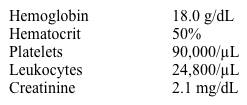 Which of the following is the best next step in management of this patient?
 (Multiple Choice)
4.9/5 (86)
(86) A 53-year-old woman is brought to the emergency department due to severe headaches, vomiting, and muscle weakness. The patient's medical problems include hypertension and obesity. Her body mass index is 34.2 kg/m2. Temperature is 38 C (100.4 F), blood pressure is 185/105 mm Hg, pulse is 110/min, and respirations are 24/min. Pulse oximetry is 99% on room air. The patient is oriented to person and place only, and has a throbbing headache and paralysis of her left side.
CT head scan without contrast reveals a right hemisphere hemorrhagic stroke.
What is the best next step in preventing deep-vein thrombosis in this patient?
(Multiple Choice)
4.9/5 (67)
(67) A 76-year old man is admitted because of cough, fever, and shortness of breath. His medical problems include type 2 diabetes mellitus and hypertension.
His blood pressure is 105/60 mm Hg, pulse is 110/min and regular, and respirations are 30/min. His oxygen saturation is 85% on room air. On examination, he had crackles at the right lower lung base. Chest x-ray showed a dense right lower lobe infiltrate. He was started on antibiotics.
Over the following 24 hours, he developed progressive respiratory failure requiring endotracheal intubation and mechanical ventilation. His antibiotic coverage was broadened. Bilateral crackles are heard on chest examination. Extremities are warm with bounding pulses.
Chest x-ray shows bilateral infiltrates involving both the upper and lower lungs. The current ventilator settings are as follows:
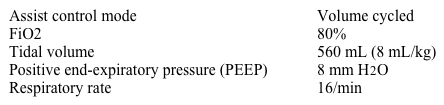 Arterial blood gas analysis shows pH 7.30, pCO2 49 mm Hg, and pO2 48 mm Hg.
Which of the following is the best next step in managing this patient?
Arterial blood gas analysis shows pH 7.30, pCO2 49 mm Hg, and pO2 48 mm Hg.
Which of the following is the best next step in managing this patient? (Multiple Choice)
4.8/5 (73)
(73) A 78-year-old woman is evaluated in a skilled nursing facility due to weakness. She recently had a prolonged hospitalization for exacerbation of chronic obstructive pulmonary disease and required mechanical ventilation in the intensive care unit due to respiratory failure. When the patient was transferred to the skilled nursing facility she was unable to rise from a chair due to profound deconditioning. She is now able to stand but has fallen twice during physical therapy. Medical history is notable for peripheral artery disease, type 2 diabetes mellitus, and moderate dementia.
On examination, the patient has diminished light touch sensation at the right lateral leg and dorsal surface of the right foot. The right foot also shows weakness of dorsiflexion and eversion. Knee reflexes are normal and symmetric, but ankle reflexes are absent bilaterally. While ambulating with a walker, the patient drags her right toes and slaps her right foot to the ground awkwardly.
Which of the following is the most appropriate next step in management of this patient's weakness?
(Multiple Choice)
4.9/5 (79)
(79) A 74-year-old man with type 2 diabetes is admitted to the cardiac care unit after an episode of substernal chest pain. He has no history of coronary artery disease. He was hospitalized two years ago for lower gastrointestinal bleeding and one year ago for community-acquired pneumonia. He has non-specific ECG changes, and his initial troponin I level is 1.3 ng/mL. Cardiac catheterization is performed showing 95% proximal left anterior descending artery stenosis and 85% proximal right coronary artery stenosis. No intervention is performed and coronary artery bypass surgery is planned for the following day.
Five hours after the catheterization procedure, the patient complains of generalized weakness and back pain. He appears to be diaphoretic and clammy. His blood pressure is 77/55 mm Hg and pulse is 122/min and regular. His neck veins are flat. Heart sounds are normal and the chest is clear to auscultation. The site of arterial puncture at his groin is mildly tender without subcutaneous hematoma. He receives 1 liter of normal saline with symptomatic improvement. Repeat blood pressure is 92/60 mm Hg and pulse is 96/min. His ECG is unchanged from the previous one.
Which of the following is the best next step in managing this patient?
(Multiple Choice)
5.0/5 (91)
(91) 
Filters
- Essay(0)
- Multiple Choice(0)
- Short Answer(0)
- True False(0)
- Matching(0)