



 Chat with AI
Exam 14: Modern Cosmology

Exam 1: Here and Now97 Questions
Exam 2: A Users Guide to the Sky116 Questions
Exam 3: Cycles of the Sun and Moon154 Questions
Exam 4: The Origin of Modern Astronomy144 Questions
Exam 5: Light and Telescopes156 Questions
Exam 6: Atoms and Spectra125 Questions
Exam 7: The Sun146 Questions
Exam 8: The Family of Stars190 Questions
Exam 9: The Formation and Structure of Stars136 Questions
Exam 10: The Deaths of Stars128 Questions
Exam 11: Neutron Stars and Black Holes99 Questions
Exam 12: The Milky Way Galaxy117 Questions
Exam 13: Galaxies: Normal and Active151 Questions
Exam 14: Modern Cosmology112 Questions
Exam 15: Origin of the Solar System and Extrasolar Planets104 Questions
Exam 16: Earth and Moon: Bases for Comparative Planetology98 Questions
Exam 17: Mercury, Venus, and Mars83 Questions
Exam 18: The Outer Solar System137 Questions
Exam 19: Meteorites, Asteroids, and Comets91 Questions
Exam 20: Astrobiology: Life on Other Worlds97 Questions
Select questions type


The redshifts of the galaxies imply that the Universe is expanding and that we are at the center.
(True/False)
4.9/5  (83)
(83) In the late 1990's, it was discovered from distances of ___________ in distant galaxies that the expansion of the Universe is ___________.
(Multiple Choice)
4.9/5 (88)
(88) The ___________ are theories that unify the electromagnetic, weak, and strong forces at extremely high energies.
(Short Answer)
4.7/5 (76)
(76) 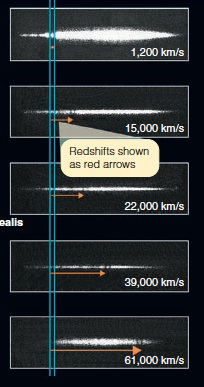 As shown in the above spectra, the higher the redshift, the higher the recessional velocity.
 (True/False)
4.9/5 (74)
(74) The deuterium and lithium-7 in distant quasars and in the interstellar medium suggests that the Universe is open.
(True/False)
4.7/5 (75)
(75) 
Filters
- Essay(0)
- Multiple Choice(0)
- Short Answer(0)
- True False(0)
- Matching(0)