



 Chat with AI
Exam 14: Modern Cosmology

Exam 1: Here and Now97 Questions
Exam 2: A Users Guide to the Sky116 Questions
Exam 3: Cycles of the Sun and Moon154 Questions
Exam 4: The Origin of Modern Astronomy144 Questions
Exam 5: Light and Telescopes156 Questions
Exam 6: Atoms and Spectra125 Questions
Exam 7: The Sun146 Questions
Exam 8: The Family of Stars190 Questions
Exam 9: The Formation and Structure of Stars136 Questions
Exam 10: The Deaths of Stars128 Questions
Exam 11: Neutron Stars and Black Holes99 Questions
Exam 12: The Milky Way Galaxy117 Questions
Exam 13: Galaxies: Normal and Active151 Questions
Exam 14: Modern Cosmology112 Questions
Exam 15: Origin of the Solar System and Extrasolar Planets104 Questions
Exam 16: Earth and Moon: Bases for Comparative Planetology98 Questions
Exam 17: Mercury, Venus, and Mars83 Questions
Exam 18: The Outer Solar System137 Questions
Exam 19: Meteorites, Asteroids, and Comets91 Questions
Exam 20: Astrobiology: Life on Other Worlds97 Questions
Select questions type


A center or an edge of the Universe would be a special place, contradicting the cosmological principle.
(True/False)
4.8/5  (81)
(81) How old is the Universe since the big bang? Pick the best answer according to radioactive dating in the solar system, light travel times to most distant galaxies, time reversal of the big bang, and observations of the 3-K radiation.
(Multiple Choice)
4.9/5 (75)
(75) One explanation of the dark sky Olbers's Paradox is that light can reach us only from objects in space out to a distance in light years _______ the age of the universe in years.
(Multiple Choice)
4.7/5 (74)
(74) The ___________ view of the Universe is that it is eternal and unchanging.
(Multiple Choice)
4.8/5 (88)
(88) The resolution of Olbers's paradox suggests that it gets dark at night because
(Multiple Choice)
4.8/5 (82)
(82) A(n) ___________ Universe is infinite and would have a density equal to the critical density.
(Short Answer)
5.0/5 (87)
(87) In the first second of the universe, the universe cooled and inflated. A result is a separation of one unified force into four distinct forces.
(True/False)
4.8/5 (84)
(84) After recombination occurred, the Universe was plunged into a period of time known as the ___________, which lasted hundreds of millions of years until the first stars were born.
(Short Answer)
4.7/5 (86)
(86) 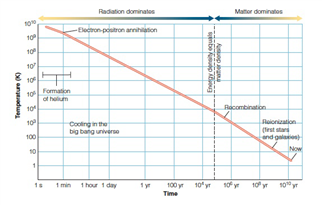 As shown in the above graph, neither radiation nor matter dominated for __________.
 (Multiple Choice)
4.8/5 (70)
(70) 
Filters
- Essay(0)
- Multiple Choice(0)
- Short Answer(0)
- True False(0)
- Matching(0)