



 Chat with AI
Exam 14: Modern Cosmology

Exam 1: Here and Now97 Questions
Exam 2: A Users Guide to the Sky116 Questions
Exam 3: Cycles of the Sun and Moon154 Questions
Exam 4: The Origin of Modern Astronomy144 Questions
Exam 5: Light and Telescopes156 Questions
Exam 6: Atoms and Spectra125 Questions
Exam 7: The Sun146 Questions
Exam 8: The Family of Stars190 Questions
Exam 9: The Formation and Structure of Stars136 Questions
Exam 10: The Deaths of Stars128 Questions
Exam 11: Neutron Stars and Black Holes99 Questions
Exam 12: The Milky Way Galaxy117 Questions
Exam 13: Galaxies: Normal and Active151 Questions
Exam 14: Modern Cosmology112 Questions
Exam 15: Origin of the Solar System and Extrasolar Planets104 Questions
Exam 16: Earth and Moon: Bases for Comparative Planetology98 Questions
Exam 17: Mercury, Venus, and Mars83 Questions
Exam 18: The Outer Solar System137 Questions
Exam 19: Meteorites, Asteroids, and Comets91 Questions
Exam 20: Astrobiology: Life on Other Worlds97 Questions
Select questions type


Astronomers have found the center of the Universe to be located in
(Multiple Choice)
4.9/5  (91)
(91) Observations of Type Ia supernova indicate that the universe is static.
(True/False)
4.9/5 (91)
(91) Measured ages of globular clusters suggests that the Universe is about
(Multiple Choice)
4.8/5 (78)
(78) The cosmological principle states that the Universe is
I. expanding.
II. accelerating.
III. homogeneous.
IV. isotropic.
(Multiple Choice)
4.9/5 (86)
(86) Which of the following types of Universe has no center and no edge?
(Multiple Choice)
5.0/5 (91)
(91) Large scale structures of the Universe include ___________.
(Multiple Choice)
4.9/5 (80)
(80) 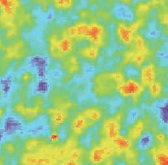 In the above observations of the CMB, the mottled (i.e., non-uniform) appearance is due to ___________ in a/an ____________ Universe.
 (Multiple Choice)
4.8/5 (86)
(86) By adding the cosmological constant, Einstein made the universe steady in that the Universe neither expanded nor contracted.
(True/False)
4.8/5 (77)
(77) Since the big bang, but before now, a time existed where matter was not dominant.
(True/False)
4.7/5 (86)
(86) As the Universe cooled, it eventually reached a temperature of 3,000 K and protons were able to capture and hold electrons to form neutral hydrogen. This process is known as
(Multiple Choice)
4.7/5 (70)
(70) The ___________ is that the Universe is both isotropic and homogeneous.
(Short Answer)
4.7/5 (73)
(73) In the late 1990's, it was announced that the expansion of the Universe is accelerating. What does this imply from the perspective of the big bang?
(Multiple Choice)
4.7/5 (79)
(79) What observational evidence supports the fact that our universe is static and unchanging?
(Multiple Choice)
5.0/5 (82)
(82) If the average density of the universe is less than the critical density, the Universe is open.
(True/False)
4.9/5 (73)
(73) The observable Universe changes with the usage of new and better telescopes like the current Hubble and the future James Webb.
(True/False)
4.9/5 (91)
(91) Why is the cosmic microwave background (CMB) so cold if the early Universe was so hot?
(Multiple Choice)
4.8/5 (86)
(86) If the density of the universe is equal to the critical density, and H equals 50 km/s/Mpc, then the true age of the Universe is 13.3 billion years.
(True/False)
4.9/5 (71)
(71) 
Filters
- Essay(0)
- Multiple Choice(0)
- Short Answer(0)
- True False(0)
- Matching(0)