



 Chat with AI
Exam 6: Atoms and Spectra

Exam 1: Here and Now97 Questions
Exam 2: A Users Guide to the Sky116 Questions
Exam 3: Cycles of the Sun and Moon154 Questions
Exam 4: The Origin of Modern Astronomy144 Questions
Exam 5: Light and Telescopes156 Questions
Exam 6: Atoms and Spectra125 Questions
Exam 7: The Sun146 Questions
Exam 8: The Family of Stars190 Questions
Exam 9: The Formation and Structure of Stars136 Questions
Exam 10: The Deaths of Stars128 Questions
Exam 11: Neutron Stars and Black Holes99 Questions
Exam 12: The Milky Way Galaxy117 Questions
Exam 13: Galaxies: Normal and Active151 Questions
Exam 14: Modern Cosmology112 Questions
Exam 15: Origin of the Solar System and Extrasolar Planets104 Questions
Exam 16: Earth and Moon: Bases for Comparative Planetology98 Questions
Exam 17: Mercury, Venus, and Mars83 Questions
Exam 18: The Outer Solar System137 Questions
Exam 19: Meteorites, Asteroids, and Comets91 Questions
Exam 20: Astrobiology: Life on Other Worlds97 Questions
Select questions type


Diagram 6-2 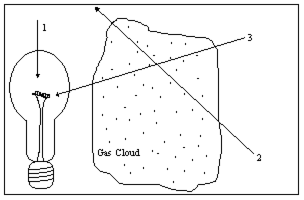 Diagram 6-2 illustrates a light source, a gas cloud, and three different lines of sight. Along which line of sight would an observer see an absorption spectrum?
 (Multiple Choice)
4.7/5  (89)
(89) 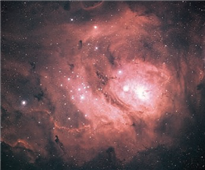 In the above image of a glowing gas cloud, you mainly see the color pink. Which spectra would you mostly expect from this gas cloud?
 (Multiple Choice)
4.8/5 (100)
(100) The process of removing an electron from a stable nucleus is known as ____________________.
(Short Answer)
5.0/5 (89)
(89) An atom is ionized if one of its electrons jumps to a higher energy level in the atom.
(True/False)
4.8/5 (85)
(85) Each element has its own set of characteristic absorption lines because
(Multiple Choice)
4.7/5 (81)
(81) ______________ will give you information on the surface temperature of the star after you obtain the wavelength of maximum emission from the ________________ spectra.
(Short Answer)
4.8/5 (81)
(81) 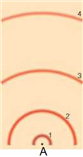 In the above model of an atom, where would the proton be located?
 (Multiple Choice)
4.7/5 (79)
(79) The higher the surface temperature of the star, the _______________ the wavelength of maximum intensity and the ____________ total radiation emitted from surface per second.
(Multiple Choice)
4.9/5 (60)
(60) If one star has a temperature of 4000 K and another star has a temperature of 40,000 K, how much more energy per second will the hotter star radiate from each square meter of its surface? ____________________
(Short Answer)
4.8/5 (80)
(80) The radiation emitted from a star has a maximum intensity at a wavelength of 500 nm. What is the temperature of this star?
(Multiple Choice)
4.9/5 (81)
(81) If a star is moving ____________ from us, then its spectra will be shifted toward ________ wavelengths, producing a redshift.
(Short Answer)
4.8/5 (64)
(64) 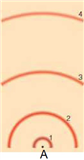 In the above model of an atom, draw a transition from the first excited state to the third excited state. Then draw a transition from the third excited state to the second excited state. Then draw a transition from the second excited state to the first excited sate. To draw these, draw the electron's motion as a line with an arrow to indicate direction and draw the photon as a wave with an arrow to indicated direction. Label the electron and photon. Label whether this is an absorption, emission, or continuous spectrum.
 (Not Answered)
This question doesn't have any answer yet
Figure 6-1 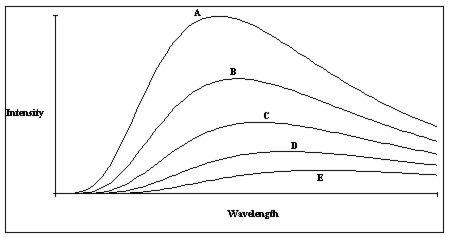 A plot of the continuous spectra of five different stars is shown in Figure 6-1. Based on these spectra, which of the stars has the lowest temperature?
 (Multiple Choice)
4.9/5 (86)
(86) The ____________________ of a star can be determined from its color.
(Short Answer)
4.8/5 (94)
(94)  Which spectrum is shown above?
 In the above model of an atom, draw a transition from the second excited state to the first excited state. To draw this, draw the electron's motion as a line with an arrow to indicate direction and draw the photon as a wave with an arrow to indicated direction. Label the electron and photon. Label whether this is an absorption, emission, or continuous spectrum.
 (Not Answered)
This question doesn't have any answer yet
You would like to know if a star is coming towards you or away from you. Therefore, you will need to obtain the star's _______________ from its shifted spectra.
(Short Answer)
4.8/5 (78)
(78) 
Filters
- Essay(0)
- Multiple Choice(0)
- Short Answer(0)
- True False(0)
- Matching(0)