



 Chat with AI
Exam 6: Atoms and Spectra

Exam 1: Here and Now97 Questions
Exam 2: A Users Guide to the Sky116 Questions
Exam 3: Cycles of the Sun and Moon154 Questions
Exam 4: The Origin of Modern Astronomy144 Questions
Exam 5: Light and Telescopes156 Questions
Exam 6: Atoms and Spectra125 Questions
Exam 7: The Sun146 Questions
Exam 8: The Family of Stars190 Questions
Exam 9: The Formation and Structure of Stars136 Questions
Exam 10: The Deaths of Stars128 Questions
Exam 11: Neutron Stars and Black Holes99 Questions
Exam 12: The Milky Way Galaxy117 Questions
Exam 13: Galaxies: Normal and Active151 Questions
Exam 14: Modern Cosmology112 Questions
Exam 15: Origin of the Solar System and Extrasolar Planets104 Questions
Exam 16: Earth and Moon: Bases for Comparative Planetology98 Questions
Exam 17: Mercury, Venus, and Mars83 Questions
Exam 18: The Outer Solar System137 Questions
Exam 19: Meteorites, Asteroids, and Comets91 Questions
Exam 20: Astrobiology: Life on Other Worlds97 Questions
Select questions type


Which of the following can be determined by using the Doppler effect?
I. the speed at which a star is moving away from an observer
II. the transverse velocity of a star
III. the radial velocity of a star
IV. the speed at which a car is traveling toward an observer
(Multiple Choice)
4.8/5  (84)
(84) The process of removing an electron from a stable nucleus is known as
(Multiple Choice)
4.9/5 (77)
(77)  To create the above spectra, which of the following is NOT true?
 (Multiple Choice)
4.9/5 (71)
(71) If the change in wavelength is less than zero, then the radial velocity tells you that the star is moving _______________ you.
(Multiple Choice)
4.9/5 (75)
(75) A blackbody's emission as observed through a low-density gas will produce a ____________________ spectrum.
(Short Answer)
4.7/5 (78)
(78) The number of ____ in the nucleus determines what element the nucleus is.
(Multiple Choice)
4.7/5 (77)
(77) What is the order of star colors with increasing temperature?
(Multiple Choice)
4.7/5 (74)
(74) Diagram 6-1  In Diagram 6-1, which of the transitions would absorb a photon with the greatest energy?
 (Multiple Choice)
4.8/5 (63)
(63) 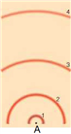 In the above model of an atom, draw a transition from the ground state to the first excited state. To draw this, draw the electron's motion as a line with an arrow to indicate direction and draw the photon as a wave with an arrow to indicated direction. Label the electron and photon. Label whether this is an absorption, emission, or continuous spectrum.
 (Not Answered)
This question doesn't have any answer yet
If continuous spectrum light from a star passes through a cool, low-density gas on its way to your telescope and spectroscope, ____ spectrum on the continuous spectrum results.
(Multiple Choice)
4.9/5 (71)
(71) At what wavelength would a star radiate the greatest amount of energy if the star has a surface temperature of 10,000 K?
(Multiple Choice)
4.8/5 (76)
(76) Figure 6-1  A plot of the continuous spectra of five different stars is shown in Figure 6-1. Based on these spectra, which of the stars is the hottest?
 (Multiple Choice)
4.8/5 (83)
(83) A ____________ will be obtained from an observed star's spectrum that has been shifted towards shorter wavelengths as the star is moving ________ us.
(Short Answer)
4.9/5 (72)
(72) In the diagram below, draw the transition that would emit a photon with the shortest wavelength. 
(Short Answer)
4.9/5 (76)
(76) You would like to know the chemical composition of a star's atmosphere. Therefore you will need to obtain the star's ______________ spectra.
(Short Answer)
4.8/5 (77)
(77) 
Filters
- Essay(0)
- Multiple Choice(0)
- Short Answer(0)
- True False(0)
- Matching(0)