



 Chat with AI
Exam 6: Atoms and Spectra

Exam 1: Here and Now97 Questions
Exam 2: A Users Guide to the Sky116 Questions
Exam 3: Cycles of the Sun and Moon154 Questions
Exam 4: The Origin of Modern Astronomy144 Questions
Exam 5: Light and Telescopes156 Questions
Exam 6: Atoms and Spectra125 Questions
Exam 7: The Sun146 Questions
Exam 8: The Family of Stars190 Questions
Exam 9: The Formation and Structure of Stars136 Questions
Exam 10: The Deaths of Stars128 Questions
Exam 11: Neutron Stars and Black Holes99 Questions
Exam 12: The Milky Way Galaxy117 Questions
Exam 13: Galaxies: Normal and Active151 Questions
Exam 14: Modern Cosmology112 Questions
Exam 15: Origin of the Solar System and Extrasolar Planets104 Questions
Exam 16: Earth and Moon: Bases for Comparative Planetology98 Questions
Exam 17: Mercury, Venus, and Mars83 Questions
Exam 18: The Outer Solar System137 Questions
Exam 19: Meteorites, Asteroids, and Comets91 Questions
Exam 20: Astrobiology: Life on Other Worlds97 Questions
Select questions type


Which of the following is not a fundamental component of the atom?
(Multiple Choice)
4.9/5  (71)
(71) When the electrons in an atom are in their lowest possible energy levels, the atom is said to be in its ____________________ state.
(Short Answer)
4.7/5 (76)
(76) 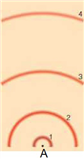 In the above model of an atom, where is the neutron located, assuming a neutron is present?
 (Multiple Choice)
4.9/5 (100)
(100) The most massive part of the atom is(are) the ____ which has(have) a ____ charge.
(Multiple Choice)
4.8/5 (79)
(79) The H δ line has a wavelength of 410.2 nm when observed in the laboratory. If the H δ line appears in a stars spectrum at 410.0 nm, what is the radial velocity of the star?
(Multiple Choice)
4.9/5 (87)
(87)  To create the above spectra, which of the following is NOT true?
 (Multiple Choice)
5.0/5 (76)
(76) 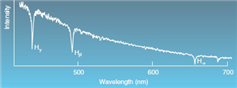 Which series is shown above?
Electrons in an atom are attracted to the nucleus by the _______________ force.
(Short Answer)
4.8/5 (79)
(79) A zero Kelvin temperature is also known as ________________________.
(Short Answer)
4.9/5 (85)
(85) Diagram 6-1 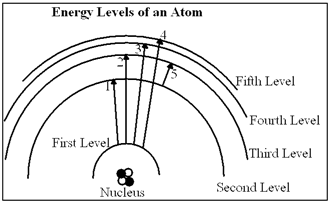 In Diagram 6-1, which of the transitions would absorb a photon with the smallest energy?
 (Multiple Choice)
4.9/5 (86)
(86) The H γ line has a wavelength of 434.0 nm when observed in the laboratory. If the H γ line appears in a stars spectrum at 434.5 nm, what is the radial velocity of the star?
(Multiple Choice)
4.9/5 (63)
(63) One star has a temperature of 30,000 K and another star has a temperature of 6,000 K. Compared to the cooler star, how much more energy per second will the hotter star radiate from each square meter of its surface?
(Multiple Choice)
4.9/5 (75)
(75) A hotter star is brighter than a cooler star of the same size. Assume both are typical stars.
(True/False)
5.0/5 (78)
(78) A(n) ____ contains two or more atoms that are bound together by exchanging or sharing electrons with each other.
(Multiple Choice)
4.8/5 (75)
(75) Since an electron is so less massive than a proton, what is the approximate mass and charge of a neutral hydrogen atom?
(Multiple Choice)
4.9/5 (87)
(87) 
Filters
- Essay(0)
- Multiple Choice(0)
- Short Answer(0)
- True False(0)
- Matching(0)