



 Chat with AI
Exam 20: Policy Disputes Using the Self-Correcting Aggregate Demand and Supply Model

Exam 1: Introducing the Economic Way of Thinking254 Questions
Exam 2: Production Possibilities, Opportunity Cost, and Economic Growth209 Questions
Exam 3: Market Demand and Supply361 Questions
Exam 4: Markets in Action259 Questions
Exam 5: Price Elasticity of Demand181 Questions
Exam 6: Production Costs254 Questions
Exam 7: Perfect Competition226 Questions
Exam 8: Monopoly175 Questions
Exam 9: Monopolistic Competition and Oligopoly166 Questions
Exam 10: Labor Markets and Income Distribution185 Questions
Exam 11: Gross Domestic Product207 Questions
Exam 12: Business Cycles and Unemployment199 Questions
Exam 13: Inflation131 Questions
Exam 14: Aggregate Demand and Supply83 Questions
Exam 15: Fiscal Policy205 Questions
Exam 16: The Public Sector131 Questions
Exam 17: Federal Deficits, Surpluses, and the National Debt102 Questions
Exam 18: Money and the Federal Reserve System159 Questions
Exam 19: Money Creation250 Questions
Exam 20: Policy Disputes Using the Self-Correcting Aggregate Demand and Supply Model246 Questions
Exam 21: International Trade and Finance251 Questions
Exam 22: Economies in Transition108 Questions
Exam 23: Growth and the Less-Developed Countries121 Questions
Select questions type


Which of the following policies could the Fed use to lower the interest rate?
(Multiple Choice)
4.8/5  (88)
(88) Using the aggregate supply and demand model, assume the economy is operating along the intermediate portion of the aggregate supply curve. An increase in the money supply will increase the price level and:
(Multiple Choice)
4.7/5 (78)
(78) According to the monetarists, which of the following is true?
(Multiple Choice)
5.0/5 (71)
(71) Exhibit 20-5 Money, Investment and product markets 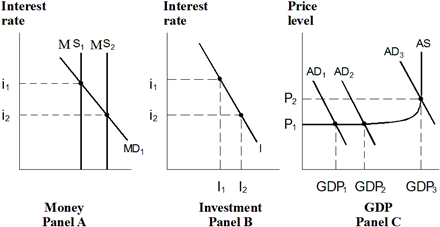 In Exhibit 20-5, a shift in aggregate demand from AD2 to AD3:
 (Multiple Choice)
5.0/5 (82)
(82) The Monetarists advocate the monetary rule in order to stabilize the business cycle which states that the money supply should be decreased by a constant rate year after year.
(True/False)
4.7/5 (82)
(82) Monetarists argue that the Federal Reserve should allow the money supply to grow:
(Multiple Choice)
5.0/5 (86)
(86) Assume the economy is experiencing an inflationary gap, classical economists believe that:
(Multiple Choice)
4.9/5 (87)
(87) Monetarists argue that the Fed should frequently adjust the money supply in response to ever-changing economic conditions.
(True/False)
4.9/5 (88)
(88) Assume the economy is operating at a real GDP above full-employment real GDP. Keynesian economists would prescribe which of the following policies?
(Multiple Choice)
4.8/5 (67)
(67) In a two-asset economy with money and T-bills, the quantity of money that people will want to hold, other things being equal, can be expected to:
(Multiple Choice)
4.8/5 (70)
(70) If the Fed uses its tools to expand the money supply, bond prices will be bid down and interest rates will rise.
(True/False)
4.9/5 (78)
(78) If the investment curve is relatively flat, the Keynesian conclusion is that the transmission mechanism has little effect on the economy.
(True/False)
4.7/5 (86)
(86) If the investment curve is relatively vertical, the Keynesian conclusion is that the transmission mechanism has little effect on the economy.
(True/False)
4.8/5 (75)
(75) Keynes called the money people hold in order to buy bonds, stocks, or other nonmoney financial assets the:
(Multiple Choice)
4.8/5 (76)
(76) While the classicists believed that both velocity and output are stable, Keynesians believe:
(Multiple Choice)
5.0/5 (71)
(71) According to the Monetarist view, the impact of expansionary monetary policy will be:
(Multiple Choice)
4.9/5 (84)
(84) If the money supply increases this will cause the interest rate to rise, investment to fall and GDP to fall.
(True/False)
4.9/5 (73)
(73) 
Filters
- Essay(0)
- Multiple Choice(0)
- Short Answer(0)
- True False(0)
- Matching(0)