



 Chat with AI
Exam 20: Policy Disputes Using the Self-Correcting Aggregate Demand and Supply Model

Exam 1: Introducing the Economic Way of Thinking254 Questions
Exam 2: Production Possibilities, Opportunity Cost, and Economic Growth209 Questions
Exam 3: Market Demand and Supply361 Questions
Exam 4: Markets in Action259 Questions
Exam 5: Price Elasticity of Demand181 Questions
Exam 6: Production Costs254 Questions
Exam 7: Perfect Competition226 Questions
Exam 8: Monopoly175 Questions
Exam 9: Monopolistic Competition and Oligopoly166 Questions
Exam 10: Labor Markets and Income Distribution185 Questions
Exam 11: Gross Domestic Product207 Questions
Exam 12: Business Cycles and Unemployment199 Questions
Exam 13: Inflation131 Questions
Exam 14: Aggregate Demand and Supply83 Questions
Exam 15: Fiscal Policy205 Questions
Exam 16: The Public Sector131 Questions
Exam 17: Federal Deficits, Surpluses, and the National Debt102 Questions
Exam 18: Money and the Federal Reserve System159 Questions
Exam 19: Money Creation250 Questions
Exam 20: Policy Disputes Using the Self-Correcting Aggregate Demand and Supply Model246 Questions
Exam 21: International Trade and Finance251 Questions
Exam 22: Economies in Transition108 Questions
Exam 23: Growth and the Less-Developed Countries121 Questions
Select questions type


Exhibit 20-2 Money market demand and supply curves 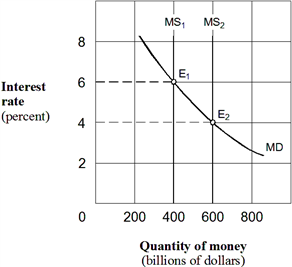 As shown in Exhibit 20-2, assume the money supply curve shifts rightward from MS1 to MS2 and the economy is operating along the intermediate segment of the aggregate supply curve. The result will be a:
 (Multiple Choice)
4.9/5  (88)
(88) Which of the following correctly gives us the equation of exchange?
(Multiple Choice)
4.8/5 (81)
(81) The opportunity cost of holding money is properly measured by the rate of interest on financial assets such as bonds.
(True/False)
4.9/5 (84)
(84) Assume the economy is experiencing a recessionary gap. Keynesian economists would support which of the following policies:
(Multiple Choice)
4.8/5 (88)
(88) The Keynesian mechanism through which monetary policy affects the price level, real GDP, and employment depends on the impact of the:
(Multiple Choice)
4.9/5 (68)
(68) The belief that the velocity of money is not constant but highly predictable is associated with the:
(Multiple Choice)
4.8/5 (86)
(86) Discuss the determinants of the equilibrium interest rate and how it may change. What can the Fed do to change the interest rate?
(Essay)
4.9/5 (84)
(84) The demand for money that households keep for emergency purposes is known as the:
(Multiple Choice)
4.9/5 (83)
(83) Assume the economy is operating at a real GDP above full-employment real GDP. Classical economists would prescribe which of the following policies?
(Multiple Choice)
4.8/5 (70)
(70) One reason that people hold money is to pay for unexpected car repairs and other unpredictable expenses. This motive for holding money is called:
(Multiple Choice)
4.8/5 (66)
(66) Exhibit 20A-3 Macro AD/AS Model
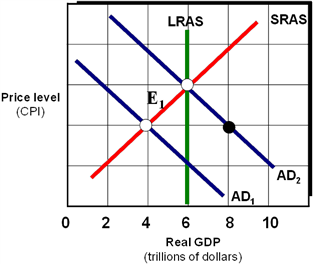 As shown in Exhibit 20A-3, assume the marginal propensity to consume MPC equals 0.75. Using discretionary fiscal policy, federal government spending should be ____ in order to restore the economy from E1 to full employment.
 (Multiple Choice)
4.9/5 (86)
(86) The assumption that the velocity of money and the quantity being produced is constant is held by the:
(Multiple Choice)
4.8/5 (71)
(71) Exhibit 20-4 Aggregate demand and supply model 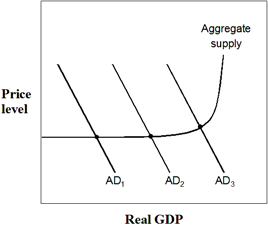 In Exhibit 20-4, which one of the following actions could the Fed use to shift the AD curve from AD3 to AD2?
 (Multiple Choice)
4.9/5 (79)
(79) Monetarists believe that an increase in the money supply will lead to:
(Multiple Choice)
4.8/5 (85)
(85) If the velocity of the M1 money supply is 4 and nominal GDP is $200 billion, the stock of money in circulation must be:
(Multiple Choice)
4.8/5 (75)
(75) The opportunity cost of holding money is measured by the rate of interest.
(True/False)
4.7/5 (90)
(90) People learn to hold a specific quantity of money for the groceries, theater tickets, gasoline, clothes, film, and other items they habitually purchase. This behavior is representative of the:
(Multiple Choice)
4.7/5 (98)
(98) The quantity of money held in response to interest rates is the:
(Multiple Choice)
4.7/5 (65)
(65) 
Filters
- Essay(0)
- Multiple Choice(0)
- Short Answer(0)
- True False(0)
- Matching(0)