



 Chat with AI
Exam 20: Policy Disputes Using the Self-Correcting Aggregate Demand and Supply Model

Exam 1: Introducing the Economic Way of Thinking254 Questions
Exam 2: Production Possibilities, Opportunity Cost, and Economic Growth209 Questions
Exam 3: Market Demand and Supply361 Questions
Exam 4: Markets in Action259 Questions
Exam 5: Price Elasticity of Demand181 Questions
Exam 6: Production Costs254 Questions
Exam 7: Perfect Competition226 Questions
Exam 8: Monopoly175 Questions
Exam 9: Monopolistic Competition and Oligopoly166 Questions
Exam 10: Labor Markets and Income Distribution185 Questions
Exam 11: Gross Domestic Product207 Questions
Exam 12: Business Cycles and Unemployment199 Questions
Exam 13: Inflation131 Questions
Exam 14: Aggregate Demand and Supply83 Questions
Exam 15: Fiscal Policy205 Questions
Exam 16: The Public Sector131 Questions
Exam 17: Federal Deficits, Surpluses, and the National Debt102 Questions
Exam 18: Money and the Federal Reserve System159 Questions
Exam 19: Money Creation250 Questions
Exam 20: Policy Disputes Using the Self-Correcting Aggregate Demand and Supply Model246 Questions
Exam 21: International Trade and Finance251 Questions
Exam 22: Economies in Transition108 Questions
Exam 23: Growth and the Less-Developed Countries121 Questions
Select questions type


Which of the following characterizes the Monetarist viewpoint?
(Multiple Choice)
4.8/5  (80)
(80) Classical economists believe that an increase in the money supply will lead to:
(Multiple Choice)
4.9/5 (68)
(68) Other things being equal, the quantity of money that people wish to hold in currency and their checking accounts can be expected to:
(Multiple Choice)
4.9/5 (79)
(79) According to the quantity theory of money, if an economy produces 5,000 units of output, its money supply equals $40,000 and the velocity of money equals one, then the price level will equal:
(Multiple Choice)
4.9/5 (78)
(78) Exhibit 20-5 Money, Investment and product markets 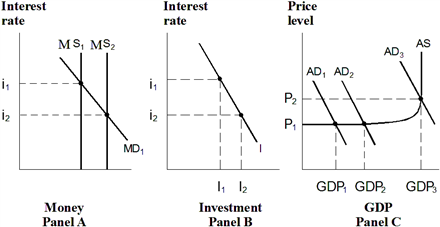 In Exhibit 20-5, if the interest rate falls from i1 to i2, investment spending will:
 (Multiple Choice)
4.7/5 (85)
(85) Exhibit 20-1 Money market demand and supply curves 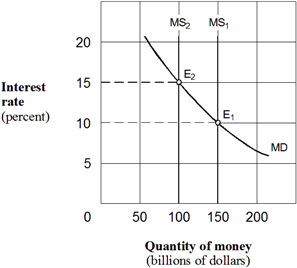 As shown in Exhibit 20-1, assume the money supply curve shifts leftward from MS1 to MS2 and the economy is operating along the intermediate segment of the aggregate supply curve. The result will be a:
 (Multiple Choice)
4.7/5 (78)
(78) Since classical economists and monetarists believe that the economy operates at full employment, real GDP, that is, along the vertical segment of aggregate supply:
(Multiple Choice)
4.9/5 (72)
(72) Assuming the economy is experiencing a recessionary gap, classical economists predict that:
(Multiple Choice)
4.9/5 (85)
(85) Exhibit 20-6 Money, investment and product markets 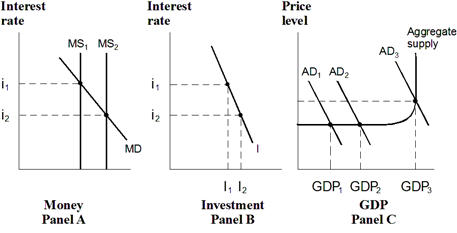 In Exhibit 20-6, an increase in the money supply from MS1 to MS2 causes:
 (Multiple Choice)
4.8/5 (94)
(94) Exhibit 20-5 Money, Investment and product markets 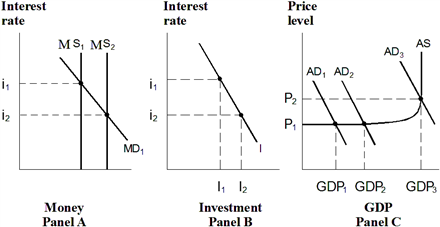 In Exhibit 20-5, a shift in aggregate demand from AD1 to AD2:
 (Multiple Choice)
4.9/5 (86)
(86) Contrast the Keynesian and Monetarist views on the effectiveness of fiscal policy?
(Essay)
4.9/5 (71)
(71) Keynesians identify three principal motives for demanding money. They are the:
(Multiple Choice)
4.8/5 (83)
(83) If the Fed reduces the discount rate, which of the following are most likely to result?
(Multiple Choice)
4.8/5 (90)
(90) According to the quantity theory of money, a 10 percent increase in the money supply leads to a 10 percent increase in:
(Multiple Choice)
4.8/5 (71)
(71) Exhibit 20A-2 Macro AD/AS Models  In Panel (a) of Exhibit 20A-2, the economy is initially in short-run equilibrium at real GDP level Y1 and price level P2. If the federal government or Fed decides to intervene, it would most likely:
 (Multiple Choice)
4.9/5 (81)
(81) The equation specifying a direct relationship between the money supply and prices is the quantity theory of:
(Multiple Choice)
4.8/5 (74)
(74) Contrast the Keynesian and Monetarist views on how a change in the money supply impacts the economy?
(Essay)
4.9/5 (84)
(84) 
Filters
- Essay(0)
- Multiple Choice(0)
- Short Answer(0)
- True False(0)
- Matching(0)