



 Chat with AI
Exam 17: Bacterial and Viral Genetics

Exam 1: Introduction to Biological Concepts and Research86 Questions
Exam 2: Life, Chemistry, and Water87 Questions
Exam 3: Biological Molecules: the Carbon Compounds of Life86 Questions
Exam 4: Cells87 Questions
Exam 5: Membranes and Transport88 Questions
Exam 6: Energy, Enzymes, and Biological Reactions87 Questions
Exam 7: Cellular Respiration: Harvesting Chemical Energy88 Questions
Exam 8: Photosynthesis83 Questions
Exam 9: Cell Communication87 Questions
Exam 10: Cell Division and Mitosis88 Questions
Exam 11: Meiosis: the Cellular Basis of Sexual Reproduction80 Questions
Exam 12: Mendel, Genes, and Inheritance79 Questions
Exam 13: Genes, Chromosomes, and Human Genetics92 Questions
Exam 14: Dna Structure, Replication, and Organization79 Questions
Exam 15: Gene Expression: From Dna to Protein83 Questions
Exam 16: Regulation of Gene Expression84 Questions
Exam 17: Bacterial and Viral Genetics85 Questions
Exam 18: Dna Technology: Making and Using Genetically Altered Organisms, and Other Applications90 Questions
Exam 19: Genomes and Proteomes81 Questions
Exam 20: The Development of Evolutionary Thought92 Questions
Exam 21: Microevolution: Genetic Changes Within Populations88 Questions
Exam 22: Speciation89 Questions
Exam 23: Paleobiology and Macroevolution87 Questions
Exam 24: Systematic Biology: Phylogeny and Classification95 Questions
Exam 25: The Origin of Life86 Questions
Exam 26: Prokaryotes and Viruses86 Questions
Exam 27: Protists90 Questions
Exam 28: Seedless Plants88 Questions
Exam 29: Seed Plants90 Questions
Exam 30: Fungi88 Questions
Exam 31: Animal Phylogeny, Acoelomates, and Protostomes95 Questions
Exam 32: Deuterostomes: Vertebrates and Their Closest Relatives93 Questions
Exam 33: The Plant Body90 Questions
Exam 34: Transport in Plants94 Questions
Exam 35: Plant Nutrition85 Questions
Exam 36: Reproduction and Development in Flowering Plants89 Questions
Exam 37: Plant Signals and Responses to the Environment90 Questions
Exam 38: Introduction to Animal Organization and Physiology87 Questions
Exam 39: Information Flow and the Neuron88 Questions
Exam 40: Nervous Systems88 Questions
Exam 41: Sensory Systems87 Questions
Exam 42: The Endocrine System94 Questions
Exam 43: Muscles, Bones, and Body Movements87 Questions
Exam 44: The Circulatory System87 Questions
Exam 45: Defenses Against Disease83 Questions
Exam 46: Gas Exchange: the Respiratory System87 Questions
Exam 47: Digestive Systems and Animal Nutrition92 Questions
Exam 48: Regulating the Internal Environment: Osmoregulation, Excretion, and Thermoregulation88 Questions
Exam 49: Animal Reproduction76 Questions
Exam 50: Animal Development88 Questions
Exam 51: Ecology and the Biosphere88 Questions
Exam 52: Population Ecology92 Questions
Exam 53: Population Interactions and Community Ecology89 Questions
Exam 54: Ecosystems90 Questions
Exam 55: Biodiversity and Conservation Biology89 Questions
Exam 56: Animal Behavior87 Questions
Select questions type


A bacterial cell that is bio-met-leu+thr-thi+is infected by a virus carrying bacterial DNA containing bio+met+leu-thr-thi+. If all five genes from the virally transduced DNA are recombined into the recipient cell, what kinds of nutrients will the resulting cell still require from the medium in order to grow? Explain your answer.
(Essay)
4.7/5  (87)
(87) After conjugation between an F+cell and an F-cell, does the F-cell remain as F-or does it become F+? After conjugation between an Hfr cell and an F-cell, does the F-cell remain as F-or does it become F+? Explain each answer.
(Essay)
4.8/5 (73)
(73) The movement of genetic material between organisms other than by descent is called ____.
(Multiple Choice)
4.8/5 (75)
(75) 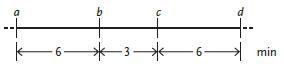 Figure 17.2
-
The accompanying figure above shows the distances between genes in minutes. Assume that the time listed between two genes corresponds to the transfer time of the first of the two genes in the pair. Use the figure to answer questions .
The genetic map shown in the figure was generated by identifying transferred genes after ____.
Figure 17.2
-
The accompanying figure above shows the distances between genes in minutes. Assume that the time listed between two genes corresponds to the transfer time of the first of the two genes in the pair. Use the figure to answer questions .
The genetic map shown in the figure was generated by identifying transferred genes after ____. (Multiple Choice)
4.9/5 (83)
(83) A plate of solid growth medium with colonies on it is pressed gently onto sterile velveteen. The velveteen "stamp" is used to make identical plates. This technique is called ____.
(Multiple Choice)
4.8/5 (79)
(79) Bacterial cells that cannot readily pick up DNA molecules from their surroundings can be induced to do so by ____.
(Multiple Choice)
4.9/5 (83)
(83) Ammonium chloride, a commonly used salt in minimal medium, ____.
(Multiple Choice)
4.9/5 (88)
(88) The linear DNA fragments taken up from disrupted infective cells recombine with the chromosomal DNA of the noninfective cells by ____, much in the same way as genetic recombination takes place during conjugation.
(Multiple Choice)
4.7/5 (63)
(63) 
Filters
- Essay(0)
- Multiple Choice(0)
- Short Answer(0)
- True False(0)
- Matching(0)