



 Chat with AI
Exam 20: The Development of Evolutionary Thought

Exam 1: Introduction to Biological Concepts and Research86 Questions
Exam 2: Life, Chemistry, and Water87 Questions
Exam 3: Biological Molecules: the Carbon Compounds of Life86 Questions
Exam 4: Cells87 Questions
Exam 5: Membranes and Transport88 Questions
Exam 6: Energy, Enzymes, and Biological Reactions87 Questions
Exam 7: Cellular Respiration: Harvesting Chemical Energy88 Questions
Exam 8: Photosynthesis83 Questions
Exam 9: Cell Communication87 Questions
Exam 10: Cell Division and Mitosis88 Questions
Exam 11: Meiosis: the Cellular Basis of Sexual Reproduction80 Questions
Exam 12: Mendel, Genes, and Inheritance79 Questions
Exam 13: Genes, Chromosomes, and Human Genetics92 Questions
Exam 14: Dna Structure, Replication, and Organization79 Questions
Exam 15: Gene Expression: From Dna to Protein83 Questions
Exam 16: Regulation of Gene Expression84 Questions
Exam 17: Bacterial and Viral Genetics85 Questions
Exam 18: Dna Technology: Making and Using Genetically Altered Organisms, and Other Applications90 Questions
Exam 19: Genomes and Proteomes81 Questions
Exam 20: The Development of Evolutionary Thought92 Questions
Exam 21: Microevolution: Genetic Changes Within Populations88 Questions
Exam 22: Speciation89 Questions
Exam 23: Paleobiology and Macroevolution87 Questions
Exam 24: Systematic Biology: Phylogeny and Classification95 Questions
Exam 25: The Origin of Life86 Questions
Exam 26: Prokaryotes and Viruses86 Questions
Exam 27: Protists90 Questions
Exam 28: Seedless Plants88 Questions
Exam 29: Seed Plants90 Questions
Exam 30: Fungi88 Questions
Exam 31: Animal Phylogeny, Acoelomates, and Protostomes95 Questions
Exam 32: Deuterostomes: Vertebrates and Their Closest Relatives93 Questions
Exam 33: The Plant Body90 Questions
Exam 34: Transport in Plants94 Questions
Exam 35: Plant Nutrition85 Questions
Exam 36: Reproduction and Development in Flowering Plants89 Questions
Exam 37: Plant Signals and Responses to the Environment90 Questions
Exam 38: Introduction to Animal Organization and Physiology87 Questions
Exam 39: Information Flow and the Neuron88 Questions
Exam 40: Nervous Systems88 Questions
Exam 41: Sensory Systems87 Questions
Exam 42: The Endocrine System94 Questions
Exam 43: Muscles, Bones, and Body Movements87 Questions
Exam 44: The Circulatory System87 Questions
Exam 45: Defenses Against Disease83 Questions
Exam 46: Gas Exchange: the Respiratory System87 Questions
Exam 47: Digestive Systems and Animal Nutrition92 Questions
Exam 48: Regulating the Internal Environment: Osmoregulation, Excretion, and Thermoregulation88 Questions
Exam 49: Animal Reproduction76 Questions
Exam 50: Animal Development88 Questions
Exam 51: Ecology and the Biosphere88 Questions
Exam 52: Population Ecology92 Questions
Exam 53: Population Interactions and Community Ecology89 Questions
Exam 54: Ecosystems90 Questions
Exam 55: Biodiversity and Conservation Biology89 Questions
Exam 56: Animal Behavior87 Questions
Select questions type


Darwin calculated that if reproduction was not limited, a single pair of elephants would leave roughly ____ descendants after 750 years.

Free
(Multiple Choice)
4.8/5  (98)
(98) Correct Answer: Verified
D
Charles Darwin did NOT study the ____ during his long career.
Free
(Multiple Choice)
4.8/5 (79)
(79) Correct Answer:Verified
VerifiedD
Darwin predicted that advantageous, heritable characteristics would become less common in a population when individuals were forced to compete for limited resources.
Free
(True/False)
4.8/5 (85)
(85) Correct Answer:Verified
VerifiedFalse
Based on his experiences while aboard the H.M.S. Beagle , Darwin realized that ____ provided the only plausible explanation for his observations.
(Multiple Choice)
5.0/5 (85)
(85) As a young child, you preferred to collect shells and insects, dig through the mud around a pond, and watch birds rather than play video games. What did you have in common with Charles Darwin?
(Multiple Choice)
4.9/5 (69)
(69) Insecticide resistance is an example of macroevolution resulting from artificial selection.
(True/False)
4.9/5 (82)
(82) A small evolutionary shift in the size of the bill of a finch species is an example of ____.
(Multiple Choice)
4.9/5 (62)
(62) A concept presented by Charles Lyell, called ____, contends the geological processes that sculpted Earth's surface over long periods of time are exactly the same as the processes observed today.
(Multiple Choice)
4.8/5 (77)
(77) New genetic variations sometimes become more common within populations because ____.
(Multiple Choice)
5.0/5 (75)
(75) Answer the questions using the accompanying figure. Examine the following figure depicting homologous bones in mammalian forelimbs. Match each letter of the figure with the appropriate bone structure. Note that homologous bones are pictured in the same color.
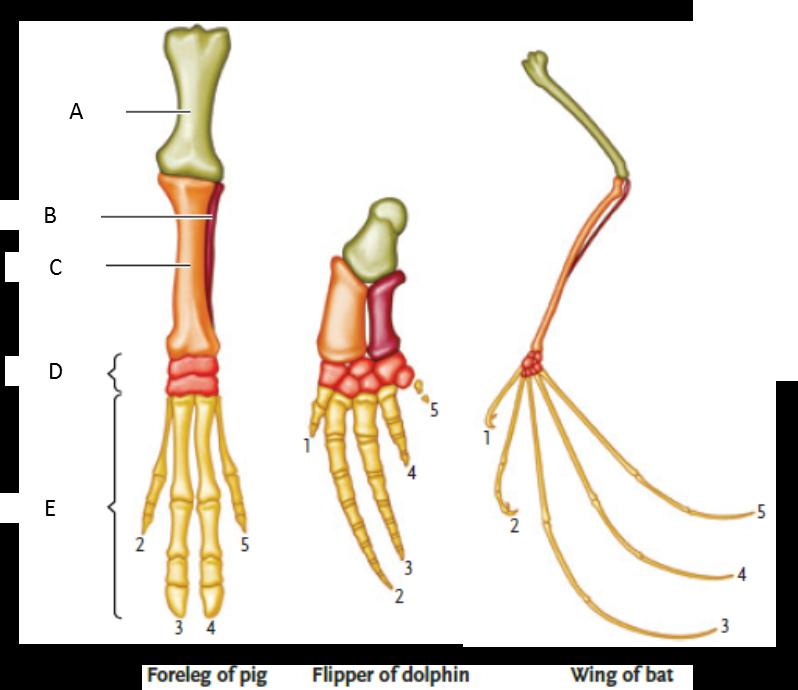
Figure 20.3
Figure 20.3
Correct Answer:Verified
VerifiedPremises:
Responses:
(Matching)
4.9/5 (82)
(82) Upon Darwin's return from his voyage on the H.M.S Beagle , he spent time breeding ____.
(Multiple Choice)
4.8/5 (87)
(87) Which morphological feature in lizards, mammals, and birds provides evidence of their descent from a shared ancestor?
(Multiple Choice)
4.8/5 (62)
(62) Georges Cuvier and his followers developed the theory of ____, reasoning that each layer of fossils represented the remains of organisms that had died as a result of dramatic shifts in ancient environments.
(Multiple Choice)
4.9/5 (78)
(78) Which branch of biology examines the form and variety of organisms in their natural environment?
(Multiple Choice)
4.8/5 (95)
(95) Species on oceanic islands often closely resemble species on the nearest mainland, suggesting that the island and mainland species share a common ancestry.
(True/False)
4.8/5 (79)
(79) The notion of orthogenesis is no longer supported because we now know that evolution proceeds as an ongoing process of dynamic adjustment, not toward any fixed goal.
(True/False)
4.9/5 (86)
(86) Early in the twentieth century, some scientists embraced the notion of orthogenesis, the idea that evolution ____.
(Multiple Choice)
4.8/5 (55)
(55) 
Filters
- Essay(0)
- Multiple Choice(0)
- Short Answer(0)
- True False(0)
- Matching(0)