



 Chat with AI
Exam 15: Monopoly.

Exam 1: Ten Principles of Economics.349 Questions
Exam 2: Thinking Like an Economist.535 Questions
Exam 3: Interdependence and the Gains from Trade.443 Questions
Exam 4: The Market Forces of Supply and Demand.571 Questions
Exam 5: Elasticity and Its Application510 Questions
Exam 6: Supply, Demand, And Government Policies.557 Questions
Exam 7: Consumers, Producers, and the Efficiency of Markets.460 Questions
Exam 8: Application: The Costs of Taxation.424 Questions
Exam 9: Application: International Trade.410 Questions
Exam 10: Externalities.441 Questions
Exam 11: Public Goods and Common Resources.349 Questions
Exam 12: The Design of the Tax System.478 Questions
Exam 13: The Costs of Production.533 Questions
Exam 14: Firms in Competitive Markets.478 Questions
Exam 15: Monopoly.526 Questions
Exam 16: Monopolistic Competition.497 Questions
Exam 17: Oligopoly.410 Questions
Exam 18: The Market For the Factors of Production.463 Questions
Exam 19: Earnings and Discrimination.398 Questions
Exam 20: Income Inequality and Poverty.374 Questions
Exam 21: The Theory of Consumer Choice.462 Questions
Exam 22: Frontiers in Microeconomics.353 Questions
Select questions type


The profit that a monopolist earns represents a loss to society that is measured through deadweight loss.
(True/False)
4.7/5  (84)
(84) By selling hardcover books to die-hard fans and paperback books to less enthusiastic readers,the publisher is able to price discriminate and raise its profits.
(True/False)
5.0/5 (70)
(70) In a competitive market,a firm's supply curve dictates the amount it will supply.In a monopoly market the
(Multiple Choice)
4.8/5 (91)
(91) Figure 15-8
 -Refer to Figure 15-8.To maximize total surplus,a benevolent social planner would choose which of the following outcomes?
 (Multiple Choice)
4.8/5 (76)
(76) Suppose a profit-maximizing monopolist faces a constant marginal cost of $10,produces an output level of 100 units,and charges a price of $50.The socially efficient level of output is 200 units.Assume that the demand curve and marginal revenue curve are the typical downward-sloping straight lines.The monopoly deadweight loss equals $4,000.
(True/False)
4.9/5 (75)
(75) Table 15-2
Tanya has the following demand curve for selling taffy. Assume that Tanya has a marginal cost of $3 per unit.
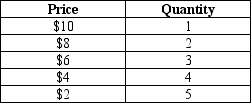 -Refer to Table 15-2.What is Tanya's profit-maximizing price?
 (Multiple Choice)
4.7/5 (73)
(73) Which of the following may eliminate some or all of the inefficiency that results from monopoly pricing?
(Multiple Choice)
4.9/5 (77)
(77) Table 15-1
 -Refer to Table 15-1.Assume this monopolist's marginal cost is constant at $12.What quantity of output (Q)will it produce and what price (P)will it charge?
 (Multiple Choice)
4.9/5 (79)
(79) As a monopolist increases the quantity of output it sells,the price consumers are willing to pay for the good
(Multiple Choice)
4.8/5 (73)
(73) A monopoly creates a deadweight loss to society because it produces less output than the socially efficient level.
(True/False)
4.7/5 (70)
(70) Figure 15-2


 -Refer to Figure 15-2.Which of the following statements is correct?
 (Multiple Choice)
4.8/5 (74)
(74) Declining average total cost with increased production is one of the defining characteristics of a natural monopoly.
(True/False)
4.8/5 (80)
(80) Suppose a profit-maximizing monopolist faces a constant marginal cost of $10,produces an output level of 100 units,and charges a price of $50.The socially efficient level of output is 200 units.Assume that the demand curve and marginal revenue curve are the typical downward-sloping straight lines.The monopoly deadweight loss equals $2,000.
(True/False)
4.9/5 (96)
(96) The assessment by George Stigler concerning the tradeoffs between "market failure" and "political failure" in the American economy provides support for which of the following solutions to the problems of monopolies?
(Multiple Choice)
4.8/5 (92)
(92) 
Filters
- Essay(0)
- Multiple Choice(0)
- Short Answer(0)
- True False(0)
- Matching(0)