



 Chat with AI
Exam 15: Monopoly.

Exam 1: Ten Principles of Economics.349 Questions
Exam 2: Thinking Like an Economist.535 Questions
Exam 3: Interdependence and the Gains from Trade.443 Questions
Exam 4: The Market Forces of Supply and Demand.571 Questions
Exam 5: Elasticity and Its Application510 Questions
Exam 6: Supply, Demand, And Government Policies.557 Questions
Exam 7: Consumers, Producers, and the Efficiency of Markets.460 Questions
Exam 8: Application: The Costs of Taxation.424 Questions
Exam 9: Application: International Trade.410 Questions
Exam 10: Externalities.441 Questions
Exam 11: Public Goods and Common Resources.349 Questions
Exam 12: The Design of the Tax System.478 Questions
Exam 13: The Costs of Production.533 Questions
Exam 14: Firms in Competitive Markets.478 Questions
Exam 15: Monopoly.526 Questions
Exam 16: Monopolistic Competition.497 Questions
Exam 17: Oligopoly.410 Questions
Exam 18: The Market For the Factors of Production.463 Questions
Exam 19: Earnings and Discrimination.398 Questions
Exam 20: Income Inequality and Poverty.374 Questions
Exam 21: The Theory of Consumer Choice.462 Questions
Exam 22: Frontiers in Microeconomics.353 Questions
Select questions type


Table 15-18
Tommy's Tie Company, a monopolist, has the following cost and revenue information. Assume that Tommy's is able to engage in perfect price discrimination.
 -Refer to Table 15-18.What are Tommy's Ties Company's fixed costs?
 (Multiple Choice)
4.9/5  (84)
(84) Amanda inherited the only local cable TV company in town after her father passed away.The company is completely unregulated by the government and is therefore free to operate as it wishes.Assume that Amanda understands the true power of her new monopoly.Which of the following statements is (are)correct?
(i)She will be able to set the price of cable TV service at whatever level she wishes.
(ii)The customers will be forced to purchase cable TV service at whatever price she wants to set.
(iii)She will be able to achieve any profit level that she desires.
(Multiple Choice)
4.8/5 (84)
(84) Figure 15-8
 -Refer to Figure 15-8.To maximize its profit,a monopolist would choose which of the following outcomes?
 (Multiple Choice)
4.9/5 (73)
(73) Table 15-12
The following table provides information on the price, quantity, and average total cost for a monopoly.
 -Refer to Table 15-12.If the firm produces the profit-maximizing level of output,it will earn profits of
 (Multiple Choice)
4.8/5 (73)
(73) Scenario 15-5
An airline knows that there are two types of travelers: business travelers and vacationers. For a particular flight, there are 100 business travelers who will pay $600 for a ticket while there are 50 vacationers who will pay $300 for a ticket. There are 150 seats available on the plane. Suppose the cost to the airline of providing the flight is $20,000, which includes the cost of the pilots, flight attendants, fuel, etc.
-Refer to Scenario 15-5.How much profit will the airline earn if it engages in price discrimination?
(Multiple Choice)
4.8/5 (81)
(81) Table 15-10
The monopolist faces the following demand curve:
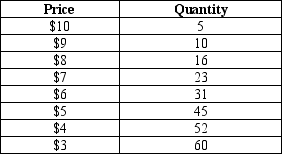 -Refer to Table 15-10.If the monopolist has total fixed costs of $40 and a constant marginal cost of $5,how much profit can the firm earn at the profit-maximizing level of output?
 (Multiple Choice)
4.7/5 (79)
(79) Scenario 15-7
Black Box Cable TV is able to purchase an exclusive right to sell a premium movie channel (PMC) in its market area. Let's assume that Black Box Cable pays $150,000 a year for the exclusive marketing rights to PMC. Since Black Box has already installed cable to all of the homes in its market area, the marginal cost of delivering PMC to subscribers is zero. The manager of Black Box needs to know what price to charge for the PMC service to maximize her profit. Before setting price, she hires an economist to estimate demand for the PMC service. The economist discovers that there are two types of subscribers who value premium movie channels. First are the 4,000 die-hard TV viewers who will pay as much as $150 a year for the new PMC premium channel. Second, the PMC channel will appeal to 20,000 occasional TV viewers who will pay as much as $20 a year for a subscription to PMC.
-Refer to Scenario 15-7.What is the deadweight loss associated with the nondiscriminating pricing policy compared to the price discriminating policy?
(Multiple Choice)
4.8/5 (62)
(62) Figure 15-2


 -Refer to Figure 15-2.Which panel could represent the demand curve facing the soybean industry?
 (Multiple Choice)
4.8/5 (82)
(82) If a monopolist can practice perfect price discrimination,the monopolist will
(Multiple Choice)
4.8/5 (76)
(76) Which of the following would be most likely to have monopoly power?
(Multiple Choice)
4.8/5 (87)
(87) Which of the following is an example of a barrier to entry?
(Multiple Choice)
4.8/5 (81)
(81) For a monopoly firm,which of the following equalities is always true?
(Multiple Choice)
4.8/5 (89)
(89) Price discrimination explains why Ivy League universities often base tuition costs on students'
(Multiple Choice)
4.8/5 (78)
(78) Figure 15-6
 -Refer to Figure 15-6.A profit-maximizing monopolist would earn total revenues of
 (Multiple Choice)
4.9/5 (77)
(77) Private ownership of a monopoly may benefit society because the monopoly will have an incentive to
(Multiple Choice)
4.8/5 (78)
(78) Figure 15-15
 -Refer to Figure 15-15.If the monopoly firm perfectly price discriminates,then the deadweight loss amounts to
 (Multiple Choice)
4.9/5 (85)
(85) 
Filters
- Essay(0)
- Multiple Choice(0)
- Short Answer(0)
- True False(0)
- Matching(0)