



 Chat with AI
Exam 15: Monopoly.

Exam 1: Ten Principles of Economics.349 Questions
Exam 2: Thinking Like an Economist.535 Questions
Exam 3: Interdependence and the Gains from Trade.443 Questions
Exam 4: The Market Forces of Supply and Demand.571 Questions
Exam 5: Elasticity and Its Application510 Questions
Exam 6: Supply, Demand, And Government Policies.557 Questions
Exam 7: Consumers, Producers, and the Efficiency of Markets.460 Questions
Exam 8: Application: The Costs of Taxation.424 Questions
Exam 9: Application: International Trade.410 Questions
Exam 10: Externalities.441 Questions
Exam 11: Public Goods and Common Resources.349 Questions
Exam 12: The Design of the Tax System.478 Questions
Exam 13: The Costs of Production.533 Questions
Exam 14: Firms in Competitive Markets.478 Questions
Exam 15: Monopoly.526 Questions
Exam 16: Monopolistic Competition.497 Questions
Exam 17: Oligopoly.410 Questions
Exam 18: The Market For the Factors of Production.463 Questions
Exam 19: Earnings and Discrimination.398 Questions
Exam 20: Income Inequality and Poverty.374 Questions
Exam 21: The Theory of Consumer Choice.462 Questions
Exam 22: Frontiers in Microeconomics.353 Questions
Select questions type


Figure 15-7
 -Refer to Figure 15-7.What is the monopoly price and quantity?
 (Multiple Choice)
4.9/5  (83)
(83) Table 15-2
Tanya has the following demand curve for selling taffy. Assume that Tanya has a marginal cost of $3 per unit.
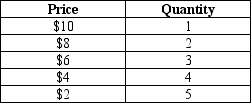 -Refer to Table 15-2.What is Tanya's profit-maximizing level of output?
 (Multiple Choice)
4.8/5 (67)
(67) Reduced competition through merging of companies will raise social welfare
(Multiple Choice)
4.7/5 (85)
(85) A monopolist does not have a supply curve because the firm's decision about how much to supply is impossible to separate from the demand curve it faces.
(True/False)
4.9/5 (78)
(78) One method used to control the ability of firms to capture monopoly profit in the United States is through
(Multiple Choice)
4.9/5 (80)
(80) Table 15-1
 -Refer to Table 15-1.If the monopolist sells 8 units of its product,how much total revenue will it receive from the sale?
 (Multiple Choice)
4.8/5 (78)
(78) Figure 15-4
 -Refer to Figure 15-4.Profit on a typical unit sold for a profit-maximizing monopoly would equal
 (Multiple Choice)
4.9/5 (69)
(69) For a monopoly,the socially efficient level of output occurs where
(Multiple Choice)
4.9/5 (87)
(87) Splitting up a monopoly is often justified on the grounds that
(Multiple Choice)
4.9/5 (72)
(72) Granting a pharmaceutical company a patent for a new medicine will lead to
(i)a product that is priced higher than it would be without the exclusive rights.
(ii)incentives for pharmaceutical companies to invest in research and development.
(iii)higher quantities of output than without the patent.
(Multiple Choice)
4.8/5 (67)
(67) Table 15-5
A monopolist faces the following demand curve:
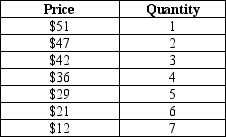 -Refer to Table 15-5.The monopolist has total fixed costs of $60 and has a constant marginal cost of $15.What is the profit-maximizing price?
 (Multiple Choice)
4.8/5 (68)
(68) Figure 15-6
 -Refer to Figure 15-6.In order to maximize profits,the monopolist should produce
 (Multiple Choice)
4.9/5 (80)
(80) A monopolist can sell 200 units of output for $36 per unit.Alternatively,it can sell 201 units of output for $35.80 per unit.The marginal revenue of the 201ˢᵗ unit of output is
(Multiple Choice)
4.7/5 (81)
(81) Which of the following statements comparing monopoly with competition is correct?
(Multiple Choice)
4.8/5 (78)
(78) Price discrimination can increase both the monopolist's profits and society's welfare.
(True/False)
4.7/5 (73)
(73) Figure 15-1
 -Refer to Figure 15-1.The shape of the average total cost curve reveals information about the nature of the barrier to entry that might exist in a monopoly market.Which of the following monopoly types best coincides with the figure?
 (Multiple Choice)
4.9/5 (90)
(90) 
Filters
- Essay(0)
- Multiple Choice(0)
- Short Answer(0)
- True False(0)
- Matching(0)