



 Chat with AI
Exam 15: Monopoly.

Exam 1: Ten Principles of Economics.349 Questions
Exam 2: Thinking Like an Economist.535 Questions
Exam 3: Interdependence and the Gains from Trade.443 Questions
Exam 4: The Market Forces of Supply and Demand.571 Questions
Exam 5: Elasticity and Its Application510 Questions
Exam 6: Supply, Demand, And Government Policies.557 Questions
Exam 7: Consumers, Producers, and the Efficiency of Markets.460 Questions
Exam 8: Application: The Costs of Taxation.424 Questions
Exam 9: Application: International Trade.410 Questions
Exam 10: Externalities.441 Questions
Exam 11: Public Goods and Common Resources.349 Questions
Exam 12: The Design of the Tax System.478 Questions
Exam 13: The Costs of Production.533 Questions
Exam 14: Firms in Competitive Markets.478 Questions
Exam 15: Monopoly.526 Questions
Exam 16: Monopolistic Competition.497 Questions
Exam 17: Oligopoly.410 Questions
Exam 18: The Market For the Factors of Production.463 Questions
Exam 19: Earnings and Discrimination.398 Questions
Exam 20: Income Inequality and Poverty.374 Questions
Exam 21: The Theory of Consumer Choice.462 Questions
Exam 22: Frontiers in Microeconomics.353 Questions
Select questions type


Table 15-7
Sally owns the only shoe store in town. She has the following cost and revenue information.
 -Refer to Table 15-7.What is the marginal cost of the 6th pair of shoes?
 (Multiple Choice)
4.9/5  (87)
(87) Price discrimination is a rational strategy for a profit-maximizing monopolist when
(Multiple Choice)
4.9/5 (66)
(66) Monopoly pricing prevents some mutually beneficial trades from taking place.These unrealized,mutually beneficial trades are
(Multiple Choice)
4.7/5 (67)
(67) The best solution to the problem of welfare loss from monopoly is public ownership.
(True/False)
5.0/5 (71)
(71) Which of the following is not an example of a barrier to entry?
(Multiple Choice)
4.9/5 (74)
(74) A common solution to monopoly in European countries is public ownership.
(True/False)
5.0/5 (65)
(65) Figure 15-4
 -Refer to Figure 15-4.A profit-maximizing monopoly will produce an output level of
 (Multiple Choice)
4.8/5 (72)
(72) The process of buying a good in one market at a low price and selling the good in another market for a higher price in order to profit from the price difference is known as
(Multiple Choice)
4.8/5 (76)
(76) Table 15-11
The following table shows quantity, price, and marginal cost information for a monopoly:
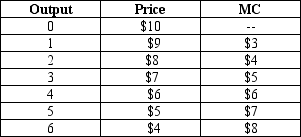 -Refer to Table 15-11.What level of output should the firm produce to maximize its profit?
 (Multiple Choice)
5.0/5 (94)
(94) Suppose that a professional photographer takes a prize-winning digital photo.She can sell a 5"x7" color print of the photo for $10.She can also sell the digital file for $20.There are 500 people willing to buy the color print and 2,000 people willing to buy the digital file.Assume the costs to the photographer are zero and that the people who purchase the digital file cannot resell the file itself or any prints made from it.What should she do in order to maximize her profits?
(Multiple Choice)
4.7/5 (71)
(71) Table 15-6
A monopolist faces the following demand curve:
 -Refer to Table 15-6.If the monopolist has a constant marginal cost for her product equal to $7,what is her profit-maximizing price?
 (Multiple Choice)
5.0/5 (77)
(77) When there are economies of scale over the relevant range of output for a monopoly,the monopoly
(Multiple Choice)
4.8/5 (60)
(60) Consider a profit-maximizing monopoly pricing under the following conditions.The profit-maximizing quantity is 40 units,the profit-maximizing price is $160,and the marginal cost of the 40th unit is $120.If the good were produced in a perfectly competitive market,the equilibrium quantity would be 50,and the equilibrium price would be $150.The demand curve and marginal cost curves are linear.What is the value of the deadweight loss created by the monopolist?
(Multiple Choice)
4.8/5 (51)
(51) When deciding what price to charge consumers,the monopolist may choose to charge them different prices based on the customers'
(Multiple Choice)
4.8/5 (85)
(85) Figure 15-4
-Refer to Figure 15-4.A profit-maximizing monopoly will charge a price of
-Refer to Figure 15-4.A profit-maximizing monopoly will charge a price of (Multiple Choice)
4.8/5 (75)
(75) Because monopoly firms do not have to compete with other firms,the outcome in a market with a monopoly is often
(Multiple Choice)
4.8/5 (79)
(79) Figure 15-5
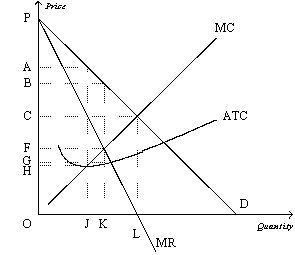 -Refer to Figure 15-5.What price will the monopolist charge?
 (Multiple Choice)
4.9/5 (63)
(63) 
Filters
- Essay(0)
- Multiple Choice(0)
- Short Answer(0)
- True False(0)
- Matching(0)