



 Chat with AI
Exam 15: Monopoly.

Exam 1: Ten Principles of Economics.349 Questions
Exam 2: Thinking Like an Economist.535 Questions
Exam 3: Interdependence and the Gains from Trade.443 Questions
Exam 4: The Market Forces of Supply and Demand.571 Questions
Exam 5: Elasticity and Its Application510 Questions
Exam 6: Supply, Demand, And Government Policies.557 Questions
Exam 7: Consumers, Producers, and the Efficiency of Markets.460 Questions
Exam 8: Application: The Costs of Taxation.424 Questions
Exam 9: Application: International Trade.410 Questions
Exam 10: Externalities.441 Questions
Exam 11: Public Goods and Common Resources.349 Questions
Exam 12: The Design of the Tax System.478 Questions
Exam 13: The Costs of Production.533 Questions
Exam 14: Firms in Competitive Markets.478 Questions
Exam 15: Monopoly.526 Questions
Exam 16: Monopolistic Competition.497 Questions
Exam 17: Oligopoly.410 Questions
Exam 18: The Market For the Factors of Production.463 Questions
Exam 19: Earnings and Discrimination.398 Questions
Exam 20: Income Inequality and Poverty.374 Questions
Exam 21: The Theory of Consumer Choice.462 Questions
Exam 22: Frontiers in Microeconomics.353 Questions
Select questions type


Figure 15-15
 -Refer to Figure 15-15.If there are no fixed costs of production,monopoly profit without price discrimination equals
 (Multiple Choice)
4.9/5  (67)
(67) A profit-maximizing monopolist charges a price of $14.The intersection of the marginal revenue curve and the marginal cost curve occurs where output is 15 units and marginal cost is $7.What is the monopolist's profit?
(Multiple Choice)
4.8/5 (89)
(89) Table 15-6
A monopolist faces the following demand curve:
 -Refer to Table 15-6.What is the marginal revenue from the sale of the 4th unit?
 (Multiple Choice)
5.0/5 (90)
(90) When a monopolist increases the amount of output that it produces and sells,average revenue
(Multiple Choice)
4.8/5 (77)
(77) Which of the following can defeat the profit-maximizing strategy of price discrimination?
(Multiple Choice)
5.0/5 (80)
(80) Which of the following is the preferred strategy for the government to follow to remedy the inefficient allocation of resources associated with monopolies?
(Multiple Choice)
4.7/5 (82)
(82) A patent gives a single person or firm the exclusive right to sell some good or service forever.
(True/False)
4.9/5 (72)
(72) Figure 15-4
 -Refer to Figure 15-4.A profit-maximizing monopoly's profit is equal to
 (Multiple Choice)
4.9/5 (78)
(78) If a product can be produced by a natural monopoly,society will benefit in the form of lower prices if the monopolist is broken up into several smaller firms.
(True/False)
4.8/5 (75)
(75) When a monopolist increases the quantity that it sells,price decreases,which,all else equal,decreases total revenue; this is called the price effect.
(True/False)
4.8/5 (69)
(69) The socially efficient quantity is found where the demand curve intersects the marginal cost curve.
(True/False)
4.8/5 (70)
(70) When a firm experiences continually declining average total costs,
(Multiple Choice)
4.9/5 (75)
(75) Monopolies are socially inefficient because the price they charge is
(Multiple Choice)
4.9/5 (82)
(82) A rational pricing strategy for a profit-maximizing monopolist is
(Multiple Choice)
5.0/5 (84)
(84) Table 15-14
The following table gives information on the price, quantity, and total cost of production for a monopolist.
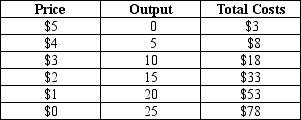 -Refer to Table 15-14.At what price does marginal revenue equal marginal cost?
 (Multiple Choice)
4.7/5 (60)
(60) The reason to regulate utilities instead of using antitrust laws to promote competition is that a utility is usually a
(Multiple Choice)
4.8/5 (79)
(79) Suppose a firm has a monopoly on the sale of widgets and faces a downward-sloping demand curve.When selling the 100ᵗʰ widget,the firm will always receive
(Multiple Choice)
4.7/5 (86)
(86) Table 15-9
Consider the following demand and cost information for a monopoly.
 -Refer to Table 15-9.What is the marginal cost of the 4th unit?
 (Multiple Choice)
4.9/5 (70)
(70) 
Filters
- Essay(0)
- Multiple Choice(0)
- Short Answer(0)
- True False(0)
- Matching(0)